Lockdown in covid containment zones extended till Nov 30; no e-permit needed for inter-state travel

Agencies
October 27, 2020

New Delhi, Oct 27: The Ministry of Home Affairs (MHA) on Tuesday extended the guidelines for reopening to further ease Covid-19 restrictions issued for October till November 30, saying the essence behind the decision is to "move ahead" but warned that it did not mean the end of the pandemic.

The MHA said there is a need to exercise abundant caution by adopting Covid-19 appropriate behaviour and referred to the 'Jan Andolan' launched by Prime Minister Narendra Modi October 8 to follow three 'mantras' -- wear your mask properly, wash your hands frequently and maintain a safe distance of six feet.

Click here for updates on Covid-19

"The essence behind graded re-opening and progressive resumption of activities is to move ahead. However, it does not mean the end of the pandemic. There is a need to exercise abundant caution by adopting Covid-19 appropriate behaviour by every citizen in their daily routine," an official statement said.

It said there was an urgent need to instil a sense of discipline and ownership amongst citizens in order that the resumption of activities is successful and gains made in the management of the pandemic are not diluted.

The MHA has already advised Chief Secretaries and Administrators of states and Union Territories that they should endeavour to promote Covid-19 appropriate behaviour extensively at the grass-root level and take measures to enforce the wearing of masks, hand hygiene and social distancing.

The 'reopening' guidelines issued on September 30 had allowed states the flexibility to decide on reopening schools after October 15 while cinema theatres, entertainment parks and business to business (B2B) exhibitions were also allowed to function from the same date.

The “reopening” guidelines had virtually opened up the whole country and also further relaxed restrictions on religious, political, social and other gatherings by entirely lifting the cap of 100 people after October 15. However, in closed spaces, a maximum of 50% hall capacity will be allowed with a ceiling of 200 persons.

International air travel other than those permitted by the government will also continue to remain suspended. Lockdown in containment zones will continue till October 31.

The guidelines are no more called “unlock guidelines”, which were issued for months since June, but “re-opening” guidelines, with the government indicating that most of the restrictions have been lifted except in containment zones.

It had also allowed the opening of cinemas, theatres and multiplexes outside containment zones from October 15 but with 50% capacity. Entertainment parks and similar places, as well as swimming pools used for training of sportspersons, will be allowed to open from October 15. Business to Business (B2B) exhibitions will also return from mid-October, in a boost to the sector.

The guidelines also reiterated its warning to states against imposing local lockdown and if a state wants to impose local lockdown outside containment zones – state-wide, district, sub-district or city level --  it will have to consult the Centre.

Comments

Add new comment

  • Coastaldigest.com reserves the right to delete or block any comments.
  • Coastaldigset.com is not responsible for its readers’ comments.
  • Comments that are abusive, incendiary or irrelevant are strictly prohibited.
  • Please use a genuine email ID and provide your name to avoid reject.
News Network
December 6,2025

pilot.jpg

New Delhi: IndiGo, India’s largest airline, faced major operational turbulence this week after failing to prepare for new pilot-fatigue regulations issued by the Directorate General of Civil Aviation (DGCA). The stricter rules—designed to improve flight safety—took effect in phases through 2024, with the latest implementation on November 1. IndiGo has acknowledged that inadequate roster planning led to widespread cancellations and delays.

Below are the key DGCA rules that affected IndiGo’s operations:

1. Longer Mandatory Weekly Rest

Weekly rest for pilots has been increased from 36 hours to 48 hours.

The government says the extended break is essential to curb cumulative fatigue. This rule remains in force despite the current crisis.

2. Cap on Night Landings

Pilots can now perform only two night landings per week—a steep reduction from the earlier limit of six.

Night hours, defined as midnight to early morning, are considered the least alert period for pilots.

Given the disruptions, this rule has been temporarily relaxed for IndiGo until February 10.

3. Reduced Maximum Night Flight Duty

Flight duty that stretches into the night is now capped at 10 hours.

This measure has also been kept on hold for IndiGo until February 10 to stabilize operations.

4. Weekly Rest Cannot Be Replaced With Personal Leave

Airlines can no longer count a pilot’s personal leave as part of the mandatory 48-hour rest.

Pilots say this closes a loophole that previously reduced actual rest time.

Currently, all airlines are exempt from this rule to normalise travel.

5. Mandatory Fatigue Monitoring

Airlines must submit quarterly fatigue reports along with corrective actions to DGCA.

This system aims to create a transparent fatigue-tracking framework across the industry.

The DGCA has stressed that these rules were crafted to strengthen flight safety and align India with global fatigue-management standards. The temporary relaxations are expected to remain until February 2025, giving IndiGo time to stabilise its schedules and restore normal air travel.

Comments

Add new comment

  • Coastaldigest.com reserves the right to delete or block any comments.
  • Coastaldigset.com is not responsible for its readers’ comments.
  • Comments that are abusive, incendiary or irrelevant are strictly prohibited.
  • Please use a genuine email ID and provide your name to avoid reject.
News Network
November 24,2025

Mangaluru, Nov 24: The original departure time of 11.10 pm was a distant memory for scores of Dammam-bound passengers at Mangaluru International Airport last Friday night, as their Air India Express flight was abruptly cancelled at the eleventh hour, sparking hours of frustration and chaos.

The flight, IX 885, initially scheduled to depart at 11.10 pm on November 22, was subject to two back-to-back reschedules—first pushed to 11.45 pm and then significantly postponed to 1.40 am—before the final, crushing announcement of cancellation was made. For the travellers, many of whom are likely expatriate workers with tight schedules, the last-minute change marked the beginning of a distressing ordeal.

"There was no drinking water, no food, and absolutely no proper guidance. We were left stranded like refugees," complained a stranded passenger.

According to multiple passenger accounts, the airline's ground staff failed to provide adequate support or essential amenities following the cancellation. Complaints poured in about the total absence of drinking water, food provisions, and any reliable guidance from the carrier's representatives. Travellers alleged they were left stranded for a considerable period, with no immediate arrangements or clear communication offered regarding accommodation or alternative travel to send them back home.

The incident has highlighted serious concerns over the carrier's contingency planning and customer service protocols during flight disruptions at one of India's key international gateways. The airline is yet to issue a comprehensive statement addressing the alleged lapse in passenger care.
 

Comments

Add new comment

  • Coastaldigest.com reserves the right to delete or block any comments.
  • Coastaldigset.com is not responsible for its readers’ comments.
  • Comments that are abusive, incendiary or irrelevant are strictly prohibited.
  • Please use a genuine email ID and provide your name to avoid reject.
News Network
November 27,2025

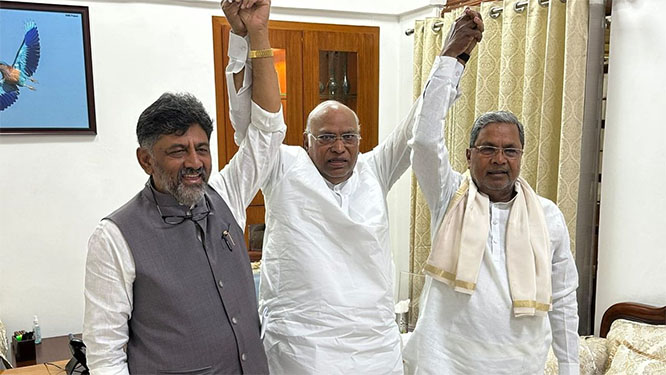
siddDKS.jpg

Congress president Mallikarjun Kharge on Thursday announced that he will convene a high-level meeting in New Delhi with senior leaders — including Rahul Gandhi, Karnataka Chief Minister Siddaramaiah and Deputy Chief Minister D.K. Shivakumar — to resolve the escalating leadership turmoil in Karnataka and “put an end to the confusion.”

Kharge said the discussions would focus on the way forward for the ruling party, as rumours of a possible leadership change continue to swirl. The speculation has intensified after the Congress government crossed the halfway mark of its five-year term on November 20, reviving talk of an alleged 2023 “power-sharing agreement” between Siddaramaiah and Shivakumar.

“After reaching Delhi, I will call three or four important leaders and hold discussions. Once we talk, we will decide how to move ahead and end this confusion,” Kharge told reporters in Bengaluru, according to PTI.

When asked specifically about calling Siddaramaiah and Shivakumar to Delhi, he responded: “Certainly, we should call them. We will discuss with them and settle the issue.”

He confirmed that Rahul Gandhi, the Chief Minister, the Deputy Chief Minister and other senior members would be part of the deliberations. “After discussing with everyone, a decision will be made,” he said.

Meanwhile, Siddaramaiah held a separate strategy meeting at his Bengaluru residence with ministers and leaders seen as his close confidants, including G. Parameshwara, Satish Jarkiholi, H.C. Mahadevappa, K. Venkatesh and K.N. Rajanna.
Signalling calm, the Chief Minister told reporters, “Will go to Delhi if the high command calls.”

Shivakumar echoed a similar stance, saying he too would head to the national capital if summoned by the party leadership.

Comments

Add new comment

  • Coastaldigest.com reserves the right to delete or block any comments.
  • Coastaldigset.com is not responsible for its readers’ comments.
  • Comments that are abusive, incendiary or irrelevant are strictly prohibited.
  • Please use a genuine email ID and provide your name to avoid reject.