



No relief in sight as India’s scorching heatwave to continue longer

Agencies
April 30, 2022

New Delhi, Apr 30: India’s severe heatwaves are expected to stretch into early next month, meaning millions of people will have to endure more days of dangerous temperatures and hours-long power cuts.

The South Asian nation is bracing for temperatures to rise to a record high, according to Mrutyunjay Mohapatra, head of the India Meteorological Department (IMD). The agency is working with states and the union government’s disaster management arm to get early warnings to those on the ground, he said in an interview in New Delhi.

Thermometer readings have already reached 46 degrees Celsius in central and northern India, with two months to go before the monsoon season that typically brings cooling rains. They hit the highest since 1901 last month. The heat has tested power grids as air conditioners run on full blast and threatened wheat crops. Local authorities are implementing action plans to manage health risks and even deaths, Mohapatra said.

 “Why is it exceptionally warm this year? The only reason is global warming,” said Roxy Mathew Koll, a climate scientist at the Indian Institute of Tropical Meteorology. “We have looked at data for seventy years and at the intensity, the number of heatwaves is directly in response to global warming.”

India is expected to suffer more frequent and intense heatwaves, extreme rainfall and erratic monsoons in the coming decades as the planet warms, according to the United Nations’ Intergovernmental Panel on Climate Change. McKinsey estimates that work hours lost to heatwaves could cause losses of as much as $250 billion, or 4.5 per cent of gross domestic product, by the end of the decade.

For India, the world’s poorest super-emitter, adapting to a hotter Earth is as urgent a task as cutting planet-warming emissions. A recent study showed a 62 per cent rise in heat-related deaths in the last 20 years. An official assessment of climate change published in 2020 showed that the frequency and intensity of droughts and cyclones had significantly increased in the last six decades. The number of days of intense rainfall and the pace at which sea levels are rising have more than doubled over that period.

The disasters underscore how countries like India, which are responsible for relatively little of the greenhouse gases accumulated in the atmosphere, often bear the brunt of climate impacts. That means spending billions to protect themselves instead of investing in economic development that could lift millions out of poverty. These countries, especially in Africa, also tend to lack resources to monitor and forecast the weather so they can better prepare for extreme events.

India is investing to improve its observational data and computing capabilities to build better climate models, said Mohapatra. The IMD managed to cut the number of deaths caused by cyclones to six in 2021 from 10,000 a year in 1999 by making more accurate short-term predictions.

Still, the country is racing against the clock as more erratic weather becomes harder to forecast. “Worsening climate change is limiting predictability of events,” said Mohapatra.

For now, local governments may have to consider a range of measures to keep people safe from the heat, Mohapatra said. They could restrict school hours to the cooler morning hours of 7 am to 11 am, advise against farm and construction work in the afternoon and provide extra support to street vendors, outdoor workers, police and to those living in city slums without access to cooling devices.

On Thursday evening, the meteorological department issued an orange alert for the next five days for northwest and central India. The region, home to some of the world’s most polluted air, hasn’t received the light summer rain that usually comes in April and May to lower temperatures and wash away dirty particulate matter.

“IPCC projections clearly show that the heat intensity is increasing and encroaching on our daily lives, and the impact is on vulnerable people who have little resources in regions where we don’t even have observations,” said Koll from the Indian Institute of Tropical Meteorology. “We need higher resolution data and, more importantly, we need long-term policies.”

Comments

Add new comment

  • Coastaldigest.com reserves the right to delete or block any comments.
  • Coastaldigset.com is not responsible for its readers’ comments.
  • Comments that are abusive, incendiary or irrelevant are strictly prohibited.
  • Please use a genuine email ID and provide your name to avoid reject.
News Network
December 5,2025

indigoCEO.jpg

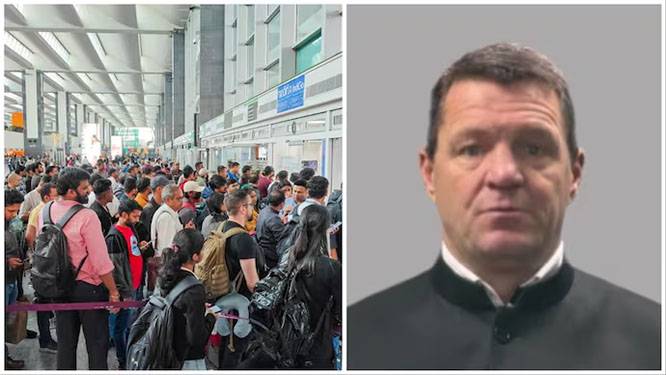
New Delhi, Dec 5: IndiGo CEO Pieter Elbers issued a public apology this evening after more than a thousand flights were cancelled today, making it the "most severely impacted day" in terms of cancellations. The biggest airline of the country cancelled "more than half" of its daily number of flights on Friday, said Elbers. He also said that even though the crisis will persist on Saturday, the airline anticipates fewer than 1,000 flight cancellations.

"Full normalisation is expected between December 10 and 15, though IndiGo cautions that recovery will take time due to the scale of operations," the IndiGo CEO said. 

IndiGo operates around 2,300 domestic and international flights daily.

Pieter Elbers, while apologising for the major inconvenience due to delays and cancellations, said the situation is a result of various causes.

The crisis at IndiGo stems from new regulations that boost pilots' weekly rest requirements by 12 hours to 48 and allow only two night-time landings per week, down from six. IndiGo has attributed the mass cancellations to "misjudgment and planning gaps".

Elbers also listed three lines of action that the airline will adopt to address the issue.

"Firstly, customer communication and addressing your needs, for this, messages have been sent on social media. And just now, a more detailed communication with information, refunds, cancellations and other customer support measures was sent," he said.

The airline has also stepped up its call centre capacity.

"Secondly, due to yesterday's situation, we had customers stranded mostly at the nation's largest airports. Our focus was for all of them to be able to travel today itself, which will be achieved. For this, we also ask customers whose flights are cancelled not to come to the airports as notifications are sent," the CEO said.

"Thirdly, cancellations were made for today to align our crew and planes to be where they need to start tomorrow morning afresh. Earlier measures of the last few days, regrettable, have proven not to be enough, but we have decided today to reboot all our systems and schedules, resulting in the highest numbers of cancellations so far, but imperative for progressive improvements starting from tomorrow," he added.

As airports witnessed chaotic scenes, the Directorate General of Civil Aviation (DGCA) stepped in to grant IndiGo a temporary exemption from stricter night duty rules for pilots. It also allowed substitution of leaves with a weekly rest period. 

Civil Aviation Minister Ram Mohan Naidu has said a high-level inquiry will be ordered and accountability will be fixed.

Comments

Add new comment

  • Coastaldigest.com reserves the right to delete or block any comments.
  • Coastaldigset.com is not responsible for its readers’ comments.
  • Comments that are abusive, incendiary or irrelevant are strictly prohibited.
  • Please use a genuine email ID and provide your name to avoid reject.
News Network
November 26,2025

students.jpg

Bengaluru, Nov 26: Karnataka is taking its first concrete steps towards lifting a three-decade-old ban on student elections in colleges and universities. Deputy Chief Minister D.K. Shivakumar announced Wednesday that the state government will form a small committee to study the reintroduction of campus polls, a practice halted in 1989 following incidents of violence.

Speaking at a 'Constitution Day' event organised by the Karnataka Congress, Mr. Shivakumar underscored the move's aim: nurturing new political leadership from the grassroots.

"Recently, (Leader of the Opposition in Lok Sabha) Rahul Gandhi wrote a letter to me and Chief Minister (Siddaramaiah) asking us to think about restarting student elections," Shivakumar stated. "I'm announcing today that we'll form a small committee and seek a report on this."

Student elections were banned in Karnataka in 1989, largely due to concerns over violence and the infiltration of political party affiliates into campus life. The ban effectively extinguished vibrant student bodies and the pipeline of young leaders they often produced.

Mr. Shivakumar, who also serves as the Karnataka Congress president, said that former student leaders will be consulted to "study the pros and cons" of the re-introduction.

Acknowledging the history of the ban, he added, "There were many criminal activities taking place back then. We’ll see how we can conduct (student) elections by regulating such criminal activities."

The Deputy CM reminisced about his own journey, which began on campus. He recalled his political activism at Sri Jagadguru Renukacharya College leading to his first Assembly ticket in 1985 at the age of 23. "That's how student leadership was at the time. Such leadership has gone today. College elections have stopped," he lamented, adding that for many, college elections were "like a big movement" where leaders were forged.

The move, driven by the Congress high command's push to cultivate young talent, will face scrutiny from academics and university authorities who have, in the past, expressed concern that the return of polls could disrupt the peaceful academic environment and turn campuses into political battlegrounds.

Comments

Add new comment

  • Coastaldigest.com reserves the right to delete or block any comments.
  • Coastaldigset.com is not responsible for its readers’ comments.
  • Comments that are abusive, incendiary or irrelevant are strictly prohibited.
  • Please use a genuine email ID and provide your name to avoid reject.
News Network
November 22,2025

Mangaluru: Police Commissioner Sudheer Kumar Reddy C H has warned of strict action against individuals spreading rumours and attempting to create insecurity within the Muslim community and fuel hatred between Hindus and Muslims through social media.

Referring to a recent social media post alleging that police personnel had entered a masjid premises to check whether beef was being cooked, the commissioner said miscreants were attempting to push their communal agenda. 

“A group of people, both from Mangaluru and abroad, are trying hard to spread rumours. For the past 10 days, they have been attempting to rake up old issues, highlight routine matters as controversies, or fabricate news altogether,” he said.

He reiterated that any such attempts to disturb communal harmony would invite legal action. “Cases will be registered and the accused will be brought to book,” he stated.

Comments

Add new comment

  • Coastaldigest.com reserves the right to delete or block any comments.
  • Coastaldigset.com is not responsible for its readers’ comments.
  • Comments that are abusive, incendiary or irrelevant are strictly prohibited.
  • Please use a genuine email ID and provide your name to avoid reject.