No written exams till class 2, assessment should not cause burden for children: Draft NCF

News Network
April 7, 2023

students.jpg

New Delhi, Apr 7: Explicit tests and exams are completely inappropriate assessment tools for children up to class 2 and written tests should be introduced from class 3 onwards, the draft National Curriculum Framework (NCF) has recommended stressing that assessment methods should be such that they do not contribute to any additional burden for the child.

The framework which is being developed along the lines of the new National Education Policy (NEP) suggests that two important methods of assessment that are appropriate for the foundational stage are observations of the child and analysing of artefacts that the child has produced as part of their learning experience.

The draft notes that explicit tests and examinations are completely inappropriate assessment tools for the Foundational stage (preschool to class 2).

"Assessment should allow for diversity among children and in their learning. Children learn differently and express their learning differently too. There might be many ways to assess the achievement of a learning outcome or competency. The teacher should have the ability to design different kinds of assessments for the same learning outcome and use each assessment appropriately.

"Assessment should enable recording and documentation. Children's progress should be described and analysed through the systematic collection of evidence. Assessment should not contribute to any additional burden for the child. Assessment tools and processes should be designed such that they are a natural extension of the learning experience for the child," it adds.

Describing the assessment for the preparatory stage (class 3 to 5), the draft recommends that "written tests should be introduced at this stage".

"A variety of assessment methods should be used to promote learning. Portfolios can be used to capture student progress holistically through their work. This could also provide a reliable picture of their learning to parents. Peer and self-assessments could also be introduced to help students monitor the trajectory of their own learning.

"At the end of the preparatory stage, there should be a comprehensive summative assessment of the student's readiness to enter the middle stage where several new curricular areas are introduced," it adds.

The education ministry released a "pre-draft" of the NCF for school education on Thursday and invited suggestions from stakeholders such as students, parents, teachers and scholars.

The draft prepared by a panel headed by K Kasturirangan, former ISRO chief, suggests that at the middle stage (class 6 to 8), the focus of the curriculum should move to conceptual understanding and higher-order capacities.

"Therefore, classroom assessment techniques such as projects, debates, presentations, experiments, investigations, role plays, journals and portfolios should be used to assess learning. Regular summative assessments at this stage will help students synthesize their learning at logical intervals such as year-end, term-end, unit-end. Summative assessments comprising multiple-choice questions and constructed responses like short and long answers may be used periodically," it says.

In the secondary stage (class 9 to 12), the panel has asserted that comprehensive classroom assessments should be effectively practised for facilitating meaningful learning and constructive feedback. Regular summative assessments should be conducted for recording students learning against competencies.

"Self-assessment will play a key role in student learning at this stage. Students should be facilitated to monitor what they are learning and use the feedback from this monitoring to adjust, adapt, and decide their own strategies for learning.

"Summative assessments can be designed using case-based questions, simulations, and essay-type questions to enable assessment of competencies. At this stage, students should also be prepared to undertake the board examinations and other selection tests to gain access to higher education and livelihood opportunities," the draft adds.

According to ministry officials, the textbooks as per the new NCF will be introduced from next year.

The Education Ministry has designed four NCFs based on the 5+3+3+4 ‘curricular and pedagogical’ structure that NEP 2020 has recommended for school education.

The ministry launched the NCF for the foundational stage (NCF-FS) for children between ages 3-8 years in October 2022. In continuation of that policy, the next NCF for school education is being prepared.

Revamping class 10 and 12 board exams, aligning the shift from 10+2 structure to 5+3+3+4 structure and emphasis on developmental perspectives suggesting curricular and pedagogical shifts at different stages - foundational, preparatory, middle and secondary - are among the recommendations made in the pre-draft.

The NCF has been revised four times - in 1975, 1988, 2000 and 2005. The new proposed revision will be the fifth of the framework.

 

Comments

Add new comment

  • Coastaldigest.com reserves the right to delete or block any comments.
  • Coastaldigset.com is not responsible for its readers’ comments.
  • Comments that are abusive, incendiary or irrelevant are strictly prohibited.
  • Please use a genuine email ID and provide your name to avoid reject.
News Network
November 21,2025

Bengaluru, Nov 21: The Karnataka government is facing pressure to overhaul its employment system after a high-level Cabinet sub-committee recommended the complete phase-out of job outsourcing in government offices, boards, and corporations by March 2028. The move is aimed at tackling a systemic issue that has led to the potential violation of constitutional reservation policies and the exploitation of workers.

The Call for Systemic Change

With over three lakh vacant posts currently being filled through private agencies on an outsource, insource, or daily wage basis, the sub-committee highlighted a significant lapse. "As a result, reservations are not being followed as per the Constitution and state laws. It’s an urgent need to take serious steps to change the system. It has been recommended to completely stop the system of outsourcing by March 2028," the panel stated in a document.

The practice of outsourcing involves private companies hiring workers to perform duties for a government agency. Critics argue this model results in lesser salaries, a lack of social security benefits (otherwise available to permanent government employees), and a failure to adhere to the provisions of Articles 14 and 15 of the Constitution, which guarantee equality before the law and prohibit discrimination.

The 'Bidar Model' as a Stop-Gap Solution

To regulate the current mode of employment and reduce worker exploitation until the 2028 deadline, the government plans to establish workers’ services multi-purpose cooperative societies across all districts, following the successful "Bidar Model."

The Bidar District Services of Labour Multi-purpose Cooperative Society Ltd., which operates under the District Commissioner, is cited as a successful example of providing a measure of social security to outsourced staff. Labour Department officials argue this society ensures workers receive their due wages and statutory facilities like ESI (Employees' State Insurance) and PF (Provident Fund), in exchange for a 1% service fee collected from the employees.

legislative push and Priority Insourcing

The recommendations, led by the sub-committee headed by Law and Parliamentary Affairs Minister H K Patil, are set to be discussed at the next Cabinet meeting. The committee has proposed the introduction of the Karnataka Outsourced Employees (Regulation, Placement and Welfare) Bill 2025.

In a move addressing immediate concerns, Labour Minister Santosh Lad, a member of the sub-committee, has reportedly assured that steps will be taken over the next 2-3 years to insource workers in "life-threatening services" on a priority basis. This includes essential personnel like pourakarmikas (sanitation workers), drivers, electrical staff in the Energy Department, and Health Department staff handling contagious diseases. The transition aims to grant these workers the long-term security and benefits they currently lack under the outsourcing system. 

Comments

Add new comment

  • Coastaldigest.com reserves the right to delete or block any comments.
  • Coastaldigset.com is not responsible for its readers’ comments.
  • Comments that are abusive, incendiary or irrelevant are strictly prohibited.
  • Please use a genuine email ID and provide your name to avoid reject.
coastaldigest.com news network
November 28,2025

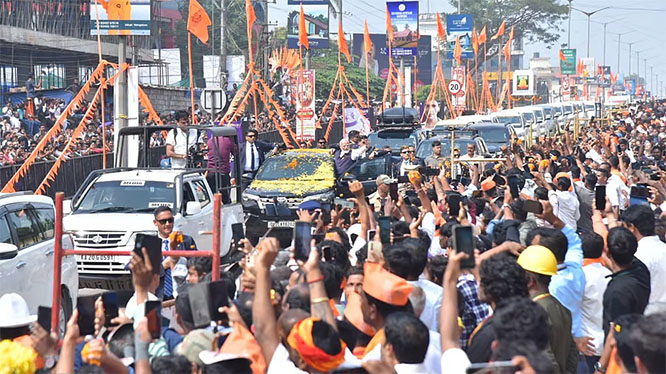
roadshow.jpg

Udupi district transformed into a sea of saffron and celebration on Friday, November 28, as Prime Minister Narendra Modi’s roadshow swept through the coastal temple town. Thousands of residents lined the streets, turning the event into a vibrant public spectacle filled with cheers, flags, and festive energy.

The procession route—from the helipad to the historic Sri Krishna Math—was decked with buntings, saffron flags, and multilayered security barricades. One of the district’s largest-ever security deployments was put in place for the high-profile visit, with over 3,000 police personnel on duty. The arrangement included ten SPs, 27 DSPs, 49 inspectors, 127 sub-inspectors, 232 assistant sub-inspectors, 1,608 constables, and 39 women staff.

Six platoons of the Karnataka State Reserve Police, six Quick Response Teams, bomb detection units, and dog squads were stationed across Udupi. Enhanced surveillance covered Adi Udupi, Bannanje bus stand, and the Sri Krishna Math parking zone, with combing operations carried out along the roadshow corridor.

At the 800-year-old Sri Krishna Math, preparations reached a ceremonial peak. Paryaya Puttige Math seer Sugunendra Teertha Swamiji said the Prime Minister would take part in the Laksha Kantha Geetha Parayana, a mass chanting of the Bhagavad Gita by one lakh devotees, and inaugurate the new Suvarna Teertha Mantapa.

“He will first offer floral tributes to saint-poet Kanakadasa and then unveil the golden covering over the Kanakana Kindi,” the seer said.

The Prime Minister will also receive a Poorna Kumbha welcome and have darshan of Lord Sri Krishna, Mukhyaprana Devaru, and the Suvarna Paduke. Union Minister Pralhad Joshi, Karnataka Governor Thaawarchand Gehlot, Minister Bairathi Suresh, Dharmadhikari D. Veerendra Heggade, and seers from the Ashta Maths are expected to join the ceremony.

Ahead of his arrival, the Prime Minister posted on X that he felt “honoured” to attend the spiritually significant gathering. “This is a special occasion that brings together people from different sections of society for a recital of the Gita. This Matha has a very special significance in our cultural life,” he wrote, noting the institution’s long-standing legacy rooted in the teachings of Sri Madhvacharya.

roadshow2.jpg

Comments

Add new comment

  • Coastaldigest.com reserves the right to delete or block any comments.
  • Coastaldigset.com is not responsible for its readers’ comments.
  • Comments that are abusive, incendiary or irrelevant are strictly prohibited.
  • Please use a genuine email ID and provide your name to avoid reject.
News Network
December 2,2025

Puttur: The long-cherished dream of a government medical college in Puttur has moved a decisive step closer to reality, with the Karnataka State Finance Department granting its official approval for the construction of a new 300-bed hospital.

Puttur MLA Ashok Kumar Rai announced the crucial development to reporters on Monday, confirming that the official communication from the finance department was issued on November 27. This 300-bed facility is intended to be the cornerstone for the establishment of the government medical college, a project announced in the state budget.

Fast-Track Implementation

The MLA outlined an aggressive timeline for the project:

•    A Detailed Project Report (DPR) for the hospital is expected to be ready within 45 days.

•    The tender process for the construction will be completed within two months.

Following the completion of the tender process, Chief Minister Siddaramaiah is scheduled to lay the foundation stone for the project.

"Setting up a medical college in Puttur is a historical decision by the Congress government in Karnataka," Rai stated. The project has an estimated budget allocation of Rs 1,000 crore for the medical college.

Focus on Medical Education Department

The MLA highlighted a key strategic move: requesting the government to implement the hospital construction through the Medical Education Department instead of the Health and Family Welfare Department. This is intended to streamline the entire process of establishing the full medical college, ensuring the facilities—including labs, operation theatres, and other necessary infrastructure—adhere to the strict guidelines set by the Medical Council of India (MCI). The proposed site for the project is in Bannur.

Rai also took the opportunity to address political criticism, stating that the government has fulfilled its promise despite "apprehensions" and "mocking and criticising" from opposition parties who had failed to take similar initiatives when they were in power. "Chief Minister Siddaramaiah has kept his word," he added.

Comments

Add new comment

  • Coastaldigest.com reserves the right to delete or block any comments.
  • Coastaldigset.com is not responsible for its readers’ comments.
  • Comments that are abusive, incendiary or irrelevant are strictly prohibited.
  • Please use a genuine email ID and provide your name to avoid reject.