



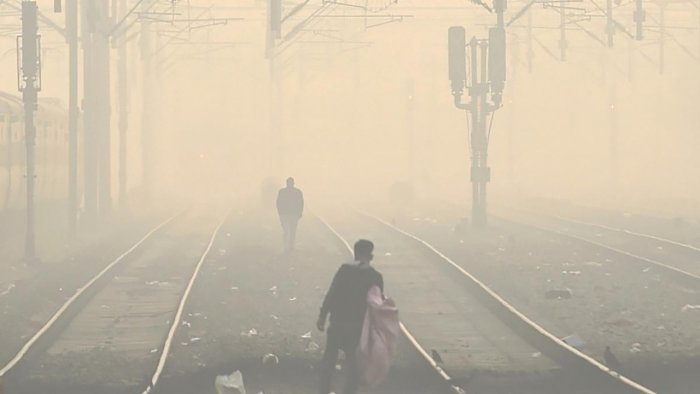
Party's over: Diwali leaves Delhi wheezing in hazardously unhealthy air

News Network
November 5, 2021

delhi.jpg

New Delhi, Nov 5: The morning after Diwali, the Hindu festival of lights, residents of New Delhi woke up under a blanket of toxic smog and breathed in the most dangerously polluted air of the year so far, after revellers, as usual, defied a fireworks ban.

New Delhi has the worst air quality of all world capitals, but even by its sorry standards Friday's reading was extra bad, as people paid the price for celebrating India's biggest festival in the noisiest, and most smoky way.

The Air Quality Index (AQI) surged to 451 on a scale of 500 - the maximum recorded this year - indicating "severe" conditions that affect healthy people and seriously impacts those with existing diseases, according to the federal pollution control board's guidance.

The AQI measures the concentration of poisonous particulate matter PM2.5 in a cubic metre of air. In Delhi, a city of nearly 20 million people, the PM2.5 reading on Friday averaged 706 micrograms, whereas the World Health Organization deems anything above an annual average of 5 micrograms as unsafe.

Airborne PM2.5 can cause cardiovascular and respiratory diseases such as lung cancer. And, in India, toxic air kills more than a million people annually.

"The firecracker ban didn't seem to be successful in Delhi, which led to hazardous pollution levels adding on top of existing perennial sources," Sunil Dahiya, Analyst, Centre for Research on Energy and Clean Air (CREA) said.

Every year, either government authorities or India's Supreme Court impose a ban on firecrackers. But the bans rarely appear to be enforced.

Making matters worse, Diwali falls in period when farmers in the Delhi's neighbouring states of Punjab and Haryana burn the stubble left after harvesting to prepare their fields for the next crop.

Stubble fires accounted for up to 35 per cent of New Delhi's PM2.5 levels, according to data from SAFAR's monitoring system, which falls under the federal Ministry of Earth Sciences

A rare spell of clear skies in October due to intermittent rains and winds had helped Delhiites breathe their cleanest air in at least four years.

But during winter months pollution levels surge in northern India, as lower temperatures and a drop in wind speed tend to trap pollutants in the air longer.

Sick of the lack of commitment to making the capital more livable, Ambrish Mithal, a doctor at the Max HealthCare hospital in New Delhi, vented his frustration over the deteriorating AQI readings.

"It's terrible for those with allergies and asthma. We will continue to squabble over reasons and are doomed to suffer," he wrote in a post on Twitter.

Indian governments are often accused of not doing enough to curb pollution, as they prioritise economic growth to lift living standards in the world's second-most populated country.

On Monday, Prime Minister Narendra Modi told the COP26 climate summit in Glasgow that India would achieve net zero carbon emissions by 2070, but some experts reckoned that target was at least two decades too late. 

Comments

Add new comment

  • Coastaldigest.com reserves the right to delete or block any comments.
  • Coastaldigset.com is not responsible for its readers’ comments.
  • Comments that are abusive, incendiary or irrelevant are strictly prohibited.
  • Please use a genuine email ID and provide your name to avoid reject.
News Network
November 22,2025

The Karnataka government has announced a 50% rebate on pending traffic and transport fines. The discount is available from November 21 to December 12.

The rebate applies to all traffic e-challans and violation cases booked by the RTO between 1991–92 and 2019–20. Officials clarified that the offer is not applicable to pending tax dues and is restricted only to traffic-violation fines.

Across Karnataka, more than 4 lakh RTO cases remain pending, including those involving transport vehicles. While thousands of vehicle owners have already cleared their dues, the department expects to generate substantial revenue through this limited-period rebate.

How to Pay and Avail the Discount

There are three ways to check and pay your pending fines:

1. Through Mobile Apps
Available on both Play Store and App Store:
•    Karnataka State Police (KSP) app
•    KarnatakaOne app
•    ASTraM app

Steps:
•    Enter your vehicle number in any of the above apps
•    Verify the photo/details of your vehicle
•    Pay the fine with the 50% discount applied

2. Visit a Traffic Police Station

You can pay your pending fine at any nearby traffic police station.

3. Visit the Traffic Management Centre (TMC)

•    Location: First Floor, Infantry Road, near Indian Express, Bengaluru

Transport Commissioner Yogeesh A M said, “We don't issue e-challans, so there's no online payment system.”

The department estimates ₹52 crore in pending RTO fines up to March 2020. “With the 50% rebate, we expect to collect around ₹25 crore if all dues are cleared,” he added.

Comments

Add new comment

  • Coastaldigest.com reserves the right to delete or block any comments.
  • Coastaldigset.com is not responsible for its readers’ comments.
  • Comments that are abusive, incendiary or irrelevant are strictly prohibited.
  • Please use a genuine email ID and provide your name to avoid reject.
News Network
November 26,2025

Mangaluru, Nov 26: Mangaluru East police have registered a case following a sophisticated online fraud where a 57-year-old local resident was allegedly cheated out of ₹13.4 lakh after being targeted on Facebook.

The scam began in February when the complainant, while browsing Facebook reels, was contacted by a woman identifying herself as "Lillian Mary George" from London. After establishing a chat relationship, the woman claimed she would visit India in November and bring a significant sum of money.

The trap was sprung on November 15, when the victim received a call from a woman named "Sonali Gupta," who claimed Lillian had arrived at Mumbai International Airport but was detained by customs. The fraudsters convinced the man that Lillian was carrying £25,000 (about ₹26 lakh) in traveller’s cheques and 1 kg of gold (valued at around ₹30 lakh).

Under the pretense of clearing these items, the victim was asked to make numerous online transfers between November 15 and 18 for various bogus charges, including:

•    "Pounds exchange registration"
•    "Customs declaration issues"
•    "Discount charges"
•    "Money-laundering charges"

Believing the fictitious story, the complainant transferred the cumulative sum of ₹13.4 lakh to various bank accounts provided by the fraudsters. He realised he was cheated when the culprits later promised a refund within two days but stopped answering his calls. The Mangaluru East police are now investigating the case, which highlights the continuing threat of transnational cyber fraud using social engineering and promises of fictitious wealth.

Comments

Add new comment

  • Coastaldigest.com reserves the right to delete or block any comments.
  • Coastaldigset.com is not responsible for its readers’ comments.
  • Comments that are abusive, incendiary or irrelevant are strictly prohibited.
  • Please use a genuine email ID and provide your name to avoid reject.
News Network
November 26,2025

students.jpg

Bengaluru, Nov 26: Karnataka is taking its first concrete steps towards lifting a three-decade-old ban on student elections in colleges and universities. Deputy Chief Minister D.K. Shivakumar announced Wednesday that the state government will form a small committee to study the reintroduction of campus polls, a practice halted in 1989 following incidents of violence.

Speaking at a 'Constitution Day' event organised by the Karnataka Congress, Mr. Shivakumar underscored the move's aim: nurturing new political leadership from the grassroots.

"Recently, (Leader of the Opposition in Lok Sabha) Rahul Gandhi wrote a letter to me and Chief Minister (Siddaramaiah) asking us to think about restarting student elections," Shivakumar stated. "I'm announcing today that we'll form a small committee and seek a report on this."

Student elections were banned in Karnataka in 1989, largely due to concerns over violence and the infiltration of political party affiliates into campus life. The ban effectively extinguished vibrant student bodies and the pipeline of young leaders they often produced.

Mr. Shivakumar, who also serves as the Karnataka Congress president, said that former student leaders will be consulted to "study the pros and cons" of the re-introduction.

Acknowledging the history of the ban, he added, "There were many criminal activities taking place back then. We’ll see how we can conduct (student) elections by regulating such criminal activities."

The Deputy CM reminisced about his own journey, which began on campus. He recalled his political activism at Sri Jagadguru Renukacharya College leading to his first Assembly ticket in 1985 at the age of 23. "That's how student leadership was at the time. Such leadership has gone today. College elections have stopped," he lamented, adding that for many, college elections were "like a big movement" where leaders were forged.

The move, driven by the Congress high command's push to cultivate young talent, will face scrutiny from academics and university authorities who have, in the past, expressed concern that the return of polls could disrupt the peaceful academic environment and turn campuses into political battlegrounds.

Comments

Add new comment

  • Coastaldigest.com reserves the right to delete or block any comments.
  • Coastaldigset.com is not responsible for its readers’ comments.
  • Comments that are abusive, incendiary or irrelevant are strictly prohibited.
  • Please use a genuine email ID and provide your name to avoid reject.