Protect environment for future, says outgoing President in farewell address to India

News Network
July 24, 2022

ramnathkovind.jpg

New Delhi, July 24: Mother nature is in deep agony and the climate crisis can endanger the very future of this planet, outgoing President Ram Nath Kovind said in his farewell address to the nation on Sunday as he appealed to all to protect the environment for the coming generations.

Emphasising that the country is getting equipped to make the 21st century "the century of India," Kovind highlighted the importance of healthcare and education and said these, along with economic reforms, would enable citizens to pursue happiness by discovering their potential.

President-elect Droupadi Murmu will be sworn in as the country's 15th President on Monday.

In his last televised address to the nation, Kovind said, "The pandemic has underlined the need to further improve the public healthcare infrastructure. I am glad that the government has accorded top priority to this task.

"Once education and healthcare are in place, economic reforms will let citizens find the best course for their lives, he said, adding that "I firmly believe that our country is getting equipped to make the 21st century, the century of India".

He said the National Education Policy will go a long way in making it possible for young Indians to connect with their heritage and also find their feet in the twenty-first century.

The president made a special mention of the threat to the environment and asked all citizens to take care of it for future generations.

"Mother Nature is in deep agony and the climate crisis can endanger the very future of this planet. We must take care of our environment, our land, air and water for the sake of our children.

"In our daily lives and routine choices, we must be more careful to protect our trees, rivers, seas and mountains as well as all other living beings. As the first citizen, if I have to give one advice to my fellow citizens, it has to be this," he added.

President Kovind also hailed the trinity of ideals of liberty, equality and fraternity, saying they must not be mistaken as abstractions beacause they ''are lofty, noble and uplifting."

"Our history, not only of modern times but also from ancient times, reminds us that they are real; that they can be realised, and indeed have been realised in different eras.

"Our ancestors and founders of our modern nation exemplified the meaning of justice, liberty, equality and fraternity with hard work and an attitude of service. We only have to follow in their footsteps and keep walking," he said.

And what do such ideals mean for a common citizen today? Kovind asked.

"I believe the chief goal is to help them discover the joy of living. For that, first of all, their basic necessities must be taken care of," the president emphasised.

During his address, the president went down memory lane to highlight the inherent power of vibrant democratic institutions.

Kovind recalled his earlier days when the country had just achieved independence and said, "There was a fresh wave of energy to rebuild the country; there were new dreams. I too had a dream, that one day I would be able to participate in a meaningful way in this nation-building exercise."

"A young boy living in a mud house could not have any idea about the highest Constitutional office of the Republic. But it is a testament to the strength of India's democracy that it has created pathways to let each citizen take part in the shaping of our collective destiny.

"If that Ram Nath Kovind from village Paraunkh is addressing you today, it is solely thanks to the inherent power of our vibrant democratic institutions," he said.

In his farewell speech on the eve of his completing five-year tenure as the president, Kovind said the founders of our modern nation exemplified the meaning of justice, liberty, equality and fraternity with hard work and an attitude of service, and "we only have to follow in their footsteps and keep walking".

The president said the nation is working with the objective of providing better housing, and access to drinking water and electricity for every family.

"This change has been made possible by the momentum of development and good governance which knows no discrimination," he said.

Kovind said the formal map for the democratic path "we all have been navigating was drafted by the Constituent Assembly" and the Constitution they prepared, with invaluable contributions from each of them, has been our guiding beacon.

"Values enshrined in it have been part of the Indian ethos since time immemorial," the outgoing president said and quoted Dr Babasaheb Bhimrao Ambedkar's concluding remarks in the Constituent Assembly where he had pointed out the distinction between political and social democracy.

"What does social democracy mean? It means a way of life which recognises liberty, equality and fraternity as the principles of life.

"These principles of liberty, equality and fraternity are not to be treated as separate items in a trinity. They form a union of trinity in the sense that to divorce one from the other is to defeat the very purpose of democracy," Kovind quoted Ambedkar as having said.

President Kovind said in modern times, the glorious journey of the country commenced with the awakening of nationalist feelings during colonial rule and the launch of the freedom struggle.

"There were many uprisings across the country in the nineteenth century. The names of many of the heroes who brought hopes of new dawn have long been forgotten.

"Contributions of some of them have come to be appreciated only in recent times. Around the turn of the century, the various struggles were coming together, creating a new consciousness," he said.
When Gandhiji returned to the motherland in 1915, the nationalist fervour was gaining momentum, Kovind said, mentioning Gurudev Rabindranath Tagore, Babasaheb Bhimrao Ambedkar, Jawaharlal Nehru and Syama Prasad Mookerjee among others.

"From Tilak and Gokhale to Bhagat Singh and Netaji, from Jawaharlal Nehru, Sardar Patel and Shyama Prasad Mukherjee to Sarojini Naidu and Kamaladevi Chattopadhyay – nowhere in the history of humankind have so many great minds come together for a common cause," he said.

Expressing deep gratitude to all fellow citizens and elected representatives, Kovind said he has been inspired and energised by interactions with farmers and workers from small villages, teachers shaping young minds, artists enriching our legacy, scholars investigating various facets of our country and business people creating wealth for the nation.

He also mentioned doctors and nurses serving the people, scientists and engineers engaged in nation-building, judges and advocates contributing to the justice delivery system of the country and civil servants who run the administration smoothly.

"'Our social workers actively connecting every social segment with development, preachers and masters of all sects who maintain the flow of spirituality in Indian society – you all have continuously helped me discharge my duties," he said.

"In short, I received full cooperation, support and blessings from all sections of society. I will especially cherish the occasions when I had an opportunity to meet our brave jawans of the armed forces, para-military forces and the police. Their patriotic zeal is as amazing, as it is inspiring," the president said.

Referring to his interaction with the Indian diaspora during his visits abroad, Kovind said he found their love and concern for the homeland very touching.

"All these re-affirm the belief that the nation is after all composed of its citizens; and with each of you striving to make India better and better, the nation’s great future is secure," he said.

Kovind said that among the most memorable moments of his life has been visiting his home during his term and touching the feet of his teachers at Kanpur to seek their blessings.

"This year, the prime minister also honoured my village Paraunkh with his visit. This connection with our roots has been the essence of India. I would request the younger generation to continue this tradition of staying connected with their village or town, their schools and teachers," the president said.

Asserting that he has discharged his responsibilities to the best of his ability and has been conscious of being a successor to great icons like Dr Rajendra Prasad, Dr S Radhakrishnan and Dr APJ Abdul Kalam, Kovind said, "Still, whenever I was in doubt, I turned to Gandhiji and his famous talisman."

"His advice of recalling the face of the poorest man and asking myself if the step I am about to take will be of any use to him. At the risk of repeating myself, I will urge you to contemplate Gandhiji’s life and teachings at least for a few minutes every day," he said. 

Comments

Add new comment

  • Coastaldigest.com reserves the right to delete or block any comments.
  • Coastaldigset.com is not responsible for its readers’ comments.
  • Comments that are abusive, incendiary or irrelevant are strictly prohibited.
  • Please use a genuine email ID and provide your name to avoid reject.
Agencies
November 22,2025

indiapak.jpg

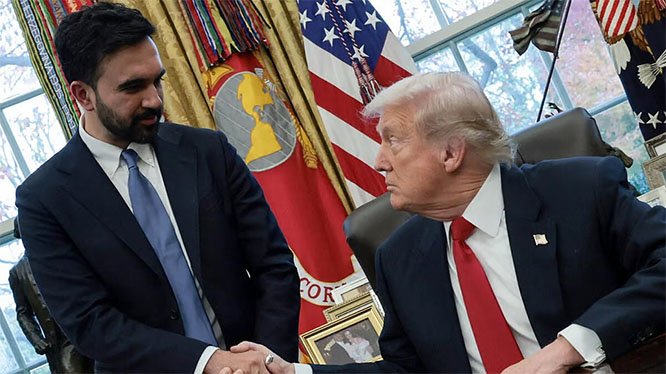
New York/Washington: US President Donald Trump has again claimed to have solved the conflict between India and Pakistan, repeating his assertion during a meeting with New York City Mayor-elect Zohran Mamdani in the Oval Office.

Mamdani flew to Washington DC for his first meeting with Trump in the White House on Friday. Trump said he “enjoyed” the meeting, which he described as “great.”

During remarks in the Oval Office, with Mamdani standing next to him, Trump repeated his claim that he solved the May conflict between India and Pakistan.

"I did eight peace deals of countries, including India and Pakistan,” he said.

On Wednesday, Trump had said he threatened to put 350 per cent tariffs on India and Pakistan if they did not end their conflict, repeating his claim that he solved the fighting between the nuclear-armed neighbours and that Prime Minister Narendra Modi had called him to say “we're not going to go to war.”

Since May 10, when Trump announced on social media that India and Pakistan had agreed to a “full and immediate” ceasefire after a “long night” of talks mediated by Washington, he has repeated his claim over 60 times that he “helped settle” the tensions between India and Pakistan.

India has consistently denied any third-party intervention. India launched Operation Sindoor on May 7, targeting terror infrastructure in Pakistan and Pakistan-occupied Kashmir in retaliation for the April 22 Pahalgam attack that killed 26 civilians. India and Pakistan reached an understanding on May 10 to end the conflict after four days of intense cross-border drone and missile strikes.

Mamdani emerged victorious in the closely-watched battle for New York City Mayor, becoming the first South Asian and Muslim to be elected to sit at the helm of the largest city in the US.

He had been the front-runner in the NYC Mayoral election for months and defeated Republican nominee Curtis Sliwa and political heavyweight former New York State Governor Andrew Cuomo, who ran as an independent candidate and was officially endorsed by Trump just hours before the elections.

Indian-descent Mamdani is the son of renowned filmmaker Mira Nair and Columbia University professor Mahmood Mamdani. He was born and raised in Kampala, Uganda and moved to New York City with his family when he was 7. Mamdani became a naturalised US citizen only recently, in 2018.

Comments

Add new comment

  • Coastaldigest.com reserves the right to delete or block any comments.
  • Coastaldigset.com is not responsible for its readers’ comments.
  • Comments that are abusive, incendiary or irrelevant are strictly prohibited.
  • Please use a genuine email ID and provide your name to avoid reject.
News Network
December 5,2025

indigoCEO.jpg

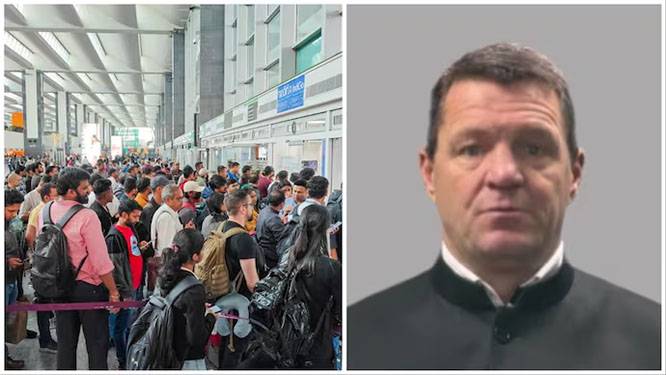
New Delhi, Dec 5: IndiGo CEO Pieter Elbers issued a public apology this evening after more than a thousand flights were cancelled today, making it the "most severely impacted day" in terms of cancellations. The biggest airline of the country cancelled "more than half" of its daily number of flights on Friday, said Elbers. He also said that even though the crisis will persist on Saturday, the airline anticipates fewer than 1,000 flight cancellations.

"Full normalisation is expected between December 10 and 15, though IndiGo cautions that recovery will take time due to the scale of operations," the IndiGo CEO said. 

IndiGo operates around 2,300 domestic and international flights daily.

Pieter Elbers, while apologising for the major inconvenience due to delays and cancellations, said the situation is a result of various causes.

The crisis at IndiGo stems from new regulations that boost pilots' weekly rest requirements by 12 hours to 48 and allow only two night-time landings per week, down from six. IndiGo has attributed the mass cancellations to "misjudgment and planning gaps".

Elbers also listed three lines of action that the airline will adopt to address the issue.

"Firstly, customer communication and addressing your needs, for this, messages have been sent on social media. And just now, a more detailed communication with information, refunds, cancellations and other customer support measures was sent," he said.

The airline has also stepped up its call centre capacity.

"Secondly, due to yesterday's situation, we had customers stranded mostly at the nation's largest airports. Our focus was for all of them to be able to travel today itself, which will be achieved. For this, we also ask customers whose flights are cancelled not to come to the airports as notifications are sent," the CEO said.

"Thirdly, cancellations were made for today to align our crew and planes to be where they need to start tomorrow morning afresh. Earlier measures of the last few days, regrettable, have proven not to be enough, but we have decided today to reboot all our systems and schedules, resulting in the highest numbers of cancellations so far, but imperative for progressive improvements starting from tomorrow," he added.

As airports witnessed chaotic scenes, the Directorate General of Civil Aviation (DGCA) stepped in to grant IndiGo a temporary exemption from stricter night duty rules for pilots. It also allowed substitution of leaves with a weekly rest period. 

Civil Aviation Minister Ram Mohan Naidu has said a high-level inquiry will be ordered and accountability will be fixed.

Comments

Add new comment

  • Coastaldigest.com reserves the right to delete or block any comments.
  • Coastaldigset.com is not responsible for its readers’ comments.
  • Comments that are abusive, incendiary or irrelevant are strictly prohibited.
  • Please use a genuine email ID and provide your name to avoid reject.
News Network
November 21,2025

Bengaluru, Nov 21: The Karnataka government is facing pressure to overhaul its employment system after a high-level Cabinet sub-committee recommended the complete phase-out of job outsourcing in government offices, boards, and corporations by March 2028. The move is aimed at tackling a systemic issue that has led to the potential violation of constitutional reservation policies and the exploitation of workers.

The Call for Systemic Change

With over three lakh vacant posts currently being filled through private agencies on an outsource, insource, or daily wage basis, the sub-committee highlighted a significant lapse. "As a result, reservations are not being followed as per the Constitution and state laws. It’s an urgent need to take serious steps to change the system. It has been recommended to completely stop the system of outsourcing by March 2028," the panel stated in a document.

The practice of outsourcing involves private companies hiring workers to perform duties for a government agency. Critics argue this model results in lesser salaries, a lack of social security benefits (otherwise available to permanent government employees), and a failure to adhere to the provisions of Articles 14 and 15 of the Constitution, which guarantee equality before the law and prohibit discrimination.

The 'Bidar Model' as a Stop-Gap Solution

To regulate the current mode of employment and reduce worker exploitation until the 2028 deadline, the government plans to establish workers’ services multi-purpose cooperative societies across all districts, following the successful "Bidar Model."

The Bidar District Services of Labour Multi-purpose Cooperative Society Ltd., which operates under the District Commissioner, is cited as a successful example of providing a measure of social security to outsourced staff. Labour Department officials argue this society ensures workers receive their due wages and statutory facilities like ESI (Employees' State Insurance) and PF (Provident Fund), in exchange for a 1% service fee collected from the employees.

legislative push and Priority Insourcing

The recommendations, led by the sub-committee headed by Law and Parliamentary Affairs Minister H K Patil, are set to be discussed at the next Cabinet meeting. The committee has proposed the introduction of the Karnataka Outsourced Employees (Regulation, Placement and Welfare) Bill 2025.

In a move addressing immediate concerns, Labour Minister Santosh Lad, a member of the sub-committee, has reportedly assured that steps will be taken over the next 2-3 years to insource workers in "life-threatening services" on a priority basis. This includes essential personnel like pourakarmikas (sanitation workers), drivers, electrical staff in the Energy Department, and Health Department staff handling contagious diseases. The transition aims to grant these workers the long-term security and benefits they currently lack under the outsourcing system. 

Comments

Add new comment

  • Coastaldigest.com reserves the right to delete or block any comments.
  • Coastaldigset.com is not responsible for its readers’ comments.
  • Comments that are abusive, incendiary or irrelevant are strictly prohibited.
  • Please use a genuine email ID and provide your name to avoid reject.