Is second Covid wave over? Positivity rate below 5% for two weeks but experts say end still far

News Network
June 21, 2021

New Delhi, June 21: India on Monday crossed the important milestone of a Covid positivity rate of less than 5 per cent for 14 consecutive days, conforming to the WHO’s recommended requirement for a region to reopen, but experts were wary of declaring the devastating second wave over.

With 53,256 new coronavirus infections, the lowest in 88 days, and a positivity rate of 3.83 per cent, it would seem the present phase of the Covid-19 crisis is over and it is a good time to lift instructions.

This optimistic picture, however, must be edged with abundant caution, said several scientists, citing the emergence of new variants, the still high absolute number of cases, the many districts where positivity rate remains over 5 per cent and concerns over the reliability of data.  

“With the current positivity rate at less than 5 per cent, India’s Covid-19 second wave is on the wane as quickly as it rushed to its peak, but the end of it may yet be far away as more transmissible new variants such as Delta plus variant are emerging,” said Naga Suresh Veerapu, associate professor at the School of Natural Sciences (SoNS), Shiv Nadar University, Delhi NCR. 

The Delta plus variant has been formed due to a mutation in the Delta or B.1.617.2 variant, first identified in India and considered one of the drivers of the second wave in the country and also in several others including the UK.  

The test positivity rate or TPR -- the percentage of all coronavirus tests performed that turn out to be positive -- is an important metric through which the public health system keeps tabs on the level of Covid transmission.  

The WHO recommends that test positivity should remain at 5 per cent or lower for 14 days before countries or regions reopen.

In February this year, the country was celebrating the end of the first wave and conveniently ignored an imminent second wave, Veerapu said.  

“The Delta variant that emerged in March spread across the different parts of India, then cases surged to the peak yielding a second wave. The second wave conjoined with the first when the latter was at 1 per cent positivity rate,” he told PTI.    

Public policy expert Chandrakant Lahariya added that while the cases are on the decline, the absolute number of cases are still very high.  

 “While the national level test positivity rate has come down, there are still many districts where TPR is above 5 per cent,” the Delhi-based physician-epidemiologist and health systems expert told PTI.

“Therefore, before saying that the second wave is over, I would like to wait for the TPR to come down below 5 per cent everywhere and sustain for two weeks or longer,” he said.

Scientist Gautam Menon agreed with Lahariya, noting that some states such as Kerala are still seeing positivity rates over 5 per cent. He added that it is unclear whether this reflects just better testing than other states or if the situation is still to improve there.  

Positivity rate was 10.84 per cent in Kerala on Sunday.   

According to Health Ministry data on Monday, India’s total tally of Covid-19 cases is 2,99,35,221 (2.99 crore/29.9 million) while active cases have reduced to 7,02,887.  

The second wave of the pandemic overwhelmed the healthcare system of the country, leaving hospitals struggling to cope with the surge in cases and critical drugs and oxygen in short supply. Infections have now slowed down and restrictions have been relaxed in most states. 

Agreeing that the drop in India’s cases has been quite dramatic, Menon noted, “From all we know, this is a genuine decline, both in urban and rural India.”  

“There is no strict definition of a ‘wave’, let alone of how and when it might be ending, but this is a good time as any to consider opening up, although with caution,” Menon, professor, Departments of Physics and Biology, Ashoka University in Haryana, told PTI.  

The experts also believe test positivity rates provide valuable information only if testing is broadly accessible across all regions.  

“Test positivity, when these tests are carried out on a random sample of the population and in sufficient quantity, is likely the best metric to dictate opening up, although we must be careful about local pockets where the level of infections have been lower than average and where the disease could still take off,” said Menon.  

“What we need to remember is that for a country the size of India, we need to have enough attention on the local level,” Lahariya added.  

He explained that Covid-19 is not just any other respiratory illness and decision-making parameters cannot be simple.  

“We know that there are new variants which are more transmissible. We know that human behaviour determines the spread of this virus. Therefore, it is not very relevant if we declare whether the second wave is over or not,” the public policy expert explained.  

“Key is, are we prepared to respond to the rise in cases? That's where the attention has to be,” Lahariya said.  

Widespread concerns about the accuracy of data, relating to both deaths and cases, also need to be factored in, said Menon. 

Though anecdotally, decline in cases appears to be true, media and other reports “suggest that deaths have been severely undercounted, sometimes by a factor of 10”.

“I hope these reports will spur states to be transparent with their numbers,” he said.  

Lahariya said India has sub-optimally performing mechanisms for medical certification of causes of deaths (MCCD). Even before the pandemic, the causes of deaths used to be certified in only one-fourth of registered deaths.  

“Therefore, it is not unthinkable that even in some cases of Covid-19 deaths; deaths have not been certified correctly,” the scientist added.   

Veerapu said asymptomatic people and some with mild symptoms may not even turn up for testing, therefore leading to the underestimation of cases.  

However, he said the waning second wave provides enough opportunities to minimise the spread of the disease.

“We should ramp up the vaccination drive, consolidate the health infrastructure to minimise the impact of the much anticipated third wave, and hone the public health strategies to prevent, control and respond to the third wave,” he added.

Comments

Add new comment

  • Coastaldigest.com reserves the right to delete or block any comments.
  • Coastaldigset.com is not responsible for its readers’ comments.
  • Comments that are abusive, incendiary or irrelevant are strictly prohibited.
  • Please use a genuine email ID and provide your name to avoid reject.
News Network
December 4,2025

Mangaluru: Chaos erupted at Mangaluru International Airport (MIA) after IndiGo flight 6E 5150, bound for Mumbai, was repeatedly delayed and ultimately cancelled, leaving around 100 passengers stranded overnight. The incident highlights the ongoing country-wide operational disruptions affecting the airline, largely due to the implementation of new Flight Duty Time Limitations (FDTL) norms for crew.

The flight was initially scheduled for 9:25 PM on Tuesday but was first postponed to 11:40 PM, then midnight, before being cancelled around 3:00 AM. Passengers expressed frustration over last-minute communication and the lack of clarity, with elderly and ailing travellers particularly affected. “Though the airline arranged food, there was no proper communication, leaving us confused,” said one family member.

An IndiGo executive at MIA cited the FDTL rules, designed to prevent pilot fatigue by limiting crew working hours, as the cause of the cancellation. While alternative arrangements, including hotel stays, were offered, about 100 passengers chose to remain at the airport, creating tension. A replacement flight was arranged but also faced delays due to the same constraints, finally departing for Mumbai around 1:45 PM on Wednesday. Passengers either flew, requested refunds, or postponed their travel.

The Mangaluru delay is part of a broader crisis for IndiGo. The airline has been forced to make “calibrated schedule adjustments”—a euphemism for widespread cancellations and delays—after stricter FDTL norms came into effect on November 1.

While an IndiGo spokesperson acknowledged unavoidable flight disruptions due to technology issues, operational requirements, and the updated crew rostering rules, the DGCA has intervened, summoning senior airline officials to explain the chaos and outline corrective measures.

The ripple effect has been felt across the country, with major hubs like Bengaluru and Mumbai reporting numerous cancellations. The Mangaluru incident underscores the systemic operational strain currently confronting India’s largest carrier, leaving passengers nationwide grappling with uncertainty and delays.

Comments

Add new comment

  • Coastaldigest.com reserves the right to delete or block any comments.
  • Coastaldigset.com is not responsible for its readers’ comments.
  • Comments that are abusive, incendiary or irrelevant are strictly prohibited.
  • Please use a genuine email ID and provide your name to avoid reject.
News Network
November 27,2025

siddDKS.jpg

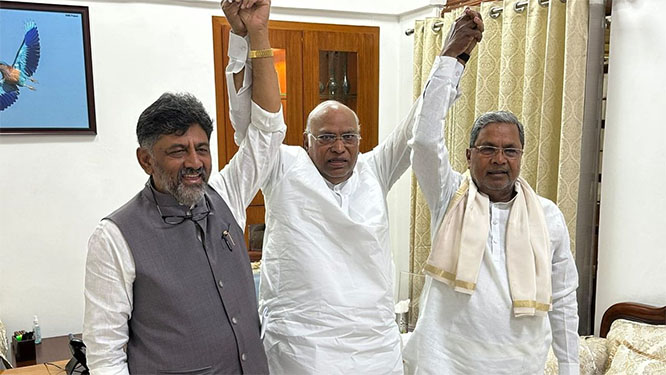
Congress president Mallikarjun Kharge on Thursday announced that he will convene a high-level meeting in New Delhi with senior leaders — including Rahul Gandhi, Karnataka Chief Minister Siddaramaiah and Deputy Chief Minister D.K. Shivakumar — to resolve the escalating leadership turmoil in Karnataka and “put an end to the confusion.”

Kharge said the discussions would focus on the way forward for the ruling party, as rumours of a possible leadership change continue to swirl. The speculation has intensified after the Congress government crossed the halfway mark of its five-year term on November 20, reviving talk of an alleged 2023 “power-sharing agreement” between Siddaramaiah and Shivakumar.

“After reaching Delhi, I will call three or four important leaders and hold discussions. Once we talk, we will decide how to move ahead and end this confusion,” Kharge told reporters in Bengaluru, according to PTI.

When asked specifically about calling Siddaramaiah and Shivakumar to Delhi, he responded: “Certainly, we should call them. We will discuss with them and settle the issue.”

He confirmed that Rahul Gandhi, the Chief Minister, the Deputy Chief Minister and other senior members would be part of the deliberations. “After discussing with everyone, a decision will be made,” he said.

Meanwhile, Siddaramaiah held a separate strategy meeting at his Bengaluru residence with ministers and leaders seen as his close confidants, including G. Parameshwara, Satish Jarkiholi, H.C. Mahadevappa, K. Venkatesh and K.N. Rajanna.
Signalling calm, the Chief Minister told reporters, “Will go to Delhi if the high command calls.”

Shivakumar echoed a similar stance, saying he too would head to the national capital if summoned by the party leadership.

Comments

Add new comment

  • Coastaldigest.com reserves the right to delete or block any comments.
  • Coastaldigset.com is not responsible for its readers’ comments.
  • Comments that are abusive, incendiary or irrelevant are strictly prohibited.
  • Please use a genuine email ID and provide your name to avoid reject.
coastaldigest.com news network
November 28,2025

roadshow.jpg

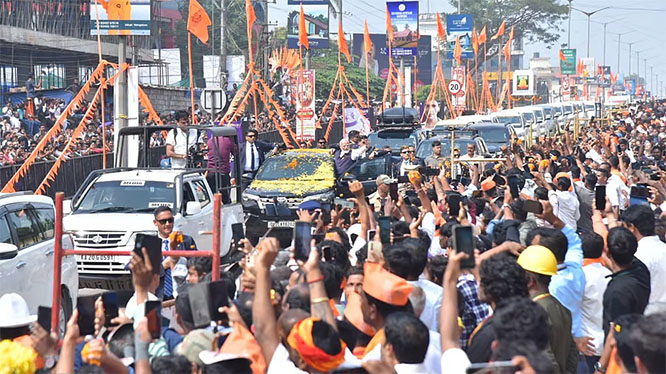
Udupi district transformed into a sea of saffron and celebration on Friday, November 28, as Prime Minister Narendra Modi’s roadshow swept through the coastal temple town. Thousands of residents lined the streets, turning the event into a vibrant public spectacle filled with cheers, flags, and festive energy.

The procession route—from the helipad to the historic Sri Krishna Math—was decked with buntings, saffron flags, and multilayered security barricades. One of the district’s largest-ever security deployments was put in place for the high-profile visit, with over 3,000 police personnel on duty. The arrangement included ten SPs, 27 DSPs, 49 inspectors, 127 sub-inspectors, 232 assistant sub-inspectors, 1,608 constables, and 39 women staff.

Six platoons of the Karnataka State Reserve Police, six Quick Response Teams, bomb detection units, and dog squads were stationed across Udupi. Enhanced surveillance covered Adi Udupi, Bannanje bus stand, and the Sri Krishna Math parking zone, with combing operations carried out along the roadshow corridor.

At the 800-year-old Sri Krishna Math, preparations reached a ceremonial peak. Paryaya Puttige Math seer Sugunendra Teertha Swamiji said the Prime Minister would take part in the Laksha Kantha Geetha Parayana, a mass chanting of the Bhagavad Gita by one lakh devotees, and inaugurate the new Suvarna Teertha Mantapa.

“He will first offer floral tributes to saint-poet Kanakadasa and then unveil the golden covering over the Kanakana Kindi,” the seer said.

The Prime Minister will also receive a Poorna Kumbha welcome and have darshan of Lord Sri Krishna, Mukhyaprana Devaru, and the Suvarna Paduke. Union Minister Pralhad Joshi, Karnataka Governor Thaawarchand Gehlot, Minister Bairathi Suresh, Dharmadhikari D. Veerendra Heggade, and seers from the Ashta Maths are expected to join the ceremony.

Ahead of his arrival, the Prime Minister posted on X that he felt “honoured” to attend the spiritually significant gathering. “This is a special occasion that brings together people from different sections of society for a recital of the Gita. This Matha has a very special significance in our cultural life,” he wrote, noting the institution’s long-standing legacy rooted in the teachings of Sri Madhvacharya.

roadshow2.jpg

Comments

Add new comment

  • Coastaldigest.com reserves the right to delete or block any comments.
  • Coastaldigset.com is not responsible for its readers’ comments.
  • Comments that are abusive, incendiary or irrelevant are strictly prohibited.
  • Please use a genuine email ID and provide your name to avoid reject.