



India is unpredictable. This is an incontrovertible fact that Indians themselves seem to have forgotten over the past decade.
Ever since Prime Minister Narendra Modi stormed into office with an unexpected and unprecedented outright legislative majority in 2014, many have assumed the country’s politics had changed forever.
The age of coalitions was over; India seemed to be heading inexorably toward one-party dominance.
To stock traders and pro-government pundits, the country’s trajectory seemed so clear: It was destined to see steady 8 per cent growth, happy voters, and a prime minister going from strength to strength at home and abroad.
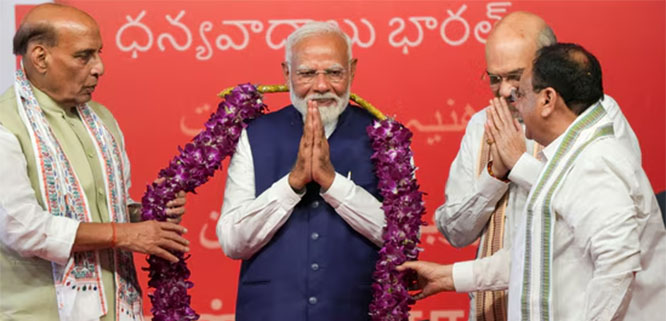
Indian voters chose to disagree. With votes still being counted in the country’s massive general elections and several races still hanging in the balance, Modi’s Bharatiya Janata Party looks almost certain to have fallen short of a parliamentary majority.
That means it will have to depend, for the first time, on fickle smaller parties to hold onto power.
This was what Indian politics looked like for decades prior to Modi’s emergence. Many thought we were living in a new normal. Instead, the old normal has reasserted itself.
In these surprising elections, Modi and the BJP appear to have discovered the limits of hype. An apparently unified public sphere, solidly pro-government media, and impressive growth numbers had left many assuming that Modi’s performance in power had few holes.
Observers should have paid more attention to contrary indicators. Employment growth under Modi has been marginal at best. Social inclusion has been patchy.
While much of the country looks very different from it did in 2014, even more of it looks largely unchanged.
Small-town India has not seen the sort of revolution in infrastructure that cities of equivalent size in China or Southeast Asia have enjoyed over recent decades.
Big metropolises were transformed during the boom years of the 2000s; they have mostly stagnated since then.
Whatever the GDP growth numbers are, whether they are believable or not, one thing is clear: Voters do not believe enough of that growth has reached their wallets.
It’s not surprising such facts have been overlooked. The Modi government and its allies have completely dominated messaging over the past decade.
They sought to maintain, week in and week out, the frenetic pace and outsize enthusiasm that marked the Prime Minister’s initial march to power.
The government thought that the lesson of its sweeping re-election in 2019 was that social conservatism and welfare delivery was enough to maintain control.
But Modi and the BJP have reached the limits of welfare-first politics and saturation advertising. Without real change on the ground, he or any successor may struggle to retain power over the next five years. They will have to pay more attention to governance than to marketing.
There’s a lot that needs attention. Modi came into power promising manufacturing jobs and private-sector-friendly reforms. In this campaign, he instead argued that loans to small-scale entrepreneurs had gone up, proving that jobs were being created — and that increases in share prices for public-sector companies validated his economic performance.
This is clearly a retreat from the ambitions of a decade ago. Any new government must recapture those ambitions; voters clearly expect it.
If India’s politics have indeed returned to normal, its government must, too. Repression of the opposition does not work, not in a country this large and variegated.
For 10 years, Modi has promised to wipe out his principal rivals in the Indian National Congress party. Yet, in this election, the Congress demonstrated that it is not going anywhere.
The government arguably misused investigative agencies to go after opposition leaders in two states in particular, Maharashtra and West Bengal; both have decisively voted against the BJP.
Modi’s personal popularity is such that he and his government can survive the sort of relatively mild rebuke the electorate has delivered. To retain power for a third term, even if dependent on allies, is an historic achievement.
This result is only startling because the Modi hype had completely detached itself from reality.
We do not live, it appears, in a post-truth world. Even the most adept populists must eventually reckon with reality. None of them are immune to the most fundamental rule of politics: If you don’t perform, you perish.

Comments
Add new comment