TDP boss N Chandrababu Naidu takes oath as AP CM for 4th term in presence of PM Modi

News Network
June 12, 2024

modinaidu.jpg

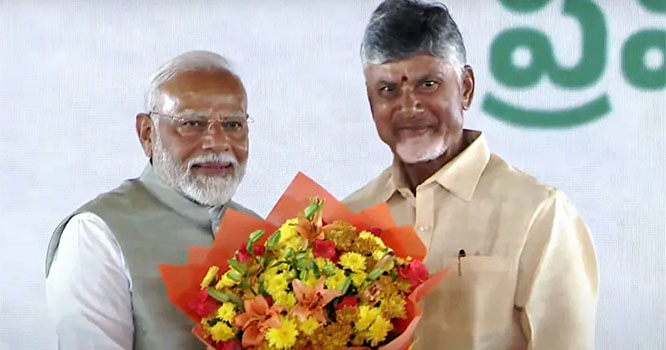
Nara Chandrababu Naidu, Telugu Desam Party supremo, was sworn in as the chief minister of Andhra Pradesh for the fourth term on Wednesday, June 12. Andhra governor S Abdul Nazeer, former Telangana governor Tamilisai Soundarajan were present at the swearing-in.

Prime Minister Narendra Modi, Union home minister Amit Shah, Union ministers JP Nadda and Bandi Sanjay Kumar, and several other leaders attended the oath-taking ceremony.

Chandrababu Naidu took oath around 11.27am near Gannavaram Airport in Kesarapalli on the outskirts of Vijayawada. Along with Chandrababu Naidu, Janasena chief Pawan Kalyan, the TDP supremo's son Nara Lokesh and 22 others also took the oath.

Pawan Kalyan reportedly has been offered the deputy chief minister's post. Janasena is being offered three cabinet berths and the Bharatiya Janata Paty one.

After taking oath as chief minister Naidu shared a hug with PM Narendra Modi on stage. This is the fourth time that Naidu is assuming charge as Andhra chief minister and the second time after the bi-furcation in 2014.

Chandrababu Naidu's son and TDP general secretary Nara Lokesh, Union minister Rammohan Naidu, actors Chiranjeevi, Rajnikanth, Nandamuri Balakrishna were also present on occasion.

Naidu had led the TDP- BJP-Janasena National Democratic Alliance to a landslide victory in the assembly as well as Parliamentary elections.

The TDP holds the majority in Andhra Pradesh's 175-member assembly with 135 MLAs, while its allies, the Janasena Party, have 21 and the BJP has eight. The opposition YSR Congress Party has 11 legislators.

The TDP MLAs who took oaths included Nara Lokesh, Kinjarapu Atchannaidu, Nimmala Ramanaidu, NMD Farooq, Anam Ramanarayana Reddy, Payyavula Kesav, Kollu Ravindra, Ponguru Narayana, Vangalapudi Anita, Anagani Satya Prasad, Kolusu Parthasaradhi, Kola Balaveeranjaneya Swamy, Gottipati Ravi, Gummadi Sandhyarani, BC Janardhan Reddy, TG Bharath, S Savitha, Vasamsetty Subhash, Kondapalli Srinivas and Mandipalli Ramprasad Reddy.

In the 175-member Andhra Pradesh assembly, the cabinet can have 26 ministers, including the chief minister.

The Telugu Desam Legislature Party and NDA partners elected Naidu as their leader in separate meetings on Tuesday, June 11.

Addressing the legislators, Naidu asserted that he is committed to developing Amaravati as the state's sole capital.

"With all your cooperation, I am swearing in tomorrow (as the CM) and I would like to thank you all for that. Prime Minister Narendra Modi is coming for the swearing-in ceremony,” Naidu said, adding he had sought cooperation from the Union government for Andhra Pradesh's development and it was "assured".

South superstars Rajinikanth, Chiranjeevi, and actor-politician Nandamuri Balakrishna also attended the event at Gannavaram Mandal, Kesarapalli IT Park.

Naidu first became the chief minister in 1995 and went on to have another two terms.

His first two terms as chief minister were at the helm of united Andhra Pradesh, beginning in 1995 and ending in 2004, while the third term came post-bifurcation of the state.

In 2014, Naidu emerged as the first chief minister of bifurcated Andhra Pradesh and served it until 2019. He lost the 2019 polls and was the opposition leader until 2024.

Following a landslide victory in the 2024 elections, he is returning as the CM for a fourth term, ousting the YSRCP.

The NDA won a landslide victory in the recently concluded simultaneous Lok Sabha and assembly elections in the state, winning 164 of the 175 assembly seats and 21 of the 25 Lok Sabha seats. 

Comments

Add new comment

  • Coastaldigest.com reserves the right to delete or block any comments.
  • Coastaldigset.com is not responsible for its readers’ comments.
  • Comments that are abusive, incendiary or irrelevant are strictly prohibited.
  • Please use a genuine email ID and provide your name to avoid reject.
News Network
January 20,2026

DGP.jpg

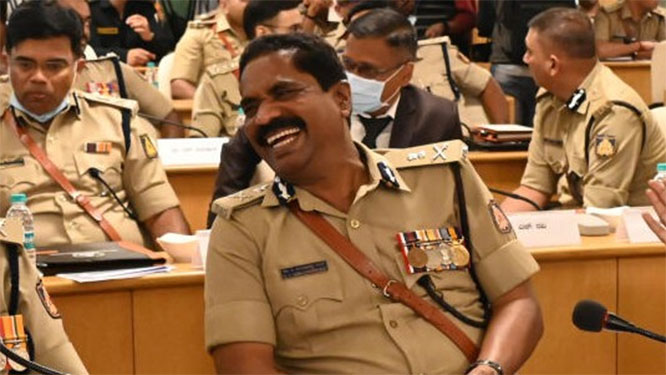
Karnataka DGP (Civil Rights Enforcement) K Ramachandra Rao was suspended with immediate effect, as per a state government order issued on Monday, 19 January. The order cited conduct unbecoming of a government servant and causing embarrassment to the state administration.

The Karnataka government suspended Rao after a purported video showed him in a compromising position with a woman inside his official chamber. The video went viral on social media. Rao rejected the videos outright, terming them "fabricated and false".

Who is K Ramachandra Rao?

Rao is a DGP-rank officer who was heading the Directorate of Civil Rights Enforcement until his suspension. He was promoted to DGP in September 2023 and assumed office in October 2023, the Sunday Guardian reported.

He also served as the Chairman and Managing Director of the Karnataka State Police Housing and Infrastructure Development Corporation Limited.

His stint as the Inspector General of Police (IGP) for the Southern Range was also marred by controversy. In 2014, during a cash seizure near Mysuru’s Yelwal, officials claimed the seized amount was ₹20 lakh, while the accused (Kerala-based merchants) claimed it was around ₹2.27 crore.

Rao, who was present during the seizure, denied all allegations. However, he was transferred soon after.

Allegations of collusion with a businessman surfaced, and a senior police officer was quoted by The Sunday Guardian as saying, “In Rao’s case, the CID has clearly mentioned that there was a great degree of lapse on the part of Rao and a deputy superintendent of police after it was brought to their notice that a few policemen, including a gunman attached to the IGP, were involved in the robbery.”

Rao had denied all wrongdoing in that incident. Despite past controversies, he rose to the state’s top police position, the Sunday Guardian reported.

Ranya Rao’s stepfather

Rao is the stepfather of Kannada actress Harshavardhini Ranya alias Ranya Rao, accused of orchestrating the illegal import of gold worth over ₹12.56 crore from Dubai to India along with two others — businessman Tarun Raju, and jewellery dealer Sahil Jain.

‘Obscene video’ controversy

A viral video showed Rao behaving inappropriately with a woman inside his office while in uniform.

The Karnataka government said in its Monday order that “vide videos and news reports widely broadcast on public news channels and media platforms, it is observed that Dr K Ramachandra Rao has acted in an obscene manner which is unbecoming of a Government Servant and also causing embarrassment to the Government.”

The order said the matter was examined by the state government, which found that the officer's conduct amounted to a violation of Rule 3 of the All India Services (Conduct) Rules, 1968.

The government said it is prima facie satisfied that "it is necessary to place Rao under suspension with immediate effect, pending inquiry".

During the suspension period, Rao will be entitled to subsistence allowance as per Rule 4 of the All India Services (Discipline and Appeal) Rules, 1969.

The order also places restrictions on his movement, stating that during the period of suspension, the officer must not leave headquarters under any circumstances without the written permission of the state government.

Comments

Add new comment

  • Coastaldigest.com reserves the right to delete or block any comments.
  • Coastaldigset.com is not responsible for its readers’ comments.
  • Comments that are abusive, incendiary or irrelevant are strictly prohibited.
  • Please use a genuine email ID and provide your name to avoid reject.
News Network
January 23,2026

Mangaluru: The Karnataka Government Polytechnic (KPT), Mangaluru, has achieved autonomous status from the All India Council for Technical Education (AICTE), becoming the first government polytechnic in the country to receive such recognition in its 78-year history. The status was granted by AICTE, New Delhi, and subsequently approved by the Karnataka Board of Technical Education in October last year.

Officials said the autonomy was conferred a few months ago. Until recently, AICTE extended autonomous status only to engineering colleges, excluding diploma institutions. However, with a renewed national focus on skill development, several government polytechnics across India have now been granted autonomy.

KPT, the second-largest polytechnic in Karnataka, was established in 1946 with four branches and has since expanded to offer eight diploma programmes, including computer science and polymer technology. The institution is spread across a 19-acre campus.

Ravindra M Keni, the first dean of the institution, told The Times of India that AICTE had proposed autonomous status for polytechnic institutions that are over 25 years old. “Many colleges applied. In the first round, 100 institutions were shortlisted, which was further narrowed down to 15 in the second round. We have already completed one semester after becoming an autonomous institution,” he said. He added that nearly 500 students are admitted annually across eight three-year diploma courses.

Explaining the factors that helped KPT secure autonomy, Keni said the institution has consistently recorded 100 per cent admissions and placements for its graduates. He also noted its strong performance in sports, with the college emerging champions for 12 consecutive years, along with active student participation in NCC and NSS activities.

Autonomous status allows KPT to design industry-oriented curricula, conduct examinations, prepare question papers, and manage academic documentation independently. The institution can also directly collaborate with industries and receive priority funding from AICTE or the Ministry of Education. While academic autonomy has been granted, financial control will continue to rest with the state government.

“There will be separate committees for examinations, question paper setting, boards of studies, and boards of examiners. The institution will now have the freedom to conduct admissions without government notifications and issue its own marks cards,” Keni said, adding that new academic initiatives would be planned after a year of functioning under the autonomous framework.

Comments

Add new comment

  • Coastaldigest.com reserves the right to delete or block any comments.
  • Coastaldigset.com is not responsible for its readers’ comments.
  • Comments that are abusive, incendiary or irrelevant are strictly prohibited.
  • Please use a genuine email ID and provide your name to avoid reject.
News Network
February 1,2026

Bengaluru: The Karnataka High Court has refused to quash an investigation against a WhatsApp group administrator accused of allowing the circulation of obscene and offensive images depicting Hindutva politicians and idols in 2021.

Justice M Nagaprasanna observed that, prima facie, the ingredients of the offence under Section 295A of the Indian Penal Code were made out. “The offence under Section 295A of the IPC is met to every word of its ingredient, albeit prima facie,” the judge said.

The petitioner, Sirajuddin, a resident of Belthangady taluk in Dakshina Kannada district, had challenged the FIR registered against him at the CEN (Cyber, Economics and Narcotics) police station, Mangaluru, for offences under Section 295A of the IPC and Section 67 of the Information Technology Act. Section 295A relates to punishment for deliberate and malicious acts intended to outrage the religious feelings of any class of citizens.

According to the complaint filed by K Jayaraj Salian, also a resident of Belthangady taluk, he received a WhatsApp group link from an unknown source and was added to the group after accessing it. The group reportedly had six administrators and around 250 participants, where obscene and offensive images depicting Hindu deities and certain political figures were allegedly circulated repeatedly.

Sirajuddin was arrested in connection with the case and later released on bail on February 16, 2021. He argued before the court that he was being selectively targeted, while other administrators—including the creator of the group—were neither arrested nor investigated. He also contended that the Magistrate could not have taken cognisance of the offence under Section 295A without prior sanction under Section 196(1) of the CrPC.

Rejecting the argument, Justice Nagaprasanna held that prior sanction is required only at the stage of taking cognisance, and not at the stage of registration of the crime or during investigation.

The judge noted that the State had produced the entire investigation material before the court. “A perusal of the material reveals depictions of Hindu deities in an extraordinarily obscene, demeaning and profane manner. The content is such that its reproduction in a judicial order would itself be inappropriate,” the court said, adding that the material, on its face, had the tendency to outrage religious feelings and disturb communal harmony.

Observing that the case was still at the investigation stage, the court said it could not interdict the probe at this juncture. However, it expressed concern that the investigating officer appeared to have not proceeded uniformly against all administrators. The court clarified that if the investigation revealed the active involvement of any member in permitting the circulation of such content, they must also be proceeded against.

“At this investigative stage, any further observation by this Court would be unnecessary,” the order concluded.

Comments

Add new comment

  • Coastaldigest.com reserves the right to delete or block any comments.
  • Coastaldigset.com is not responsible for its readers’ comments.
  • Comments that are abusive, incendiary or irrelevant are strictly prohibited.
  • Please use a genuine email ID and provide your name to avoid reject.