



India's economic growth held back due to demonetisation, GST: Raghuram Rajan

Agencies
November 10, 2018

Washington, Nov 10: Demonetisation and the Goods and Services Tax (GST) are the two major headwinds that held back India's economic growth last year, former RBI Governor Raghuram Rajan has said, asserting that the current seven per cent growth rate is not enough to meet the country's needs.

Addressing an audience at the University of California in Berkley on Friday, Rajan said for four years -- 2012 to 2016 -- India was growing at a faster pace before it was hit by two major headwinds. 

"The two successive shocks of demonetisation and the GST had a serious impact on growth in India. Growth has fallen off interestingly at a time when growth in the global economy has been peaking up," he said delivering the second Bhattacharya Lectureship on the Future of India.

On the second anniversary of demonetisation on November 8, Finance Minister Arun Jaitley staunchly defended the demonetisation drive, saying 'prophets of doom' have been proven wrong as hard data of two years shows an increase in tax base, greater formalisation of the economy and India retaining the fastest growing economy tag for the fifth year in a row.

"By the time the first five years of this government are over, we will be close to doubling the assessee base," he said in a Facebook blog 'Impact of Demonetisation'.

Jaitley said India clocking the fastest growth rate has proved "prophets of doom", who had predicted that demonetisation will shave off 2 per cent of growth rate, conclusively wrong.

Rajan, in his address, said a growth rate of seven per cent per year for 25 years is "very very strong" growth, but in some sense this has become the new Hindu rate of growth, which earlier used to be three-and-a-half per cent, Rajan said.

"The reality is that seven is not enough for the kind of people coming into the labour market and we need jobs for them, So, we need more and cannot be satisfied at this level," he said. 

Observing that India is sensitive to global growth, he said India has become a much more open economy, and if the world grows, it also grows more. 

"What happened in 2017 is that even as the world picked up, India went down. That reflects the fact that these blows (demonetisation and GST) have really really been hard blows...Because of these headwinds we have been held back, he said. 

While India's growth is picking up again, there is the issue of oil prices, the economist noted referring to the huge reliance of India on import of oil for its energy needs.

With the oil prices going up, Rajan said things are going to be little tougher for the Indian economy, even though the country is recovering from the headwinds of demonetisation and initial hurdles in the implementation of the GST.

Commenting on the rising Non-Performing Assets (NPA), he said the best thing to do in such a situation is to "clean up". 

It is essential to "deal up with the bad stuff", so that with clean balance sheets, banks can be put back on the track. "It has taken India far long to clean up the banks, partly because the system did not had instruments to deal with bad debts," Rajan said.

The bankruptcy code, he asserted, cannot be the only way to clean up the banks. It is the only one element of the larger cleanup plan, he said and called for a multi-prong approach to address the challenge of NPAs in India.

India, he asserted, is capable of a strong growth. As such the seven per cent growth is now being taken granted. 

"If we go below seven per cent, then we must be doing something wrong," he said adding that that is the base on which India has to grow at least for next 10-15 years. 

India, he said, needs to create one million jobs a month for the people joining the labour force.

The country today is facing three major bottlenecks. One is the torn infrastructure, he said, observing that construction is the one industry that drives the economy in early stages. Infrastructure creates growth, he said. 

Second, short term target should be to clean up the power sector and to make sure that the electricity produced actually goes to the people who want the power, he said. 

Cleaning up the banks is the third major bottleneck in India's growth, he said.

Part of the problem in India is that there is an excessive centralisation of power in the political decision making, he said. 

"India can't work from the centre. India works when you have many people taking up the burden. And today the central government is excessively centralised," Rajan said. 

An example of this is the quantum of decisions that requires the ascent of the Prime Minister's Office, Rajan said as he highlighted the recent unveiling of the 'Statue of Unity' of Sardar Vallabhbhai Patel as an example of a massive project that required the approval of the PMO. 

On the 143rd birth anniversary of Sardar Vallabhbhai Patel on October 31, Prime Minister Narendra Modi unveiled the 'Statue of Unity' in Gujarat's Narmada district.

Touted to be the tallest statue in the world, the 182-metre tall statue was built at a cost of Rs 2,989 crore. The concrete and brass-clad statue is the quickest to be completed in 33 months.

Comments

Add new comment

  • Coastaldigest.com reserves the right to delete or block any comments.
  • Coastaldigset.com is not responsible for its readers’ comments.
  • Comments that are abusive, incendiary or irrelevant are strictly prohibited.
  • Please use a genuine email ID and provide your name to avoid reject.
News Network
December 7,2025

envoy.jpg

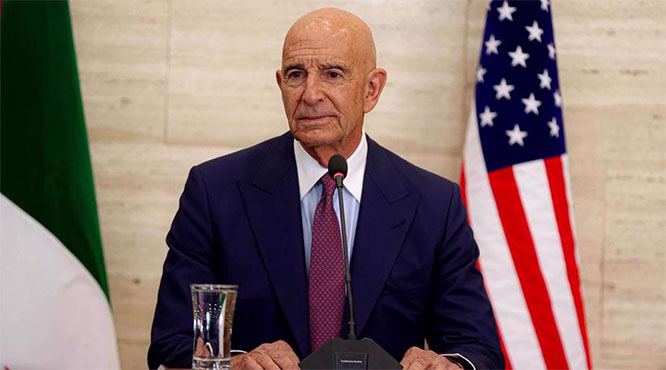
Since 1946, the United States has attempted 93 coups or “regime change” operations across the world — including two in Iran, US Special Envoy for Syria Tom Barrack has admitted.

Speaking to the UAE-based IMI Media Group, in remarks published by The National, Barrack said Washington tried twice to overthrow the Iranian government but failed both times. 

“For (Trump) then to be imputed with regime change — we had two regime changes in Iran already. Neither one worked. So I think wisely leave it to the region to solve,” said Barrack, who also serves as the US ambassador to Turkey.

His comments come six months after the US joined Israel in airstrikes against Iran during ongoing indirect nuclear negotiations between Tehran and Washington.

On June 13, Israel launched an attack on Iran that killed at least 1,064 people and hit civilian infrastructure. Days later, the United States targeted three nuclear facilities — Fordow, Natanz and Isfahan — in what Iran called a clear violation of international law. Iranian retaliation eventually forced a halt to the assault on June 24.

Barrack further claimed that US President Donald Trump and Foreign Secretary Marco Rubio are “not into regime change” and prefer a regional approach driven by Middle Eastern countries themselves. According to him, regional dialogue and non-interference by outside powers offer a more durable path forward.

He added that Washington is still open to an agreement with Tehran if Iranian authorities show “seriousness” and willingness to engage constructively.

However, Iran maintains the US has not shown readiness for meaningful talks. In an interview with Japan’s Kyodo News, Iranian Foreign Minister Abbas Araghchi said negotiations could advance only if Washington acknowledges Iran’s right to peaceful nuclear energy and lifts unilateral sanctions.

Comments

Add new comment

  • Coastaldigest.com reserves the right to delete or block any comments.
  • Coastaldigset.com is not responsible for its readers’ comments.
  • Comments that are abusive, incendiary or irrelevant are strictly prohibited.
  • Please use a genuine email ID and provide your name to avoid reject.
News Network
December 13,2025

New Delhi: School-going children are picking up drug and smoking habits and engaging in consumption of alcohol, with the average age of introduction to such harmful substances found to be around 13 years, suggesting a need for earlier interventions as early as primary school, a multi-city survey by AIIMS-Delhi said.

The findings also showed substance use increased in higher grades, with grade XI/XII students two times more likely to report use of substances when compared with grade VIII students. This emphasised the importance of continued prevention and intervention through middle and high school.

The study led by Dr Anju Dhawan of AIIMS's National Drug Dependence Treatment Centre, published in the National Medical Journal of India this month, looks at adolescent substance use across diverse regions.

The survey included 5,920 students from classes 8, 9, 11 and 12 in urban government, private and rural schools across 10 cities -- Bengaluru, Chandigarh, Delhi, Dibrugarh, Hyderabad, Imphal, Jammu, Lucknow, Mumbai, and Ranchi. The data were collected between May 2018 and June 2019.

The average age of initiation for any substance was 12.9 (2.8) years. It was lowest for inhalants (11.3 years) followed by heroin (12.3 years) and opioid pharmaceuticals (without prescription; 12.5 years).

Overall, 15.1 per cent of participants reported lifetime use, 10.3 per cent reported past year use, and 7.2 per cent reported use in the past month of any substance, the study found.

The most common substances used in the past year, after tobacco (4 per cent) and alcohol (3.8 per cent), were opioids (2.8 per cent), followed by cannabis (2 per cent) and inhalants (1.9 per cent). Use of non-prescribed pharmaceutical opioids was most common among opioid users (90.2 per cent).

On being asked, 'Do you think this substance is easily available for a person of your age' separately for each substance category, nearly half the students (46.3 per cent) endorsed that tobacco products and more than one-third of the students (36.5 per cent) agreed that a person of their age can easily procure alcohol products.

Similarly, for Bhang (21.9 per cent), ganja/charas (16.1 per cent), inhalants (15.2 per cent), sedatives (13.7 per cent), opium and heroin (10 per cent each), the students endorsed that these can be easily procured.

About 95 per cent of the children, irrespective of their grade, agreed with the statement that 'drug use is harmful'.

The rates of substance use (any) among boys were significantly higher than those of girls for substance use (ever), use in the past year and use in the past 30 days. Compared to grade VIII students, grade IX students were more likely, and grade XI/XII students were twice as likely to have used any substance (ever).

The likelihood of past-year use of any substance was also higher for grade IX students and for grade XI/XII students as compared to grade VIII students.

About 40 per cent of students mentioned that they had a family member who used tobacco or alcohol each. The use of cannabis (any product) and opioid (any product) by a family member was reported by 8.2 per cent and 3.9 per cent of students, respectively, while the use of other substances, such as inhalants/sedatives by family was 2-3 per cent, the study found.

A relatively smaller percentage of students reported use of tobacco or alcohol among peers as compared to among family members, while a higher percentage reported inhalants, sedatives, cannabis or opioid use among peers.

Children using substances (past year) compared to non-users reported significantly higher any substance use by their family members and peers.

There were 25.7 per cent students who replied 'yes' to the question 'conflicts/fights often occur in your family'. Most students also replied affirmatively to 'family members are aware of how their time is being spent' and 'damily members are aware of with whom they spend their time'.

Comments

Add new comment

  • Coastaldigest.com reserves the right to delete or block any comments.
  • Coastaldigset.com is not responsible for its readers’ comments.
  • Comments that are abusive, incendiary or irrelevant are strictly prohibited.
  • Please use a genuine email ID and provide your name to avoid reject.
News Network
December 16,2025

Mangaluru, Dec 16: The Mangaluru City police have significantly escalated their campaign against drug trafficking, arresting 25 individuals and booking 12 cases under the Narcotic Drugs and Psychotropic Substances (NDPS) Act between November 30 and December 13. The crackdown resulted in the seizure of a substantial quantity of illicit substances, including 685.6 grams of MDMA and 1.5 kg of ganja.

The success of this recent drive has been significantly boosted by the city’s innovative, QR code-based anonymous reporting system.

"The anonymous reporting system has received an encouraging response. Several recent arrests were made based on inputs received through this system, helping police tighten the noose around drug peddlers," said the City Police Commissioner.

The latest arrests contribute to a robust year-to-date record, underscoring the police's relentless commitment to combating the drug menace.

Up to December 14 this year, the police have registered a total of 107 cases of drug peddling, leading to the arrest of 219 peddlers. Furthermore, they have booked 562 cases of drug consumption, resulting in the arrest of 671 individuals.

The scale of the seizure for the year reflects the magnitude of the problem being tackled: police have seized 320.6 kg of ganja worth ₹88.7 lakh and 1.4 kg of MDMA valued at ₹1.2 crore. Other significant seizures include hydro-weed ganja worth ₹94.7 lakh and cocaine worth ₹1.9 lakh, among others.

The Commissioner emphasized a policy of rigorous enforcement: "We ensure that peddlers are caught red-handed so that they cannot later dispute the case or claim innocence."

To counter the rising trend of substance abuse among youth, the Mangaluru City police have rolled out uniform guidelines for random drug testing across educational institutions.

As part of the drive, tests were conducted in approximately 100 institutions, screening an estimated 5,500 to 6,000 students in the first phase. 20 students tested positive for drug consumption during the initial screening.

Students who tested positive have been provided counselling and are scheduled for re-testing in the second quarter. The testing will also be expanded to students not covered in the first phase. In a move to ensure strict implementation, police personnel were deployed in mufti in some institutions. Reiterating a zero-tolerance stance, the Commissioner confirmed that random testing will continue, and colleges have also been instructed to conduct drug tests at the time of admission to deter substance abuse from an early stage.

Comments

Add new comment

  • Coastaldigest.com reserves the right to delete or block any comments.
  • Coastaldigset.com is not responsible for its readers’ comments.
  • Comments that are abusive, incendiary or irrelevant are strictly prohibited.
  • Please use a genuine email ID and provide your name to avoid reject.