



Indo-Pak FS meet: terror, Kashmir dominate talks

April 26, 2016

New Delhi, Apr 26: In their first formal bilateral meeting after Pathankot attack, Foreign Secretaries of India and Pakistan today held talks focusing on a range of sticky issues including probe into the strike and Kashmir, which Pakistani side asserted was the "core issue".
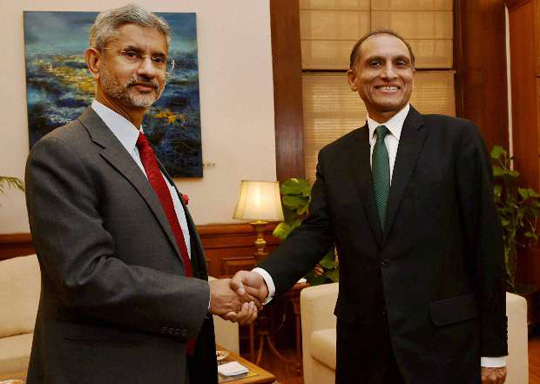
fs

Foreign Secretary S Jaishankar and his Pakistani counterpart Aizaz Ahmed Chaudhry, here to attend the Heart of Asia conference, met after which the Pakistani side said its Foreign Secretary "emphasised that Kashmir remains the core issue that requires a just solution in accordance with UNSC resolutions and wishes of Kashmiri people."

There was no immediate formal word from the Indian side on the meeting.

Ahead of the meeting, the Indian officials had maintained that Pathankot attack and a possible visit by the NIA to Pakistan will be raised during the FS-level talks, which were deferred in January in the wake of the strike at the strategic air base at Pathankot.

"In line with our PM's vision of peaceful neighborhood, FS underscored Pakistan's commitment to have friendly relations with all its neighbors/India. All outstanding issues including the Jammu and Kashmir dispute were discussed," the Pakistan High Commission here said.

India has been pressing for action against terrorists responsible for the audacious attack on the IAF base, to take the talks forward.

This is also the first time the two foreign secretaries are meeting after the announcement of Comprehensive Bilateral Dialogue(CBD) by the Foreign Ministers in Islamabad last December. The two secretaries had a informal brief interaction during a SAARC meeting in Nepal in March this year.

The efforts to resume CBD at the Foreign Secretary-level hit a deadlock after the Pathankot attack that India said was carried out by militants from Pakistan-based Jaish-e-Mohammad (JeM)terror group.

Jaishankar was scheduled to travel to Islamabad to hold talks with Chaudhary on January 15 but both the countries had announced deferment of the talks with "mutual consent" in the wake of the Pathankot attack.

Todays's meeting came in the backdrop of Pakistan High Commissioner Abdul Basit's recent comments that the bilateral peace process was suspended, evoking a sharp reaction by Indian side.

India has been maintaining that communication channels were on at various levels but also made it clear it wants to see action on terror and Pathankot first before the dialogue could be resumed.

Earlier, Jaishankar met Afghan Deputy Foreign Minister Hekmat Karzai and discussed issues of mutual interests.

After the talks which lasted for nearly 90-minutes, the Pakistan High Commission said in a statement that Chaudhry also took up the matter of capture of RAW officer, Kulbushan Jadev and expressed serious concern over RAW's alleged involvement in subversive activities in Balochistan and Karachi.

"He said such acts undermine efforts to normalise relations between the two countries. He also conveyed concern over efforts by Indian authorities for the release of the prime suspects of the Samjhauta Express blasts," it added.

He expressed confidence that building on the goodwill generated by the recent high level contacts, the two countries should remain committed to a sustained, meaningful and comprehensive dialogue process.

In this spirit, the Foreign Secretary underscored the need for early commencement of comprehensive dialogue for which the Indian Foreign Secretary's visit to Pakistan is due.

Comments

Add new comment

  • Coastaldigest.com reserves the right to delete or block any comments.
  • Coastaldigset.com is not responsible for its readers’ comments.
  • Comments that are abusive, incendiary or irrelevant are strictly prohibited.
  • Please use a genuine email ID and provide your name to avoid reject.
News Network
December 13,2025

New Delhi: School-going children are picking up drug and smoking habits and engaging in consumption of alcohol, with the average age of introduction to such harmful substances found to be around 13 years, suggesting a need for earlier interventions as early as primary school, a multi-city survey by AIIMS-Delhi said.

The findings also showed substance use increased in higher grades, with grade XI/XII students two times more likely to report use of substances when compared with grade VIII students. This emphasised the importance of continued prevention and intervention through middle and high school.

The study led by Dr Anju Dhawan of AIIMS's National Drug Dependence Treatment Centre, published in the National Medical Journal of India this month, looks at adolescent substance use across diverse regions.

The survey included 5,920 students from classes 8, 9, 11 and 12 in urban government, private and rural schools across 10 cities -- Bengaluru, Chandigarh, Delhi, Dibrugarh, Hyderabad, Imphal, Jammu, Lucknow, Mumbai, and Ranchi. The data were collected between May 2018 and June 2019.

The average age of initiation for any substance was 12.9 (2.8) years. It was lowest for inhalants (11.3 years) followed by heroin (12.3 years) and opioid pharmaceuticals (without prescription; 12.5 years).

Overall, 15.1 per cent of participants reported lifetime use, 10.3 per cent reported past year use, and 7.2 per cent reported use in the past month of any substance, the study found.

The most common substances used in the past year, after tobacco (4 per cent) and alcohol (3.8 per cent), were opioids (2.8 per cent), followed by cannabis (2 per cent) and inhalants (1.9 per cent). Use of non-prescribed pharmaceutical opioids was most common among opioid users (90.2 per cent).

On being asked, 'Do you think this substance is easily available for a person of your age' separately for each substance category, nearly half the students (46.3 per cent) endorsed that tobacco products and more than one-third of the students (36.5 per cent) agreed that a person of their age can easily procure alcohol products.

Similarly, for Bhang (21.9 per cent), ganja/charas (16.1 per cent), inhalants (15.2 per cent), sedatives (13.7 per cent), opium and heroin (10 per cent each), the students endorsed that these can be easily procured.

About 95 per cent of the children, irrespective of their grade, agreed with the statement that 'drug use is harmful'.

The rates of substance use (any) among boys were significantly higher than those of girls for substance use (ever), use in the past year and use in the past 30 days. Compared to grade VIII students, grade IX students were more likely, and grade XI/XII students were twice as likely to have used any substance (ever).

The likelihood of past-year use of any substance was also higher for grade IX students and for grade XI/XII students as compared to grade VIII students.

About 40 per cent of students mentioned that they had a family member who used tobacco or alcohol each. The use of cannabis (any product) and opioid (any product) by a family member was reported by 8.2 per cent and 3.9 per cent of students, respectively, while the use of other substances, such as inhalants/sedatives by family was 2-3 per cent, the study found.

A relatively smaller percentage of students reported use of tobacco or alcohol among peers as compared to among family members, while a higher percentage reported inhalants, sedatives, cannabis or opioid use among peers.

Children using substances (past year) compared to non-users reported significantly higher any substance use by their family members and peers.

There were 25.7 per cent students who replied 'yes' to the question 'conflicts/fights often occur in your family'. Most students also replied affirmatively to 'family members are aware of how their time is being spent' and 'damily members are aware of with whom they spend their time'.

Comments

Add new comment

  • Coastaldigest.com reserves the right to delete or block any comments.
  • Coastaldigset.com is not responsible for its readers’ comments.
  • Comments that are abusive, incendiary or irrelevant are strictly prohibited.
  • Please use a genuine email ID and provide your name to avoid reject.