



Info from Pakistan helped NIA identify Pathankot attackers

April 8, 2016

New Delhi, Apr 8: Information received from anonymous individuals in Pakistan, after photos of the slain Pathankot terrorists were put up on the National Investigation Agency (NIA) website, was crucial in identifying four Pakistan terrorists who stormed the airbase, a senior government official said.
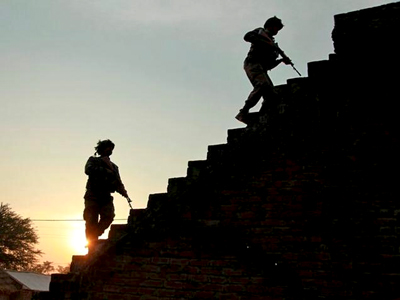
Pathankot copy
The NIA had published the photographs of the deceased terrorists on its website last month, inviting information from public. Officials said they received a number of anonymous messages from foreign countries, including Pakistan, which helped them get additional information about the identity of the four terrorists killed at the Pathankot airbase on January 2.

“Based on phone intercepts and technical intelligence, we had some information about the identity of the four men. After we published their photographs on our website, we got information which helped us collect more personal details of these men. When we presented the details before the Joint Investigation Team [JIT], they were also convinced,” said a senior government official.

The NIA has identified the terrorists as Hafiz Abu Bakar, resident of Gujranwala (Punjab), Umar Farooq of Sanghar (Sindh), Nasir Hussain, resident of Vehari (Punjab), and Abdul Qayum of Sukkur (Sindh) in Pakistan.

The NIA had handed over the DNA samples of the four to the JIT and had asked them to track the family members and match it with them.

The official also said Pakistan had agreed ahead of the JIT’s visit to India that it would not get access to any of the defence personnel involved in the operation at the Pathankot airbase attack.

“The Terms of Reference of the visit sent to Pakistan ahead of the JIT’s visit clearly mentioned that they would not get access to any defence personnel involved in Pathankot operation,” the official said.

According to the Terms of Reference for the recent visit of the JIT, it was to interview key witnesses and victims of Pathankot terror attack but there was no mention of access to military or any other security personnel.

Pakistan had on Wednesday said India did not produce witnesses belonging to the security forces before the JIT.

“The JIT visited the crime scene and also recorded the statements of some witnesses. However, the witnesses belonging to the Indian security forces were not produced before it,” said the Pakistan Foreign Office, in its first statement on the team’s return from India.

The Terms of Reference say the JIT would collect, review and document physical evidence regarding the Pathankot incident, collect pieces of forensic evidence for possible matching with specimens of relevant individuals in Pakistan. The team would collect, collate, analyse and document electronic/ digital evidence, visit crime scene and other relevant places related to Pathankot investigation, it says.


Comments

Add new comment

  • Coastaldigest.com reserves the right to delete or block any comments.
  • Coastaldigset.com is not responsible for its readers’ comments.
  • Comments that are abusive, incendiary or irrelevant are strictly prohibited.
  • Please use a genuine email ID and provide your name to avoid reject.
News Network
December 16,2025

jordan.jpg

Prime Minister Narendra Modi on Monday held talks with Jordan’s King Abdullah II in Amman, during which the two leaders discussed ways to further strengthen bilateral relations, with the Prime Minister outlining an eight-point vision covering key areas of cooperation.

Describing the meeting as “productive”, PM Modi said he shared a roadmap focused on trade and economy, fertilisers and agriculture, information technology, healthcare, infrastructure, critical and strategic minerals, civil nuclear cooperation, and people-to-people ties.

In a post on social media platform X, the Prime Minister praised King Abdullah II’s personal commitment to advancing India–Jordan relations, particularly as both countries mark the 75th anniversary of the establishment of diplomatic ties this year.

“Held productive discussions with His Majesty King Abdullah II in Amman. His personal commitment towards vibrant India-Jordan relations is noteworthy. This year, we are celebrating the 75th anniversary of our bilateral diplomatic relations,” PM Modi said.

The meeting took place at the Al Husseiniya Palace, where the two leaders also exchanged views on regional and global issues of mutual interest. According to the Ministry of External Affairs (MEA), both sides agreed to further deepen cooperation in areas including trade and investment, defence and security, counter-terrorism and de-radicalisation, fertilisers and agriculture, infrastructure, renewable energy, tourism, and heritage.

The MEA said both leaders reaffirmed their united stand against terrorism.

PM Modi arrived in Amman earlier on Monday and was received by Jordanian Prime Minister Jafar Hassan, who accorded him a formal welcome. Following the talks, King Abdullah II hosted a banquet dinner in honour of the Prime Minister, reflecting the warmth of bilateral ties.

Jordan is the first leg of PM Modi’s three-nation tour. From Amman, the Prime Minister will travel to Ethiopia at the invitation of Prime Minister Abiy Ahmed Ali, marking his first official visit to the African nation. The tour will conclude with a visit to Oman.

Comments

Add new comment

  • Coastaldigest.com reserves the right to delete or block any comments.
  • Coastaldigset.com is not responsible for its readers’ comments.
  • Comments that are abusive, incendiary or irrelevant are strictly prohibited.
  • Please use a genuine email ID and provide your name to avoid reject.