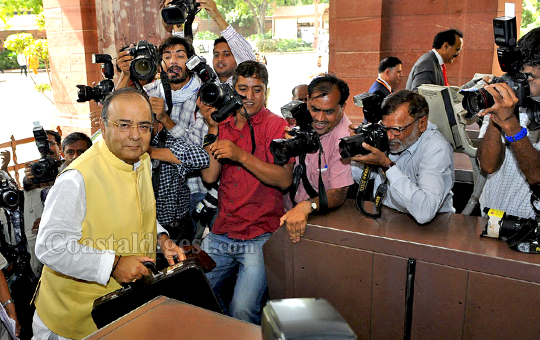
IT rates unchanged; sops to small, marginal assessees in Bud

July 10, 2014

Modi Budget

New Delhi, Jul 10: The Budget for 2014-15 today left income tax rates unchanged but provided sops to small and marginal assessees by raising the threshold exemption limit from Rs 2 lakh to Rs 2.5 lakh and investments under 80C by Rs 50,000 to Rs 1.5 lakh while promising not to bring tax changes with retrospective effect.

Presenting the maiden budget of the BJP-led NDA government, Finance Minister Arun Jaitley raised the deduction limit on interest on housing loan for self-occupied property from Rs 1.5 lakh to Rs 2 lakh and free-baggage allowance for inbound passengers from Rs 35,000 to Rs 45,000.

The Budget makes cigarettes, tobacco, pan-masala, gutka and cold-drinks costlier by raising excise duties while CRT TVs used by poor, LCD and LED TV panels of less than 19-inches will be cheaper through cuts in customs duties.

In encouraging signals to domestic and foreign investors, Jaitley announced that all fresh cases arising out of retrospective amendments of 2012 in respect of indirect transfers will be scrutinised by a high level committee to be constituted by the CBDT before any action is initiated.

"I hope the investor community both within India and abroad will repose confidence on our stated position and participate in the Indian growth story with renewed vigour," he said, offering a stable and predictable tax regime.

He also said the government will revive the revised Direct Taxes Code (DTC) taking into account the comments of stakeholders.

The Finance Minister said government will promote FDI by raising the cap to 49 per cent in Defence and Insurance with full Indian management and control.

The direct tax proposals involve a sacrifice of Rs 22,200 crore while indirect tax proposal will yield a revenue of Rs 7,725 crore The Budget raises defence spending by 12.5 per cent to Rs 2.29 lakh crore. Non-plan expenditure for the current year has been estimated at Rs 12,19,892 crore with additional amount for fertiliser subsidy and capital expenditure for armed forces.

The total expenditure estimates stand at Rs 17,94,892 crore. Gross tax receipts will be Rs 13,64,524 crore, of which Centre's share will Rs 9,77,258 crore. Non-tax revenues for current financial year will be Rs 2,12,505 crore and capital receipts other than borrowings will be Rs 73,952 crore.

The Budget pegs the fiscal deficit for the current fiscal at 4.1 per cent of the GDP and 3.6 and 3 per cent in 2015-16 and 2016-17 respectively.

In an apparent reference to the previous government, Jaitley said slow decision making had resulted in a loss of opportunity and two years of sub-5 per cent growth in the economy has resulted in challenging situation.

He said government intends to usher in a policy regime that would bring the desired growth, lower inflation, sustained level of external sector balance and prudent policy stance.

The Finance Minister said the present situation presents a challenge of slow growth in manufacturing sector, in infrastructure and also the need to introduce fiscal prudence.

The tax to GDP ratio must be improved and non-tax revenue increased, he said while pruning the negative list for levy of service tax.

The government will constitute an Expenditure Management Commission to look into every aspect of expenditure reform. It will overhaul the subsidy regime while providing full protection to the marginalised.

Jaitely said the government would like to introduce the Goods and Services Tax (GST) to streamline tax administration, avoid harassment of business and ensure higher revenue collection.

The Budget proposes to infuse Rs 2.40 lakh crore in PSU banks in which citizens will be allowed direct shareholding.

The Budget sets a target of Rs 8 lakh crore for agriculture credit during the current year and will continue the interest subvention scheme and raise the corpus of rural infrastructure development fund (RIDF) to Rs 25,000 crore.

Towards food security, the government commits itself to restructuring Food Corp of India (FCI), reducing transportation and distribution losses and efficacy of PDS.

Wheat and rice will be provided at reasonable prices to weaker sections.

In direct taxes, the Budget makes no changes in the rate of surcharge for any class of tax payer while continuing the education cess at 3 per cent for all.

As a measure of encouraging infrastructure and construction sectors to revive growth and provide jobs, the Budget provides tax incentives for real estate investment trust and infrastructure investment trust.

In manufacturing, considering the need to incentivise smaller entrepreneurs, it provides investment allowance at the rate of 15 per cent to a manufacturing company that invests more than Rs 25 crore in a year in plant and machinery for three years.

Jaitely also proposed to extend the investment linked deduction to new sectors namely slurry pipelines for transportation of iron ore.

The concessional tax rate of 15 per cent on dividends received by Indian companies from foreign subsidiaries is being continued because it has resulted in enhanced repatriation of funds. There is no sunset date to ensure stability of policy.

To enhance the functioning of income tax department as facilitators, 60 more Ayaykar Seva Kendras will be opened to promote excellence in service delivery.

Taking note of the fact that power supply continues to a major area of concern in the country, the Budget proposes to extend the 10-year tax holiday to undertakings which begin generation, transmission and distribution by March 31, 2017, instead of annual extensions.

As part of financial inclusion mission, a special small savings instrument to cater to the requirement of education and marriage of the girl child will be introduced.

A National Savings Certificate with insurance cover will also be launched to provide additional benefits for small savers. In the PPF scheme, annual ceiling will be enhanced to Rs 1.5 lakh per annum from Rs 1 lakh at present.

In defence allocation, Rs 1000 crore has been set apart for implementing one-rank-one-pension policy. Capital outlay for defence has been raised by Rs 5,000 crore over the amount provided in the interim budget.

The Finance Minister also announced setting up a war memorial, war museum and a national police memorial. For modernisation of state police forces, Rs 3,000 crore has been allocated.

An integrated Ganga conservation mission, called 'Namami Gange' is proposed to be set up with an outlay of Rs 2,037 crore for this year.

An NRI fund for Ganga will be set up which will finance special projects. Rs 100 crore have been set aside for ghat development and beautification of river front at Kedarnath, Varnasi, Haridwar, Kanpur, Allahabad, Patna and Delhi.

A 1,620-km Ganga inland waterway development from Haridwar to Haldia is planned to be completed in 6 years at a cost of Rs 4,200 crore, Jaitley said.


Comments

Add new comment

  • Coastaldigest.com reserves the right to delete or block any comments.
  • Coastaldigset.com is not responsible for its readers’ comments.
  • Comments that are abusive, incendiary or irrelevant are strictly prohibited.
  • Please use a genuine email ID and provide your name to avoid reject.
News Network
December 6,2025

pilot.jpg

New Delhi: IndiGo, India’s largest airline, faced major operational turbulence this week after failing to prepare for new pilot-fatigue regulations issued by the Directorate General of Civil Aviation (DGCA). The stricter rules—designed to improve flight safety—took effect in phases through 2024, with the latest implementation on November 1. IndiGo has acknowledged that inadequate roster planning led to widespread cancellations and delays.

Below are the key DGCA rules that affected IndiGo’s operations:

1. Longer Mandatory Weekly Rest

Weekly rest for pilots has been increased from 36 hours to 48 hours.

The government says the extended break is essential to curb cumulative fatigue. This rule remains in force despite the current crisis.

2. Cap on Night Landings

Pilots can now perform only two night landings per week—a steep reduction from the earlier limit of six.

Night hours, defined as midnight to early morning, are considered the least alert period for pilots.

Given the disruptions, this rule has been temporarily relaxed for IndiGo until February 10.

3. Reduced Maximum Night Flight Duty

Flight duty that stretches into the night is now capped at 10 hours.

This measure has also been kept on hold for IndiGo until February 10 to stabilize operations.

4. Weekly Rest Cannot Be Replaced With Personal Leave

Airlines can no longer count a pilot’s personal leave as part of the mandatory 48-hour rest.

Pilots say this closes a loophole that previously reduced actual rest time.

Currently, all airlines are exempt from this rule to normalise travel.

5. Mandatory Fatigue Monitoring

Airlines must submit quarterly fatigue reports along with corrective actions to DGCA.

This system aims to create a transparent fatigue-tracking framework across the industry.

The DGCA has stressed that these rules were crafted to strengthen flight safety and align India with global fatigue-management standards. The temporary relaxations are expected to remain until February 2025, giving IndiGo time to stabilise its schedules and restore normal air travel.

Comments

Add new comment

  • Coastaldigest.com reserves the right to delete or block any comments.
  • Coastaldigset.com is not responsible for its readers’ comments.
  • Comments that are abusive, incendiary or irrelevant are strictly prohibited.
  • Please use a genuine email ID and provide your name to avoid reject.
News Network
December 13,2025

New Delhi: School-going children are picking up drug and smoking habits and engaging in consumption of alcohol, with the average age of introduction to such harmful substances found to be around 13 years, suggesting a need for earlier interventions as early as primary school, a multi-city survey by AIIMS-Delhi said.

The findings also showed substance use increased in higher grades, with grade XI/XII students two times more likely to report use of substances when compared with grade VIII students. This emphasised the importance of continued prevention and intervention through middle and high school.

The study led by Dr Anju Dhawan of AIIMS's National Drug Dependence Treatment Centre, published in the National Medical Journal of India this month, looks at adolescent substance use across diverse regions.

The survey included 5,920 students from classes 8, 9, 11 and 12 in urban government, private and rural schools across 10 cities -- Bengaluru, Chandigarh, Delhi, Dibrugarh, Hyderabad, Imphal, Jammu, Lucknow, Mumbai, and Ranchi. The data were collected between May 2018 and June 2019.

The average age of initiation for any substance was 12.9 (2.8) years. It was lowest for inhalants (11.3 years) followed by heroin (12.3 years) and opioid pharmaceuticals (without prescription; 12.5 years).

Overall, 15.1 per cent of participants reported lifetime use, 10.3 per cent reported past year use, and 7.2 per cent reported use in the past month of any substance, the study found.

The most common substances used in the past year, after tobacco (4 per cent) and alcohol (3.8 per cent), were opioids (2.8 per cent), followed by cannabis (2 per cent) and inhalants (1.9 per cent). Use of non-prescribed pharmaceutical opioids was most common among opioid users (90.2 per cent).

On being asked, 'Do you think this substance is easily available for a person of your age' separately for each substance category, nearly half the students (46.3 per cent) endorsed that tobacco products and more than one-third of the students (36.5 per cent) agreed that a person of their age can easily procure alcohol products.

Similarly, for Bhang (21.9 per cent), ganja/charas (16.1 per cent), inhalants (15.2 per cent), sedatives (13.7 per cent), opium and heroin (10 per cent each), the students endorsed that these can be easily procured.

About 95 per cent of the children, irrespective of their grade, agreed with the statement that 'drug use is harmful'.

The rates of substance use (any) among boys were significantly higher than those of girls for substance use (ever), use in the past year and use in the past 30 days. Compared to grade VIII students, grade IX students were more likely, and grade XI/XII students were twice as likely to have used any substance (ever).

The likelihood of past-year use of any substance was also higher for grade IX students and for grade XI/XII students as compared to grade VIII students.

About 40 per cent of students mentioned that they had a family member who used tobacco or alcohol each. The use of cannabis (any product) and opioid (any product) by a family member was reported by 8.2 per cent and 3.9 per cent of students, respectively, while the use of other substances, such as inhalants/sedatives by family was 2-3 per cent, the study found.

A relatively smaller percentage of students reported use of tobacco or alcohol among peers as compared to among family members, while a higher percentage reported inhalants, sedatives, cannabis or opioid use among peers.

Children using substances (past year) compared to non-users reported significantly higher any substance use by their family members and peers.

There were 25.7 per cent students who replied 'yes' to the question 'conflicts/fights often occur in your family'. Most students also replied affirmatively to 'family members are aware of how their time is being spent' and 'damily members are aware of with whom they spend their time'.

Comments

Add new comment

  • Coastaldigest.com reserves the right to delete or block any comments.
  • Coastaldigset.com is not responsible for its readers’ comments.
  • Comments that are abusive, incendiary or irrelevant are strictly prohibited.
  • Please use a genuine email ID and provide your name to avoid reject.
News Network
December 20,2025

train.jpg

At least seven elephants were killed and one calf injured after a herd collided with the Sairang-New Delhi Rajdhani Express in Assam's Hojai on Saturday morning, leading to disruption of rail services. 

The Sairang-New Delhi Rajdhani Express struck a herd of elephants, resulting in the derailment of the locomotive and five coaches. No passenger casualties or injuries were reported, officials said.

The New Delhi-bound train met with the accident around 2.17 am, PTI reported. The Sairang-New Delhi Rajdhani Express connects Mizoram's Sairang (near Aizawl) to Anand Vihar Terminal (Delhi). 

Railway has issued helpline numbers at the Guwahati Railway Station:-

•    0361-2731621
•    0361-2731622
•    0361-2731623

The accident site is located about 126 km from Guwahati. Following the incident, accident relief trains and railway officials rushed to the spot to initiate rescue operations.

Train Services Disrupted

Sources said that due to the derailment and elephant body parts scattered on the tracks, train services to Upper Assam and other parts of the Northeast were affected.

Passengers from the affected coaches were temporarily accommodated in vacant berths available in other coaches of the train. Once the train reaches Guwahati, additional coaches will be attached to accommodate all passengers, after which the train will resume its onward journey.

The incident occurred at a location that is not a designated elephant corridor. The loco pilot, upon spotting the herd on the tracks, applied emergency brakes. Despite this, the elephants dashed into the train, leading to the collision and derailment.

Last month, an elephant was killed after being hit by a train in Dhupguri in West Bengal's Jalpaiguri district. The incident took place on November 30. 

The adult elephant was killed on the spot, and a calf was discovered lying injured beside the tracks. 

Over 70 Elephants Killed In Train Collisions Over Last 5 Years

At least 79 elephants have died in train collisions across the country in the last five years, the Environment Ministry had informed Parliament in August.

In a written reply in the Lok Sabha, Minister of State for Environment Kirti Vardhan Singh had said the figure is based on reports from state governments and Union Territory administrations for the period 2020-21 to 2024-25.

He said that the ministry does not maintain consolidated data on the deaths of other wild animals on railway tracks, including in designated elephant corridors.

Singh confirmed that three elephants, including a mother and her calf, were killed on July 18 this year after being hit by a speeding express train on the Kharagpur-Tatanagar section in West Bengal's Paschim Midnapore district. The incident took place near Banstala between Jhargram and Banstala stations.

The minister said several measures have been taken jointly by the Environment Ministry and the Railways to prevent such accidents.

These include imposing speed restrictions in elephant habitats, pilot projects such as seismic sensor-based detection of elephants near tracks and construction of underpasses, ramps and fencing at vulnerable points.

The Wildlife Institute of India, in consultation with the ministry and other stakeholders, has also issued guidelines titled 'Eco-friendly Measures to Mitigate Impacts of Linear Infrastructure' to help agencies design railways and other projects in ways that reduce human-animal conflicts.

Singh added that capacity-building workshops were conducted for railway officials at the Wildlife Institute of India in 2023 and 2024 to raise awareness on elephant conservation and protection.

A detailed report titled 'Suggested Measures to Mitigate Elephant & Other Wildlife Train Collisions on Vulnerable Railway Stretches in India' had also been prepared after surveys across 127 railway stretches covering 3,452 km.

Of these, 77 stretches spanning 1,965 km in 14 states were prioritised for mitigation, with site-specific interventions suggested. 

Comments

Add new comment

  • Coastaldigest.com reserves the right to delete or block any comments.
  • Coastaldigset.com is not responsible for its readers’ comments.
  • Comments that are abusive, incendiary or irrelevant are strictly prohibited.
  • Please use a genuine email ID and provide your name to avoid reject.