



It is time to set a new agenda: Modi and Obama

September 30, 2014

Washington, Sep 30: Calling for a new agenda in a novel joint editorial, Prime Minister Narendra Modi and US President Barack Obama today pledged themselves as global partners to enhancing homeland security by sharing intelligence through counter-terrorism and law enforcement cooperation.
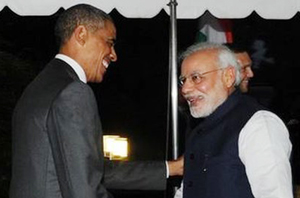
modi obama

Writing in the Washington Post, the two leaders also said India and the US will work jointly to maintain freedom of navigation to lawful commerce across the seas, in significant comments against the backdrop China flexing its muscle over disputes with its neighbours in East and South China seas.

"As global partners, we are committed to enhancing our homeland security by sharing intelligence, through counter-terrorism and law-enforcement cooperation, while we jointly work to maintain freedom of navigation and lawful commerce across the seas," they said.

Referring to the relationship, Modi and Obama said though the it was robust, reliable, enduring and expanding, the true potential of the ties was yet to be fully realised and the advent of a new government in India was a natural opportunity to broaden and deepen the engagement.

"Still, the true potential of our relationship has yet to be fully realised. The advent of a new government in India is a natural opportunity to broaden and deepen our relationship.

"With a reinvigorated level of ambition and greater confidence, we can go beyond modest and conventional goals. It is time to set a new agenda, one that realizes concrete benefits for our citizens," Modi and Obama said, hours before their summit meeting at the White House.

They said the it will be an agenda which will enable both the countries to find mutually rewarding ways to expand collaboration in trade, investment and technology that harmonise with India's ambitious development agenda, while sustaining the US as the global engine of growth.

Modi and Obama said "Today our relationship involves more bilateral collaboration than ever before - not just at the federal level but also at the state and local levels, between our two militaries, private sectors and civil society.

"Indeed, so much has happened that, in 2000, then-Prime Minister Atal Bihari Vajpayee could declare that we are natural allies."

Modi and Obama said they will aim for the strategic partnership to be "larger" than merely the sum of its parts to ensure a better future for the citizens of the two countries as well as to the world at large.

"While India benefits from the growth generated by U S investment and technical partnerships, the United States benefits from a stronger, more prosperous India. In turn, the region and the world benefit from the greater stability and security that our friendship creates.

They lauded the role being played by the "vibrant" Indian American community saying it has been a living bridge between the two nations.

Both the leaders said they will discuss ways to enhance cooperation in trade, science and technology and government-to-government level to help improve the quality, reliability and availability of basic services in India.

"In this, the United States stands ready to assist. An immediate area of concrete support is the "Clean India" campaign, where we will leverage private and civil society innovation, expertise and technology to improve sanitation and hygiene throughout India," they said.

Referring to areas of deeper cooperation, Modi and Obama said collaboration in health sector will help tackling the "toughest of challenges" like combating the spread of Ebola, researching cancer cures or conquering diseases such as tuberculosis, malaria and dengue.

Talking about the existing cooperation, they said "our militaries conduct joint exercises in air, on land and at sea, and our space programmes engage in unprecedented areas of cooperation, leading us from Earth to Mars."

"The exploration of space will continue to fire our imaginations and challenge us to raise our ambitions. That we both have satellites orbiting Mars tells its own story. The promise of a better tomorrow is not solely for Indians and Americans: It also beckons us to move forward together for a better world.

"This is the central premise of our defining partnership for the 21st century. Forward together we go - chalein saath saath," the two leaders said.

They said natural and unique partnership between India and the US can help shape international security and peace.

"Ties between the United States and India are rooted in the shared desire of our citizens for justice and equality. When Swami Vivekananda presented Hinduism as a world religion, he did so at the 1893 World's Parliament of Religions in Chicago.

"When Martin Luther King Jr. sought to end discrimination and prejudice against African Americans, he was inspired by Mahatma Gandhi's nonviolent teachings. Gandhiji himself drew upon the writings of Henry David Thoreau," they said.


Comments

Add new comment

  • Coastaldigest.com reserves the right to delete or block any comments.
  • Coastaldigset.com is not responsible for its readers’ comments.
  • Comments that are abusive, incendiary or irrelevant are strictly prohibited.
  • Please use a genuine email ID and provide your name to avoid reject.
News Network
December 16,2025

jordan.jpg

Prime Minister Narendra Modi on Monday held talks with Jordan’s King Abdullah II in Amman, during which the two leaders discussed ways to further strengthen bilateral relations, with the Prime Minister outlining an eight-point vision covering key areas of cooperation.

Describing the meeting as “productive”, PM Modi said he shared a roadmap focused on trade and economy, fertilisers and agriculture, information technology, healthcare, infrastructure, critical and strategic minerals, civil nuclear cooperation, and people-to-people ties.

In a post on social media platform X, the Prime Minister praised King Abdullah II’s personal commitment to advancing India–Jordan relations, particularly as both countries mark the 75th anniversary of the establishment of diplomatic ties this year.

“Held productive discussions with His Majesty King Abdullah II in Amman. His personal commitment towards vibrant India-Jordan relations is noteworthy. This year, we are celebrating the 75th anniversary of our bilateral diplomatic relations,” PM Modi said.

The meeting took place at the Al Husseiniya Palace, where the two leaders also exchanged views on regional and global issues of mutual interest. According to the Ministry of External Affairs (MEA), both sides agreed to further deepen cooperation in areas including trade and investment, defence and security, counter-terrorism and de-radicalisation, fertilisers and agriculture, infrastructure, renewable energy, tourism, and heritage.

The MEA said both leaders reaffirmed their united stand against terrorism.

PM Modi arrived in Amman earlier on Monday and was received by Jordanian Prime Minister Jafar Hassan, who accorded him a formal welcome. Following the talks, King Abdullah II hosted a banquet dinner in honour of the Prime Minister, reflecting the warmth of bilateral ties.

Jordan is the first leg of PM Modi’s three-nation tour. From Amman, the Prime Minister will travel to Ethiopia at the invitation of Prime Minister Abiy Ahmed Ali, marking his first official visit to the African nation. The tour will conclude with a visit to Oman.

Comments

Add new comment

  • Coastaldigest.com reserves the right to delete or block any comments.
  • Coastaldigset.com is not responsible for its readers’ comments.
  • Comments that are abusive, incendiary or irrelevant are strictly prohibited.
  • Please use a genuine email ID and provide your name to avoid reject.
News Network
December 13,2025

New Delhi: School-going children are picking up drug and smoking habits and engaging in consumption of alcohol, with the average age of introduction to such harmful substances found to be around 13 years, suggesting a need for earlier interventions as early as primary school, a multi-city survey by AIIMS-Delhi said.

The findings also showed substance use increased in higher grades, with grade XI/XII students two times more likely to report use of substances when compared with grade VIII students. This emphasised the importance of continued prevention and intervention through middle and high school.

The study led by Dr Anju Dhawan of AIIMS's National Drug Dependence Treatment Centre, published in the National Medical Journal of India this month, looks at adolescent substance use across diverse regions.

The survey included 5,920 students from classes 8, 9, 11 and 12 in urban government, private and rural schools across 10 cities -- Bengaluru, Chandigarh, Delhi, Dibrugarh, Hyderabad, Imphal, Jammu, Lucknow, Mumbai, and Ranchi. The data were collected between May 2018 and June 2019.

The average age of initiation for any substance was 12.9 (2.8) years. It was lowest for inhalants (11.3 years) followed by heroin (12.3 years) and opioid pharmaceuticals (without prescription; 12.5 years).

Overall, 15.1 per cent of participants reported lifetime use, 10.3 per cent reported past year use, and 7.2 per cent reported use in the past month of any substance, the study found.

The most common substances used in the past year, after tobacco (4 per cent) and alcohol (3.8 per cent), were opioids (2.8 per cent), followed by cannabis (2 per cent) and inhalants (1.9 per cent). Use of non-prescribed pharmaceutical opioids was most common among opioid users (90.2 per cent).

On being asked, 'Do you think this substance is easily available for a person of your age' separately for each substance category, nearly half the students (46.3 per cent) endorsed that tobacco products and more than one-third of the students (36.5 per cent) agreed that a person of their age can easily procure alcohol products.

Similarly, for Bhang (21.9 per cent), ganja/charas (16.1 per cent), inhalants (15.2 per cent), sedatives (13.7 per cent), opium and heroin (10 per cent each), the students endorsed that these can be easily procured.

About 95 per cent of the children, irrespective of their grade, agreed with the statement that 'drug use is harmful'.

The rates of substance use (any) among boys were significantly higher than those of girls for substance use (ever), use in the past year and use in the past 30 days. Compared to grade VIII students, grade IX students were more likely, and grade XI/XII students were twice as likely to have used any substance (ever).

The likelihood of past-year use of any substance was also higher for grade IX students and for grade XI/XII students as compared to grade VIII students.

About 40 per cent of students mentioned that they had a family member who used tobacco or alcohol each. The use of cannabis (any product) and opioid (any product) by a family member was reported by 8.2 per cent and 3.9 per cent of students, respectively, while the use of other substances, such as inhalants/sedatives by family was 2-3 per cent, the study found.

A relatively smaller percentage of students reported use of tobacco or alcohol among peers as compared to among family members, while a higher percentage reported inhalants, sedatives, cannabis or opioid use among peers.

Children using substances (past year) compared to non-users reported significantly higher any substance use by their family members and peers.

There were 25.7 per cent students who replied 'yes' to the question 'conflicts/fights often occur in your family'. Most students also replied affirmatively to 'family members are aware of how their time is being spent' and 'damily members are aware of with whom they spend their time'.

Comments

Add new comment

  • Coastaldigest.com reserves the right to delete or block any comments.
  • Coastaldigset.com is not responsible for its readers’ comments.
  • Comments that are abusive, incendiary or irrelevant are strictly prohibited.
  • Please use a genuine email ID and provide your name to avoid reject.