



Jailed in Pak on charge of spying, Indian techie Hamid Ansari finally returns home

News Network
December 19, 2018

Chandigarh/Mumbai, Dec 19: It was an emotional reunion with his parents when 33-year-old Hamid Nehal Ansari, an Indian software engineer, entered India through Punjab's  Wagah-Attari border with Pakistan, after six years on Tuesday evening.
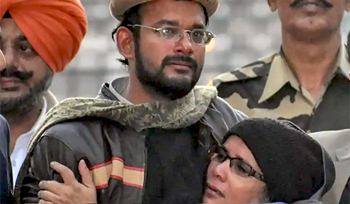
He had languished for years in a Pakistani jail after being caught while entering the neighbouring country and being charged with "spying".

As soon as he entered, he hugged his parents - Nehal and Fauzia Ansari - and all three knelt, bowed down to touch the Indian soil in reverence.

His brother, Dr Khalid Ansari, too was there to receive him.

On Monday, Hamid was released after completion of his prison term and repatriated to India.

On Wednesday, he is expected to visit New Delhi and then after a brief stopover would proceed for Mumbai. A resident of Jogeshwari western suburbs of India, he had entered Pakistan in 2012.

Love gone wrong

Ansari’s story is of love gone wrong, for which he had to pay a price. Ansari’s parents and family members waited with bated breath at the border. As Hamid walked his way from Pakistan, he hugged his mother tightly. Tears rolled down his father’s eyes as he stood speechless.

As the family walked further away from the Pakistan border, Hamid’s mother Fauzia kept her hands tightly wrapped in her son’s arm refusing to let go of him. As she choked out of emotion, Hamid gave her water to drink. Hamid was then taken by the authorities concerned for necessary questioning and documentation.

The Mumbai resident was arrested by agencies in Pakistan in 2012 after he allegedly entered northwest Pakistan illegally to meet a woman he befriended online. He was tried by a military court and given a three-year sentence for possessing a fake Pakistani identity card on December 15, 2015.

Panacea

Hamid’s release comes close on the heels of the opening of the Kartarpur corridor with Pakistan, viewed as a panacea for the animosity between the two nations. The techie went missing after being reportedly taken into custody in the Khyber-Pakhtunkhwa area. His mother had filed a habeas corpus petition through Pakistani lawyers after details of his whereabouts emerged.

For the sake of his love, Hamid went to Pakistan without a visa. He forged documents to enter Pakistan. His mother said, Hamid’s release is a victory for humanity. The ministry of external affairs had raised the issue of Ansari in a formal communication sent to Pakistan on December 11 amid apprehensions that he would be held for a longer period.

"Finally Hamid arrived...," Jatin Desai, general secretary, Pakistan-India Peoples' Forum for Peace and Democracy (PIPFPD), said.

"The parents' resolve and patience was one of the major aspects....their prayers have been answered," he added.

Hamid, who had gone to Kabul, Afghanistan for a job interview in November 2012 was befriended on Facebook and got close to a Pakistani girl.

Hamid was believed to have reached Kohat in Pakistan in an attempt to save this Facebook friend, who reportedly was being forced to marry someone twice her age following a Jirga decision.

Hamid crossed over from Afghanistan border in Jalalabad to Peshawar, Pakistan - where he was caught by the Pakistani agencies.

Comments

Add new comment

  • Coastaldigest.com reserves the right to delete or block any comments.
  • Coastaldigset.com is not responsible for its readers’ comments.
  • Comments that are abusive, incendiary or irrelevant are strictly prohibited.
  • Please use a genuine email ID and provide your name to avoid reject.
News Network
December 15,2025

Udupi, Dec 15: What was meant to be a post-pilgrimage gathering turned tragic in Padukere village of Brahmavar taluk, Udupi district, late Sunday night, when a clash among youths escalated into a fatal assault, leaving one man dead.

The victim has been identified as 30-year-old Santosh Mogaveera, a resident of Padukere.

According to preliminary information, the incident took place during a late-night drinking party involving a group of local youths who had recently returned after completing their pilgrimage to the Sabarimala shrine. An argument reportedly broke out among the group and soon escalated into a violent confrontation.

During the ensuing brawl, Santosh Mogaveera was allegedly assaulted and collapsed at the spot after sustaining serious injuries. He was rushed by local residents to a private hospital in Brahmavar, where doctors declared him dead.

On receiving information, senior police officials, including Brahmavar Circle Inspector Gopikrishna, Kota Police Sub-Inspector Praveen Kumar T, Station ASI Manthesh Jabagoudar, and head constables Pradeep and Ashok, visited the spot and conducted an inspection.

Police have taken four youths into custody in connection with the incident. A case has been registered at the Kota police station, and further investigation is underway to ascertain the exact sequence of events leading to the death.

Comments

Add new comment

  • Coastaldigest.com reserves the right to delete or block any comments.
  • Coastaldigset.com is not responsible for its readers’ comments.
  • Comments that are abusive, incendiary or irrelevant are strictly prohibited.
  • Please use a genuine email ID and provide your name to avoid reject.
News Network
December 19,2025

Mangaluru: Public transport in Mangaluru is set for a state-led transformation as the government moves to deploy 100 new electric govt buses to replace unreliable private services. The initiative aims to provide a dependable alternative to private operators who have been frequently "cutting trips," leaving thousands of commuters stranded.

The announcement was made by Deputy Commissioner and MCC Administrator Darshan HV during a public phone-in session. The move specifically targets routes where private bus service has become erratic, ensuring that citizens no longer have to rely on a fluctuating private sector for their daily commute.

Restoring the Govt Presence

The transport crisis was brought to the forefront by Ramayya, a resident of Bajal, who highlighted a growing trend of private buses skipping morning and night trips. With the previous KSRTC (govt) services discontinued, residents have been left without a fallback option.

To fix this, the DC confirmed that the PM-eBus Sewa Scheme will bring 100 government-owned electric buses to the city:

•    Phased Deployment: The first 50 of the new 100 government buses are scheduled to arrive by March 2026.

•    State Infrastructure: Two new government depots, including one at Mudipu, are being prepared for operations.

•    Recruitment: The state has already begun training a new batch of government bus drivers to ensure the fleet is operational the moment it arrives.

Comments

Add new comment

  • Coastaldigest.com reserves the right to delete or block any comments.
  • Coastaldigset.com is not responsible for its readers’ comments.
  • Comments that are abusive, incendiary or irrelevant are strictly prohibited.
  • Please use a genuine email ID and provide your name to avoid reject.
News Network
December 13,2025

New Delhi: School-going children are picking up drug and smoking habits and engaging in consumption of alcohol, with the average age of introduction to such harmful substances found to be around 13 years, suggesting a need for earlier interventions as early as primary school, a multi-city survey by AIIMS-Delhi said.

The findings also showed substance use increased in higher grades, with grade XI/XII students two times more likely to report use of substances when compared with grade VIII students. This emphasised the importance of continued prevention and intervention through middle and high school.

The study led by Dr Anju Dhawan of AIIMS's National Drug Dependence Treatment Centre, published in the National Medical Journal of India this month, looks at adolescent substance use across diverse regions.

The survey included 5,920 students from classes 8, 9, 11 and 12 in urban government, private and rural schools across 10 cities -- Bengaluru, Chandigarh, Delhi, Dibrugarh, Hyderabad, Imphal, Jammu, Lucknow, Mumbai, and Ranchi. The data were collected between May 2018 and June 2019.

The average age of initiation for any substance was 12.9 (2.8) years. It was lowest for inhalants (11.3 years) followed by heroin (12.3 years) and opioid pharmaceuticals (without prescription; 12.5 years).

Overall, 15.1 per cent of participants reported lifetime use, 10.3 per cent reported past year use, and 7.2 per cent reported use in the past month of any substance, the study found.

The most common substances used in the past year, after tobacco (4 per cent) and alcohol (3.8 per cent), were opioids (2.8 per cent), followed by cannabis (2 per cent) and inhalants (1.9 per cent). Use of non-prescribed pharmaceutical opioids was most common among opioid users (90.2 per cent).

On being asked, 'Do you think this substance is easily available for a person of your age' separately for each substance category, nearly half the students (46.3 per cent) endorsed that tobacco products and more than one-third of the students (36.5 per cent) agreed that a person of their age can easily procure alcohol products.

Similarly, for Bhang (21.9 per cent), ganja/charas (16.1 per cent), inhalants (15.2 per cent), sedatives (13.7 per cent), opium and heroin (10 per cent each), the students endorsed that these can be easily procured.

About 95 per cent of the children, irrespective of their grade, agreed with the statement that 'drug use is harmful'.

The rates of substance use (any) among boys were significantly higher than those of girls for substance use (ever), use in the past year and use in the past 30 days. Compared to grade VIII students, grade IX students were more likely, and grade XI/XII students were twice as likely to have used any substance (ever).

The likelihood of past-year use of any substance was also higher for grade IX students and for grade XI/XII students as compared to grade VIII students.

About 40 per cent of students mentioned that they had a family member who used tobacco or alcohol each. The use of cannabis (any product) and opioid (any product) by a family member was reported by 8.2 per cent and 3.9 per cent of students, respectively, while the use of other substances, such as inhalants/sedatives by family was 2-3 per cent, the study found.

A relatively smaller percentage of students reported use of tobacco or alcohol among peers as compared to among family members, while a higher percentage reported inhalants, sedatives, cannabis or opioid use among peers.

Children using substances (past year) compared to non-users reported significantly higher any substance use by their family members and peers.

There were 25.7 per cent students who replied 'yes' to the question 'conflicts/fights often occur in your family'. Most students also replied affirmatively to 'family members are aware of how their time is being spent' and 'damily members are aware of with whom they spend their time'.

Comments

Add new comment

  • Coastaldigest.com reserves the right to delete or block any comments.
  • Coastaldigset.com is not responsible for its readers’ comments.
  • Comments that are abusive, incendiary or irrelevant are strictly prohibited.
  • Please use a genuine email ID and provide your name to avoid reject.