



Jaitley to present budget today amid worries over growth, reforms

February 29, 2016

New Delhi, Feb 29: Finance Minister Arun Jaitley faces a tough task of balancing the needs of farm sector as well as the industry when he presents his third and challenging Budget Monday as he seeks to garner resources to boost public spending for higher growth amid global headwinds.
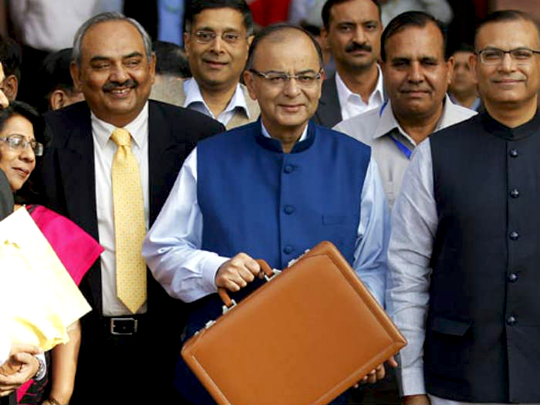
Jaitley

On the income tax front, the Budget may continue with the status quo on the tax slabs while it may tinker with the exemptions.

Rising rural distress because of back-to-back droughts have put considerable pressure on the Finance Minister to spend more on social schemes, while at the same time he has to win back foreign investors craving for faster reforms.

His difficulties have been compounded by the huge payout of Rs 1.02 lakh crore that will become necessary on account of the 7th Pay Commission recommendations for government employees.

How much he does this without compromising on the previously-announced goal of lowering the fiscal deficit to 3.5 per cent of the GDP next year is to be seen.

Jaitley is also likely to fulfil his last year's promise of gradual reduction of corporate tax from 30 per cent to 25 per cent over four years.

It is expected that he may begin the exercise in the Budget tomorrow that may be accompanied by withdrawal of tax exemptions to keep the exercise revenue neutral.

To shore up revenues to meet the increased expenditure, the finance minister may need to increase indirect tax rates or introduce new taxes. Service Tax, raised to 14.5 per cent last year, may see a hike to prepare for the level of 18 per cent being envisaged in the GST.

Further, new cess to fund initiatives such as Start-up India or Digital India and other programmes is being speculated, similar to the Swachh Bharat cess levied last year.

On his agenda would also be the revival of the investment cycle. While capital expenditure in 2015-16 increased by 25.5 per cent over last fiscal, as a percentage of GDP it is still stuck at 1.7 per cent and needs to go up to 2 per cent.

He will have to steer spending towards sectors like infrastructure and raise public spending in view of private investment not picking up at desired pace

It remains to be seen if Jaitley will loosen his purse strings or continue to consolidate. In the event the government decides to increase spending, it would be a challenge to ensure that the funds are channelised into capital investments.

"Even if budgetary consolidation continues, India's fiscal metrics will remain weaker than rating peers in the near term," analysts at Moody's Investors Service said earlier this month.

Foreign investors have sold a net USD 2.4 billion in shares this year, the second-biggest outflows in Asia excluding China.

The Budget will need to focus on the commodity driven sectors by providing protection measures, since these sectors are stressed due to the collapse in global demand and oversupply.

Jaitley has shifted the proportion of expenditure toward infrastructure and away from subsidies in the last two Budgets.

Besides implementation of the 7th Pay Commission, he also faces challenge of bank recapitalisation.

With agriculture reeling from drought and lower crop prices, the government is likely to retain spending on the rural employment guarantee programme, expand crop insurance and boost irrigation outlays.

On reforms, he may open more sectors to foreign investment and give tax breaks for labour-intensive sectors such as leather and jewelry.

In view of sharp fall in crude prices and low probability of increase over the next one year, the government may reintroduce customs duty on imported crude, petrol and diesel, which was removed in 2011, when crude prices had increased over USD 100 per barrel.

The government could increase import duty on gold, since gold imports have increased over the year and has partly contributed to the trade deficit and weak rupee on account of forex outflows.


Comments

Add new comment

  • Coastaldigest.com reserves the right to delete or block any comments.
  • Coastaldigset.com is not responsible for its readers’ comments.
  • Comments that are abusive, incendiary or irrelevant are strictly prohibited.
  • Please use a genuine email ID and provide your name to avoid reject.
News Network
December 20,2025

train.jpg

At least seven elephants were killed and one calf injured after a herd collided with the Sairang-New Delhi Rajdhani Express in Assam's Hojai on Saturday morning, leading to disruption of rail services. 

The Sairang-New Delhi Rajdhani Express struck a herd of elephants, resulting in the derailment of the locomotive and five coaches. No passenger casualties or injuries were reported, officials said.

The New Delhi-bound train met with the accident around 2.17 am, PTI reported. The Sairang-New Delhi Rajdhani Express connects Mizoram's Sairang (near Aizawl) to Anand Vihar Terminal (Delhi). 

Railway has issued helpline numbers at the Guwahati Railway Station:-

•    0361-2731621
•    0361-2731622
•    0361-2731623

The accident site is located about 126 km from Guwahati. Following the incident, accident relief trains and railway officials rushed to the spot to initiate rescue operations.

Train Services Disrupted

Sources said that due to the derailment and elephant body parts scattered on the tracks, train services to Upper Assam and other parts of the Northeast were affected.

Passengers from the affected coaches were temporarily accommodated in vacant berths available in other coaches of the train. Once the train reaches Guwahati, additional coaches will be attached to accommodate all passengers, after which the train will resume its onward journey.

The incident occurred at a location that is not a designated elephant corridor. The loco pilot, upon spotting the herd on the tracks, applied emergency brakes. Despite this, the elephants dashed into the train, leading to the collision and derailment.

Last month, an elephant was killed after being hit by a train in Dhupguri in West Bengal's Jalpaiguri district. The incident took place on November 30. 

The adult elephant was killed on the spot, and a calf was discovered lying injured beside the tracks. 

Over 70 Elephants Killed In Train Collisions Over Last 5 Years

At least 79 elephants have died in train collisions across the country in the last five years, the Environment Ministry had informed Parliament in August.

In a written reply in the Lok Sabha, Minister of State for Environment Kirti Vardhan Singh had said the figure is based on reports from state governments and Union Territory administrations for the period 2020-21 to 2024-25.

He said that the ministry does not maintain consolidated data on the deaths of other wild animals on railway tracks, including in designated elephant corridors.

Singh confirmed that three elephants, including a mother and her calf, were killed on July 18 this year after being hit by a speeding express train on the Kharagpur-Tatanagar section in West Bengal's Paschim Midnapore district. The incident took place near Banstala between Jhargram and Banstala stations.

The minister said several measures have been taken jointly by the Environment Ministry and the Railways to prevent such accidents.

These include imposing speed restrictions in elephant habitats, pilot projects such as seismic sensor-based detection of elephants near tracks and construction of underpasses, ramps and fencing at vulnerable points.

The Wildlife Institute of India, in consultation with the ministry and other stakeholders, has also issued guidelines titled 'Eco-friendly Measures to Mitigate Impacts of Linear Infrastructure' to help agencies design railways and other projects in ways that reduce human-animal conflicts.

Singh added that capacity-building workshops were conducted for railway officials at the Wildlife Institute of India in 2023 and 2024 to raise awareness on elephant conservation and protection.

A detailed report titled 'Suggested Measures to Mitigate Elephant & Other Wildlife Train Collisions on Vulnerable Railway Stretches in India' had also been prepared after surveys across 127 railway stretches covering 3,452 km.

Of these, 77 stretches spanning 1,965 km in 14 states were prioritised for mitigation, with site-specific interventions suggested. 

Comments

Add new comment

  • Coastaldigest.com reserves the right to delete or block any comments.
  • Coastaldigset.com is not responsible for its readers’ comments.
  • Comments that are abusive, incendiary or irrelevant are strictly prohibited.
  • Please use a genuine email ID and provide your name to avoid reject.