



Newsroom, Aug 14: A solidarity team of prominent Indian activists which extensively travelled in besieged Jammu and Kashmir after the controversial abrogation of Article 370 and 35A by the union government of India has claimed that it has found is completely different situation in the valley from what has been reported in the mainstream media so far.
The team consisting of economist Jean Dreze and rights activist Kavita Krishnan today released a report along with photo and video documentation at a press conference at the Press Club, New Delhi.
Following is the full text of the report:
We spent five days (9-13 August 2019) traveling extensively in Kashmir. Our visit began on 9 August 2019 – four days after the Indian government abrogated Articles 370 and 35A, dissolved the state of Jammu and Kashmir, and bifurcated it into two Union Territories.
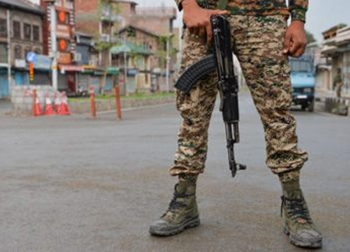
When we arrived in Srinagar on 9 August, we found the city silenced and desolated by curfew, and bristling with Indian military and paramilitary presence. The curfew was total, as it had been since 5th August. The streets of Srinagar were empty and all institutions and establishments were closed (shops, schools, libraries, petrol pumps, government offices, banks). Only some ATMs and chemists’ shops - and all police stations - were open. People were moving about in ones and twos here and there, but not in groups.
We travelled widely, inside and outside Srinagar – far beyond the small enclave (in the centre of Srinagar) where the Indian media operates. In that small enclave, a semblance of normalcy returns from time to time, and this has enabled the Indian media to claim that life in Kashmir is back to normal. Nothing could be further from the truth.
We spent five days moving around and talking to hundreds of ordinary people in Srinagar city, as well as villages and small towns of Kashmir. We spoke to women, school and college students, shopkeepers, journalists, people who run small businesses, daily wage labourers, workers and migrants from UP, West Bengal and other states. We spoke to Kashmiri Pandits and Sikhs who live in the Valley, as well as Kashmiri Muslims.
Everywhere, we were cordially received, even by people who were very angry about the situation or sceptical of our purpose. Even as people expressed their pain, anger, and sense of betrayal against the Government of India, they extended warmth and unstinting hospitality to us. We are deeply moved by this.
Except for the BJP spokesperson on Kashmir Affairs, we did not meet a single person who supported the Indian government’s decision to abrogate Article 370. On the contrary, most people were extremely angry, both at the abrogation of Article 370 (and 35A) and at the manner in which it had been done.
Anger and fear were the dominant emotions we encountered everywhere. People expressed their anger freely in informal conversation, but no-one was willing to speak on camera. Anyone who speaks up is at risk of persecution from the government.
Many told us that they expected massive protests to erupt sooner or later (after restrictions were relaxed, after Eid, after 15 August, or even later), and anticipated violent repression even if the protests were peaceful.
A summary of our observations
• There is intense and virtually unanimous anger in Kashmir against the Indian
government’s decision to abrogate Articles 370 and 35A, and also about the way this has been done.
• To control this anger, the government has imposed curfew-like conditions in Kashmir. Except for some ATMs, chemists’ shops and police stations, most establishments are closed for now.
• The clampdown on public life and effective imposition of curfew have also crippled economic life in Kashmir, that too at a time of the BakrEid festival that is meant for abundance and celebration.
• People live in fear of harassment from the government, army or police. People expressed their anger freely in informal conversation, but no-one was willing to speak on camera.
• The Indian media’s claims of a rapid return to normalcy in Kashmir are grossly misleading. They are based on selective reports from a small enclave in the centre of Srinagar.
• As things stand, there is no space in Kashmir for any sort of protest, however peaceful. However, mass protests are likely to erupt sooner or later.
Reactions to the Government’s Treatment of J&K
• When our flight landed, and the airlines staff announced that passengers could switch on our mobiles, the entire flight (with mostly Kashmiris in it) burst into mocking laughter. “What a joke”, we could hear people say - since mobile and landline phones and internet have all been blocked since 5 August!
• As soon as we set foot in Srinagar, we came across a few small children playacting in a park. We could hear them say ‘Iblees Modi’. ‘Iblees’ means ‘Satan’.
• The words we heard over and over from people about the Government decisions on J&K were ‘zulm’ (oppression), ‘zyadti’ (excess/cruelty), and ‘dhokha’ (betrayal). As one man in Safakadal (downtown Srinagar) put it, “The Government has treated us Kashmiris like slaves, taking decisions about our lives and our future while we are captive. It’s like forcing something down our throats while keeping us bound and gagged, with a gun to our heads.”
• In every lane of Srinagar city, every town, every village, that we visited, we received an extensive schooling from ordinary people, including school kids, on the history of the Kashmir dispute. They were angry and appalled at the manner in which the Indian media was whitewashing this history. Many said: “Article 370 was the contract between Kashmir’s leadership and India’s. Had that contract not been signed, Kashmir would never have acceded to India. With Article 370 gone, India no longer has any basis for its claim over Kashmir.” One man in the Jahangir Chowk area near Lal Chowk, described Article 370 as a ‘mangalsutra’ (sacred necklace worn by married women) symbolising a contract (analogous to the marital contract) between Kashmir and India. (More on people’s reactions to the abrogation of Articles 370 and 35A below)
• There is widespread anger against the Indian media. People are imprisoned in their homes, unable to communicate with each other, express themselves on social media, or make their voices heard in any way. In their homes, they watch Indian TV claim that Kashmir welcomes the Government decisions. They seethe with rage at the erasure of their voices. As one young man in Safakadal put it, “Kiski shaadi hai, aur kaun naach raha hai?! (It’s supposed to be our wedding, but it’s only others who are dancing!) If this move is supposed to be for our benefit and development, why not ask what we ourselves think about it?”
Reactions To The Abrogation Of Article 370 and 35A
• A man in Guree village (Anantnag district) said: “Hamara unse rishta Article 370 aur 35A se tha. Ab unhone apne hi paer par kulhadi mar di hai. In Articles ko khatm kar diya hai. Ab to ham azad ho gaye hain.” (Our relation with them (India) was through Article 370 and Article 35A. Now they have themselves committed the folly of dissolving these Articles. So now we are free.” The same man raised slogans of “We want freedom” followed by slogans of “Restore Articles 370 and 35A.”
• Many described Article 370 and 35A as Kashmir’s “pehchan” (identity). They felt that the abrogation of these Articles is a humiliating attack on Kashmir’s self-respect and identity.
• Not all demanded restoration of Article 370. Many said that it was only the parliamentary parties who had asked people to have faith that India would honour the contract that was Article 370. The abrogation of Article 370 only discredited those “pro-India parties”, and vindicated those who argued for Kashmir’s “azaadi" (independence) from India, they felt. One man in Batamaloo said: “Jo india ke geet gate hain, apne bande hain, ve bhi band hain! (Those who sang praises of India, India’s own agents, they too are imprisoned!” A Kashmiri journalist observed, “Many people are happy about the treatment the mainstream parties are getting. These parties batted for the Indian State and are being humiliated now.”
• “Modi has destroyed India's own law, its own Constitution” was another common refrain. Those who said this, felt that Article 370 was more important to India (to legitimise its claim to Kashmir) than it was to Kashmir. But the Modi Government had not only sought to destroy Kashmir, it had destroyed a law and Constitution that was India’s own.
• A hosiery businessman in Jahangir Chowk, Srinagar said, “Congress ne peeth mein choora bhonka tha, BJP ne saamne se choora bhonka hai.” (Congress had stabbed us from the back, BJP is stabbing us up front). He added, “They strangled their own Constitution. It's first step towards Hindu Rashtra.”
• In some ways, people were more concerned about the effects of the abrogation of 35A than that of 370. It is widely recognised that Article 370 retained only nominal, symbolic autonomy and had already been diluted. With 35A gone,
though, people fear that “State land will be sold cheap to investors. Ambani, Patanjali etc can come in easily. Kashmir’s resources and land will be grabbed. In Kashmir as it stands now, education and employment levels are better than in the mainland. But tomorrow Kashmiris will have to compete for Government jobs with those from other states. After one generation, most Kashmiris won't have jobs or be forced to move to the mainland.”
“Normalcy” - Or “Peace Of The Graveyard”?
Is the situation in Kashmir “normal” and “peaceful”? The answer is an emphatic NO.
• One young man in Sopore said: “This is bandook ki khamoshi (the silence at gunpoint), kabristan ki khamoshi (the peace of the graveyard).”
• The newspaper Greater Kashmir had one (front) page of news and a sports page at the back: the two inside pages were full of cancellation announcements of weddings or receptions!
• Between 5-9 August, people had suffered for lack of food, milk, and basic needs. People had been prevented even from going to hospitals in case of sickness.
• The Government claim is that only Section 144 has been imposed, not “curfew”. But in reality, police vans keep patrolling Srinagar warning people to “stay safe at home and not venture out during the curfew”, and tell shops to close their shutters. They demand that people display “curfew passes” to be allowed to move about.
• All of Kashmir is under curfew. Even on Eid, the roads and bazaars were silent and desolate. All over Srinagar, mobility is restricted by concertina wires on streets, and massive paramilitary deployment. Even on Eid, this was the case. In many villages, azaan was prohibited by the paramilitary and people were forced to do namaaz prayers at home rather than collectively at the mosque as it usual on Eid.
• In Anantnag, Shopian and Pampore (South Kashmir) on the day of Eid, we only saw very small kids dressed in Eid finery. Everyone else was in mourning. “We feel like we’re in jail”, said a woman in Guree (Anantnag). Girls in Nagbal (Shopian) said, “With our brothers in police or army custody, how can we celebrate Eid?”
• On 11 August, on the eve of Eid, a woman at Sopore told us she had come to the bazaar during a brief respite in the curfew, to buy a few supplies for Eid. She said: “We were prisoners in our own homes for 7 days. Even today, shops are closed in my village Langet, so I came to Sopore town to shop for Eid and to check on my daughter who is a nursing student here.”
• “It’s Army rule not Modi rule. There are more soldiers here than people”, said a young baker at Watpura near Bandipora. His friend added, “We’re afraid, because the army camp nearby keeps imposing impossible rules. They insist we have to return within half an hour if we leave home. If my kid isn't well, and I have to take her to the hospital, it may take more than half an hour. If someone visits their daughter who lives in next village, they may take more than half hour to return. But if there’s any delay, they will harass us.” The CRPF paramilitary is everywhere, outside nearly every home in Kashmir. These are clearly not there to provide “security” to Kashmiris - on the contrary, their presence creates fear for the people.
• Sheep traders and herders could be seen with unsold sheep and goats. Animals they had been rearing all year long, would not be sold. This meant they would incur a huge loss. With people unable to earn, many could not afford to buy animals for the Eid sacrifice.
• A shopkeeper from Bijnore (UP) showed us the stacks of unsold sweets and delicacies going waste, since people could not buy them. Shops and bakeries wore a deserted look on the eve of Eid, with their perishable food items lying unsold.
• An asthmatic auto driver in Srinagar, showed us his last remaining dose of salbutamol and asthalin. He had been trying for the past several days to buy more
- but the chemists’ shops and hospitals in his area had run out of stocks. He could go to other, bigger hospitals - but CRPF would prevent him. He showed us the empty, crushed cover of one asthalin inhaler - when he told a CRPF man he needed to go further to get the medicine, the man stamped on the cover with his boot. “Why stamp on it? He hates us, that’s why”, said the auto driver.
Protests, Repression, and Brutality
• Some 10,000 people protested in Soura (Srinagar) on 9 August. The forces responded with pellet gun fire, injuring several. We attempted to go to Soura on 10 August, but were stopped by a CRPF barricade. We did see young protestors on the road that day as well, blockading the road.
• We met two victims of pellet gun injuries in SMHS hospital in Srinagar. The two young men (Waqar Ahmad and Wahid) had faces, arms and torso full of pellets. Their eyes were bloodshot and blinded. Waqar had a catheter in which the urine, red with blood from internal bleeding, could be seen. Their family members, weeping with grief and rage, told us that the two men had not been pelting stones. They had been peacefully protesting.
• On 6 August, a graphic designer for the Rising Kashmir newspaper, Samir Ahmad, (in his early 20s) had remonstrated with a CRPF man near his home in the Manderbag area of Srinagar, asking him to allow an old man to pass. Later the same day, when Samir opened the door to his house, CRPF fired at him with a pellet gun, unprovoked. He got 172 pellets in his arm and face near the eyes, but his eyesight is safe. It is clear that the pellet guns are deliberately aimed at the face and eyes, and unarmed, peaceful civilians standing at their own front doors can be targets.
• At least 600 political leaders and civil society activists are under arrest. There is no clear information on what laws are invoked to arrest them, or where they are being held.
• A very large number of political leaders are under house arrest - it is impossible to ascertain how many. We tried to meet CPIM MLA Mohd Yusuf Tarigami - but were refused entry into his home in Srinagar, where he is being under house arrest.
• In every village we visited, as well as in downtown Srinagar, there were very young schoolboys and teenagers who had been arbitrarily picked up by police or army/paramilitary and held in illegal detention. We met a 11-year-old boy in Pampore who had been held in a police station between 5 August and 11 August. He had been beaten up, and he said there were boys even younger than him in custody, from nearby villages.
• Hundreds of boys and teens are being picked up from their beds in midnight raids. The only purpose of these raids is to create fear. Women and girls told us of molestation by armed forces during these raids. Parents feared meeting us and telling us about the “arrests” (abductions) of their boys. They are afraid of Public Security Act cases being filed. The other fear is that the boys may be “disappeared” - i.e killed in custody and dumped in mass graves of which Kashmir has a grim history. As one neighbour of an arrested boy said, “There is no record of these arrests. It is illegal detention. So if the boy “disappears” - i.e is killed in custody - the police/army can just say they never had him in custody in the first place.”
• But the protests are not likely to stop. A young man at Sopore said: “Jitna zulm karenge, utna ham ubharenge” (The more you oppress us, the more we will rise up) A familiar refrain we heard at many places was: “Never mind if leaders are arrested. We don’t need leaders. As long as even a single Kashmiri baby is alive, we will struggle.”
The Gag On Media
• A journalist told us: “Newspapers are printing in spite of everything. Without the internet, we do not get any feed from agencies. We were reduced to reporting the J&K related developments in Parliament, from NDTV! This is undeclared censorship. If Govt is giving internet and phone connectivity to police but not to media houses what does it mean? We had some people come to our offices, speaking on behalf of Army and CRPF, asking “Why are you publishing photos of
The curfew-affected streets?”
• Kashmiri TV channels are completely closed and unable to function.
• Kashmiri newspapers that carry the barest mention of protests (such as the one on Soura) are made to feel the heat from the authorities.
• Foreign press reporters told us that they are facing restrictions on their movement by the authorities. Also, because of the lack of internet, they are unable to communicate with their own main offices.
• When we visited Press Enclave in Srinagar on 13 August, we found the newspaper offices closed and the area deserted except for a few stray journalists, and some CID men. One of the journalists told us that papers could not be printed till at least 17 August, because they have run out of newsprint which comes from Delhi.
• As mentioned above, one graphic designer working with a newspaper suffered pellet gun injuries, during a completely unprovoked attack by CRPF
Does Kashmir Lack Development?
In an op-ed in the Times Of India (August 9, 2019), former Foreign Secretary and
Ambassador Nirupama Rao wrote: “A young Kashmiri told this writer a few months ago her birthplace was in the “stone age”; that in terms of economic development, Kashmir was two hundred years behind the rest of India.”
We struggled to find this “backward”, “stone age” Kashmir anywhere at all.
• It is striking how in every Kashmiri village, we found young men and women who go to college or University; speak Kashmiri, Hindi and English fluently; and are able to argue points of Constitutional and international law in relation to the Kashmir conflict with factual accuracy and erudition. All four of the team members are familiar with villages in North Indian states. This high level of education is extremely rare in any village in, say, Bihar, UP, MP, or Jharkhand.
• The homes in rural Kashmir are all pucca constructions. We saw no shacks like the ones that are common in rural Bihar, UP, Jharkhand.
• There are poor people in Kashmir, certainly. But the levels of destitution, starvation and abject poverty seen in many North Indian states, is simply absent in rural Kashmir.
• We met migrant labourers from North India and West Bengal at many places.
They told us that they feel safe and free from xenophobic violence that they face in, say, Maharashtra or Gujarat. Daily wage migrant labourers told us “Kashmir is our Dubai. We earn Rs 600 to Rs 800 per day here - that is three or four times
what we earn in other states.”
• We found Kashmir refreshingly free of communal tension or mob lynchings. We met Kashmiri pandits who told us they felt safe in Kashmir, and that the Kashmiris always celebrate their festivals together. “We celebrate Eid, Holi, Diwali together. That is our Kashmiriyat. It is something different, special,” said one Kashmiri Pandit young man.
• The myth of the “backward” Kashmiri woman is perhaps the biggest lie. Kashmiri girls enjoy a high level of education. They are articulate and assertive. Of course, they face and resist patriarchy and gender discrimination in their societies. But does BJP, whose Haryana CM and Muzaffarnagar MLA speak of “getting Kashmiri brides” as though Kashmiri women are property to be looted, have any right to preach feminism to Kashmir? Kashmiri girls and women told us, “We are capable of fighting our own battles. We don’t want our oppressors to claim to liberate us!”
The BJP Spokesperson’s “Warning”
We met BJP spokesperson on Kashmir affairs, Ashwani Kumar Chrungoo at the office of Rising Kashmir, a Kashmir newspaper. The conversation was initially cordial. He told us he had come to Kashmir from Jammu to persuade people to support the abrogation of Article 370. His main argument was that since the BJP had won a 46% vote share in J&K and had won an unprecedented majority in Parliament, they had not only a right but a duty to keep their promise of scrapping Article 370. “46% vote share - that’s a license”, he said.
He refused to acknowledge that this 46% vote share while winning only three Lok Sabha seats (Jammu, Udhampur and Ladakh) was possible only because the voter turnout in the three other LS seats (Srinagar, Anantnag and Baramulla) was the lowest in the whole country.
Should a Government impose an unpopular decision on people of Kashmir who have not voted for that decision, at gunpoint? Chrungoo said, “In Bihar when Nitish
Kumar imposed prohibition, he didn’t ask the alcoholics for their permission or consent. It’s the same here.” His contempt for the people of Kashmir was evident from this analogy.
Towards the end of the conversation, he became increasingly edgy when confronted by facts and arguments by us. He got up and wagged a finger at Jean Dreze, saying “We won’t let anti-nationals like you do your work here. I am warning you.”
Conclusion
The whole of Kashmir is, at the moment, a prison, under military control. The decisions taken by the Modi Government on J&K are immoral, unconstitutional and illegal. The means being adopted by the Modi Government to hold Kashmiris captive and suppress potential protests are also immoral, unconstitutional, and illegal.
• We demand the immediate restoration of Articles 370 and 35A.
• We assert that no decision about the status or future of J&K should be taken without the will of its people.
• We demand that communications - including landline telephones, mobile phones and internet be restored with immediate effect.
• We demand that the gags on the freedom of speech, expression and protest be lifted from J&K with immediate effect. The people of J&K are anguished - and they must be allowed to express their protest through media, social media, public gatherings and other peaceful means.
• We demand that the gags on journalists in J&K be lifted immediately.
-Jean Drèze, economist
-Kavita Krishnan, Communist Party of India (Marxist-Leninist) and AIPWA
-Maimoona Mollah, All India Democratic Women's Association (AIDWA)
-Vimal Bhai, National Alliance of People's Movements (NAPM)

Comments
Add new comment