



Kovind files nomination in presence of PM, NDA CMs

Agencies
June 23, 2017

New Delhi, Jun 23: NDA's presidential candidate Ram Nath Kovind today filed his nomination papers in the presence of Prime Minister Narendra Modi and a battery of NDA chief ministers and party leaders. BJP President Amit Shah and party veterans LK Advani and Murli Manohar Joshi were present during the filing of nominations.
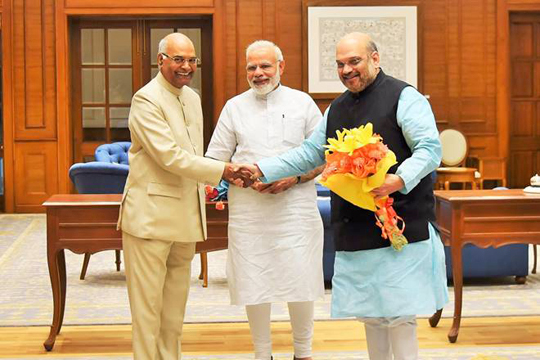
kovind

All chief ministers of BJP-ruled states and its allies except Manohar Parrikar of Goa and Mehbooba Mufti of Jammu and Kashmir were present. Telangana chief minister K Chandrashekar Rao and Tamil Nadu Chief Minister Edappadi K Palaniswami were among those present.

Besides NDA constituents, which comprise over 48.6 percent of votes in the electoral college that will elect the next president, regional parties such as the AIADMK, BJD, TRS and JD(U) have announced their support to the Dalit leader, making his win an almost foregone conclusion.

Kovind is guaranteed to get more than 61 per cent of votes, and the final tally depends on how some still- undecided regional parties vote, BJP source said. A group of opposition parties had yesterday announced that former Speaker Meira Kumar, also a Dalit leader, would be their joint candidate against Kovind.

The election is scheduled for July 17 and the counting of votes will take place on July 20. The term of President Pranab Mukherjee ends on July 24.

Once elected, Kovind will be the second Dalit to occupy the highest constitutional office. The first was K R Narayanan, who was in the Rashtrapati Bhavan in 1997-2002.

A low-profile Dalit leader who held various organisational positions in the BJP, Kovind, 71, was made the Bihar Governor in 2015 after the NDA came to power in May 2014.

The name of the two-term Rajya Sabha member did not figure among the probables but his nomination by the BJP is now being seen as a "political masterstroke".

He enjoys a clean reputation and has steered clear of any controversy in his over 26-year-old political career. His Dalit background makes him a sound political choice for the saffron party working overtime to woo Dalits.

 

Comments

Add new comment

  • Coastaldigest.com reserves the right to delete or block any comments.
  • Coastaldigset.com is not responsible for its readers’ comments.
  • Comments that are abusive, incendiary or irrelevant are strictly prohibited.
  • Please use a genuine email ID and provide your name to avoid reject.
News Network
December 13,2025

New Delhi: School-going children are picking up drug and smoking habits and engaging in consumption of alcohol, with the average age of introduction to such harmful substances found to be around 13 years, suggesting a need for earlier interventions as early as primary school, a multi-city survey by AIIMS-Delhi said.

The findings also showed substance use increased in higher grades, with grade XI/XII students two times more likely to report use of substances when compared with grade VIII students. This emphasised the importance of continued prevention and intervention through middle and high school.

The study led by Dr Anju Dhawan of AIIMS's National Drug Dependence Treatment Centre, published in the National Medical Journal of India this month, looks at adolescent substance use across diverse regions.

The survey included 5,920 students from classes 8, 9, 11 and 12 in urban government, private and rural schools across 10 cities -- Bengaluru, Chandigarh, Delhi, Dibrugarh, Hyderabad, Imphal, Jammu, Lucknow, Mumbai, and Ranchi. The data were collected between May 2018 and June 2019.

The average age of initiation for any substance was 12.9 (2.8) years. It was lowest for inhalants (11.3 years) followed by heroin (12.3 years) and opioid pharmaceuticals (without prescription; 12.5 years).

Overall, 15.1 per cent of participants reported lifetime use, 10.3 per cent reported past year use, and 7.2 per cent reported use in the past month of any substance, the study found.

The most common substances used in the past year, after tobacco (4 per cent) and alcohol (3.8 per cent), were opioids (2.8 per cent), followed by cannabis (2 per cent) and inhalants (1.9 per cent). Use of non-prescribed pharmaceutical opioids was most common among opioid users (90.2 per cent).

On being asked, 'Do you think this substance is easily available for a person of your age' separately for each substance category, nearly half the students (46.3 per cent) endorsed that tobacco products and more than one-third of the students (36.5 per cent) agreed that a person of their age can easily procure alcohol products.

Similarly, for Bhang (21.9 per cent), ganja/charas (16.1 per cent), inhalants (15.2 per cent), sedatives (13.7 per cent), opium and heroin (10 per cent each), the students endorsed that these can be easily procured.

About 95 per cent of the children, irrespective of their grade, agreed with the statement that 'drug use is harmful'.

The rates of substance use (any) among boys were significantly higher than those of girls for substance use (ever), use in the past year and use in the past 30 days. Compared to grade VIII students, grade IX students were more likely, and grade XI/XII students were twice as likely to have used any substance (ever).

The likelihood of past-year use of any substance was also higher for grade IX students and for grade XI/XII students as compared to grade VIII students.

About 40 per cent of students mentioned that they had a family member who used tobacco or alcohol each. The use of cannabis (any product) and opioid (any product) by a family member was reported by 8.2 per cent and 3.9 per cent of students, respectively, while the use of other substances, such as inhalants/sedatives by family was 2-3 per cent, the study found.

A relatively smaller percentage of students reported use of tobacco or alcohol among peers as compared to among family members, while a higher percentage reported inhalants, sedatives, cannabis or opioid use among peers.

Children using substances (past year) compared to non-users reported significantly higher any substance use by their family members and peers.

There were 25.7 per cent students who replied 'yes' to the question 'conflicts/fights often occur in your family'. Most students also replied affirmatively to 'family members are aware of how their time is being spent' and 'damily members are aware of with whom they spend their time'.

Comments

Add new comment

  • Coastaldigest.com reserves the right to delete or block any comments.
  • Coastaldigset.com is not responsible for its readers’ comments.
  • Comments that are abusive, incendiary or irrelevant are strictly prohibited.
  • Please use a genuine email ID and provide your name to avoid reject.