



Let's open a new page in ties, Sharif tells Modi

May 27, 2014

New Delhi, May 27: Pakistan Prime Minister Nawaz Sharif said Tuesday after "a very good meeting" with his Indian counterpart Narendra Modi that it was time to open "a new page" in bilateral relationship.
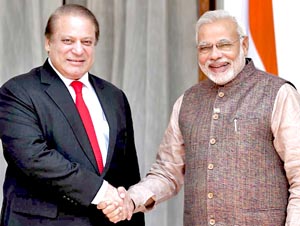
Modi sharif 27

Sharif told the media before flying back to Islamabad that he had underlined to Modi, who became prime minister a day earlier, that India as well as Pakistan needed peace to build their economies.

Sharif described his 45-minute meeting with Modi at the Hyderabad House as "very good and constructive" and added: "It was held in a warm and cordial atmosphere."

He told Modi that he desired to take forward the peace process that he had initiated with then Indian prime minister Atal Bihari Vajpayee in 1999 until it was derailed by a military coup.

"I intend to pick up the threads of the Lahore peace declaration."

The Pakistani premier said his own election and Modi's electoral victory - both "with a clear mandate" - "should be a historic opportunity for both our countries".

This, he said, "provides us the opportunity of meeting the hopes and aspirations of our people" and added that he hoped "to succeed and turn a new page in our relationship".

He recalled to Modi his invitation to the now ailing Vajpayee to Lahore in February 1999 "and told him that I intend to pick up the threads of the Lahore declaration" of peace.

"I stressed that we have a common agenda of economic revival which is not possible to achieve without peace."

Sharif said he urged Modi "to strive to change confrontation to cooperation" and added his government was "ready to discuss all issues in a spirit of cooperation".

"After all we owe it to our people ... to rid the region of instability and insecurity that has plagued us for decades.

"Accusations and counter-accusations will be counter productive... We must end the legacy of mistrust."

"Modi warmly reciprocated my sentiments," Sharif said.

Modi and Sharif agreed to let the two foreign secretaries meet soon to carry forward the bilateral agenda.

Sharif said he also had "warm and friendly exchanges" with President Pranab Mukherjee after meeting Modi.

Comments

Add new comment

  • Coastaldigest.com reserves the right to delete or block any comments.
  • Coastaldigset.com is not responsible for its readers’ comments.
  • Comments that are abusive, incendiary or irrelevant are strictly prohibited.
  • Please use a genuine email ID and provide your name to avoid reject.
News Network
December 13,2025

New Delhi: School-going children are picking up drug and smoking habits and engaging in consumption of alcohol, with the average age of introduction to such harmful substances found to be around 13 years, suggesting a need for earlier interventions as early as primary school, a multi-city survey by AIIMS-Delhi said.

The findings also showed substance use increased in higher grades, with grade XI/XII students two times more likely to report use of substances when compared with grade VIII students. This emphasised the importance of continued prevention and intervention through middle and high school.

The study led by Dr Anju Dhawan of AIIMS's National Drug Dependence Treatment Centre, published in the National Medical Journal of India this month, looks at adolescent substance use across diverse regions.

The survey included 5,920 students from classes 8, 9, 11 and 12 in urban government, private and rural schools across 10 cities -- Bengaluru, Chandigarh, Delhi, Dibrugarh, Hyderabad, Imphal, Jammu, Lucknow, Mumbai, and Ranchi. The data were collected between May 2018 and June 2019.

The average age of initiation for any substance was 12.9 (2.8) years. It was lowest for inhalants (11.3 years) followed by heroin (12.3 years) and opioid pharmaceuticals (without prescription; 12.5 years).

Overall, 15.1 per cent of participants reported lifetime use, 10.3 per cent reported past year use, and 7.2 per cent reported use in the past month of any substance, the study found.

The most common substances used in the past year, after tobacco (4 per cent) and alcohol (3.8 per cent), were opioids (2.8 per cent), followed by cannabis (2 per cent) and inhalants (1.9 per cent). Use of non-prescribed pharmaceutical opioids was most common among opioid users (90.2 per cent).

On being asked, 'Do you think this substance is easily available for a person of your age' separately for each substance category, nearly half the students (46.3 per cent) endorsed that tobacco products and more than one-third of the students (36.5 per cent) agreed that a person of their age can easily procure alcohol products.

Similarly, for Bhang (21.9 per cent), ganja/charas (16.1 per cent), inhalants (15.2 per cent), sedatives (13.7 per cent), opium and heroin (10 per cent each), the students endorsed that these can be easily procured.

About 95 per cent of the children, irrespective of their grade, agreed with the statement that 'drug use is harmful'.

The rates of substance use (any) among boys were significantly higher than those of girls for substance use (ever), use in the past year and use in the past 30 days. Compared to grade VIII students, grade IX students were more likely, and grade XI/XII students were twice as likely to have used any substance (ever).

The likelihood of past-year use of any substance was also higher for grade IX students and for grade XI/XII students as compared to grade VIII students.

About 40 per cent of students mentioned that they had a family member who used tobacco or alcohol each. The use of cannabis (any product) and opioid (any product) by a family member was reported by 8.2 per cent and 3.9 per cent of students, respectively, while the use of other substances, such as inhalants/sedatives by family was 2-3 per cent, the study found.

A relatively smaller percentage of students reported use of tobacco or alcohol among peers as compared to among family members, while a higher percentage reported inhalants, sedatives, cannabis or opioid use among peers.

Children using substances (past year) compared to non-users reported significantly higher any substance use by their family members and peers.

There were 25.7 per cent students who replied 'yes' to the question 'conflicts/fights often occur in your family'. Most students also replied affirmatively to 'family members are aware of how their time is being spent' and 'damily members are aware of with whom they spend their time'.

Comments

Add new comment

  • Coastaldigest.com reserves the right to delete or block any comments.
  • Coastaldigset.com is not responsible for its readers’ comments.
  • Comments that are abusive, incendiary or irrelevant are strictly prohibited.
  • Please use a genuine email ID and provide your name to avoid reject.