



Lucky Grahak draw: Central Bank of India customer wins Rs 1 crore

April 10, 2017

New Delhi, Apr 10: A transaction of Rs 1,590 has bagged a Central Bank of India customer lucky bounty of Rs 1 crore under the government's promotional scheme to popularise digital payments.
digidan2

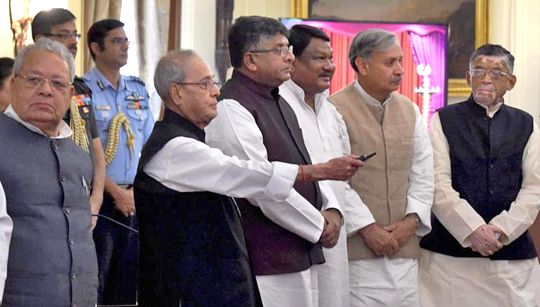
President Pranab Mukherjee picked up the lucky winners from the 100th draw of lots under digital payments promotion schemes at Rashtrapati Bhavan here.

He congratulated the six winners, three consumers and three merchants of Lucky Grahak Yojana and Digi Dhan Vyapar Yojana.

In the consumer section, the first mega prize of Rs 1 crore went to a customer of Central Bank of India, while the second prize of Rs 50 lakh went to a Bank of Baroda customer. A customer of Punjab National Bank is the winner of third prize of Rs 25 lakh.

All the three customers had done transactions using their RuPay debit cards. The names of three winners were not yet known as the draw only displayed their transaction numbers. These will be matched with card details to identify the winners.

Three merchants also won prizes of Rs 50 lakh, Rs 25 lakh and Rs 12 lakh, respectively.

The winners will be felicitated by Prime Minister Narendra Modi on April 14 at Nagpur on the occasion of Ambedkar Jayanti.

Following demonetisation of old Rs 500/1000 notes on November 9 last year, the government took a slew of measures to promote digital payments in the country.

The government launched the Lucky Grahak Yojana for consumers and Digi Dhan Vyapar Yojana for merchants on December 25, 2016 to promote digital transactions. These schemes are being implemented by the National Payment Corporation of India (NPCI).

In his address, Mukherjee asked citizens to extend their unstinted support to the mission of a less-cash India.

"India has a long way to go to become a cash less society. The initiatives of the government are a good beginning and we need to sustain and nurture these with active participation from all segments of the society.

"It is necessary to reduce cash in circulation and impart greater urgency to promoting secure digital payment methods to ensure greater transparency," the President said.

Presently, India remain primarily a cash based economy with about 95 percent of the personal consumption and 86 percent of all transactions being in cash.

"All efforts of the government will achieve their end only if people were to adopt them proactively," he said, as he complemented the government on its "bold initiatives" for promoting the culture of digital payments.

Stressing that India is on the cusp of a digital revolution, Mukherjee noted more than one billion Indians have a unique identity number with a biometric identifier which is unique in its own way.

"Even countries which are technologically far more advanced than India with comparatively much smaller size population do not have such a system in place. The Aadhaar card initiative is a watershed event in the development story of India," he said.

Speaking on the occasion, Cabinet Secretary P K Sinha said, "I would like reiterate our resolve and committement to take India towards digital economy.

"It is indeed a challenging task that requires behavioural change, apart from digital literacy and entire ecosystem that favours digital payments."

As part of the government's promotional schemes, digiDhan melas were held in 100 cities over 100 days and 15,000 consumers qualified everyday for total prize money of Rs 1.5 crore.

Additionally, 14,000 weekly winners, both consumers and merchants, have received a total prize money of over Rs 8.3 crore every week.

Comments

Add new comment

  • Coastaldigest.com reserves the right to delete or block any comments.
  • Coastaldigset.com is not responsible for its readers’ comments.
  • Comments that are abusive, incendiary or irrelevant are strictly prohibited.
  • Please use a genuine email ID and provide your name to avoid reject.
News Network
December 13,2025

New Delhi: School-going children are picking up drug and smoking habits and engaging in consumption of alcohol, with the average age of introduction to such harmful substances found to be around 13 years, suggesting a need for earlier interventions as early as primary school, a multi-city survey by AIIMS-Delhi said.

The findings also showed substance use increased in higher grades, with grade XI/XII students two times more likely to report use of substances when compared with grade VIII students. This emphasised the importance of continued prevention and intervention through middle and high school.

The study led by Dr Anju Dhawan of AIIMS's National Drug Dependence Treatment Centre, published in the National Medical Journal of India this month, looks at adolescent substance use across diverse regions.

The survey included 5,920 students from classes 8, 9, 11 and 12 in urban government, private and rural schools across 10 cities -- Bengaluru, Chandigarh, Delhi, Dibrugarh, Hyderabad, Imphal, Jammu, Lucknow, Mumbai, and Ranchi. The data were collected between May 2018 and June 2019.

The average age of initiation for any substance was 12.9 (2.8) years. It was lowest for inhalants (11.3 years) followed by heroin (12.3 years) and opioid pharmaceuticals (without prescription; 12.5 years).

Overall, 15.1 per cent of participants reported lifetime use, 10.3 per cent reported past year use, and 7.2 per cent reported use in the past month of any substance, the study found.

The most common substances used in the past year, after tobacco (4 per cent) and alcohol (3.8 per cent), were opioids (2.8 per cent), followed by cannabis (2 per cent) and inhalants (1.9 per cent). Use of non-prescribed pharmaceutical opioids was most common among opioid users (90.2 per cent).

On being asked, 'Do you think this substance is easily available for a person of your age' separately for each substance category, nearly half the students (46.3 per cent) endorsed that tobacco products and more than one-third of the students (36.5 per cent) agreed that a person of their age can easily procure alcohol products.

Similarly, for Bhang (21.9 per cent), ganja/charas (16.1 per cent), inhalants (15.2 per cent), sedatives (13.7 per cent), opium and heroin (10 per cent each), the students endorsed that these can be easily procured.

About 95 per cent of the children, irrespective of their grade, agreed with the statement that 'drug use is harmful'.

The rates of substance use (any) among boys were significantly higher than those of girls for substance use (ever), use in the past year and use in the past 30 days. Compared to grade VIII students, grade IX students were more likely, and grade XI/XII students were twice as likely to have used any substance (ever).

The likelihood of past-year use of any substance was also higher for grade IX students and for grade XI/XII students as compared to grade VIII students.

About 40 per cent of students mentioned that they had a family member who used tobacco or alcohol each. The use of cannabis (any product) and opioid (any product) by a family member was reported by 8.2 per cent and 3.9 per cent of students, respectively, while the use of other substances, such as inhalants/sedatives by family was 2-3 per cent, the study found.

A relatively smaller percentage of students reported use of tobacco or alcohol among peers as compared to among family members, while a higher percentage reported inhalants, sedatives, cannabis or opioid use among peers.

Children using substances (past year) compared to non-users reported significantly higher any substance use by their family members and peers.

There were 25.7 per cent students who replied 'yes' to the question 'conflicts/fights often occur in your family'. Most students also replied affirmatively to 'family members are aware of how their time is being spent' and 'damily members are aware of with whom they spend their time'.

Comments

Add new comment

  • Coastaldigest.com reserves the right to delete or block any comments.
  • Coastaldigset.com is not responsible for its readers’ comments.
  • Comments that are abusive, incendiary or irrelevant are strictly prohibited.
  • Please use a genuine email ID and provide your name to avoid reject.