



Lynchings: An era of voyeurism and social media misuse

Agencies
July 27, 2018

New Delhi, Jul 27: Social media platforms are the medium and vigilantism the message. Delivered by volatile crowds provoked to murderous rage, the all-too frequent lynchings are being played in all their goriness within hours on smartphone screens across India.

Affordable smartphones and the rapid spread of mobile internet have come together in recent months to lay bare the brutality of lynchings in chilling detail – savage mobs kicking and pummelling mercilessly, helpless victims cowering and begging for their lives and then, their bloodied and broken bodies lying limp in the dirt.

As lynching becomes the new buzzword, occupying headline space and dominating drawing room discussions, the montages of violence circulated endlessly highlight the gratuitous nature of the killings, the brittle civility that gives way only too easily to collective violence and the nonchalance of the bystander busy capturing the action rather than saving the victim.

It’s a lethal cocktail of voyeurism, the fear of missing out, or FOMO as it has come to be known, desensitisation and maybe just plain apathy underscored by the need for validation, said experts as the numbers spiral and they attempt to get a grip of why a mob behaves the way it does.

In 2015, when 52-year-old Mohammed Akhlaq was beaten to death in Bisada village in Dadri on the outskirts of Delhi on suspicion that he had stored beef in his home, it sent shockwaves through the country.

Three years later, the cases continue to pile up, with the latest being the lynching of suspected cow smuggler Rakbar Khan in Alwar, Rajasthan, but the outrage has dulled.

Fuelled by rumours that they are cattle smugglers or child abductors, the cases are reported from across the country. At least 25 people are believed to have been lynched this year.

Attempting to explain the hows and whys of mob psyche, Dr Cicilia Chettiar, head of department, Department of Psychology at Mumbai’s Maniben Nanavati Women's College, said the country is a "mix of collectivist and individualistic mini cultures".

In her view, lynchings are not going to be curbed anytime soon as society is power hungry and "uninvolved".

"We are an uninvolved society. We are also a culture which wants to show that I'm bigger than you, I've got something more powerful than you. That powerful or important thing could be a positive thing or a negative.

"As long as it's powerful - that I got this first - perhaps the video of someone dying or in an accident… elicits the feeling of self-assertion," Chettiar told PTI.

Sometimes, she added, people thrashing a person to death have no connect with the incident.

"Often, they are taking out their frustration. I can't do it with my boss or home or the system. We as humans don't like talking badly about ourselves. We tell ourselves a story about our own life. We don't want to introspect as we cannot manage this cognitive overload."

According to experts, easy access to social media platforms has amplified the voyeuristic tendency in people and the need to be the first to carry and disseminate the ‘news’.

Instead of intervening and preventing the situation from getting bad to worse, people either tend to stand around as mute spectators or jump into the crowd to participate in the ongoing vigilantism, they said.

Everybody wants to be a part of everything, said Dr Aditi Kaul, a Puducherry-based psychology professional.

"Somewhere, it highlights our deep need for the sense of validation. We tend to record each and everything. That whatever we do it should reach out to the public. It's a very disoriented form of recognition. They want to leave a footprint behind… Even if we talk in the generic sense, everyone is shouting just one thing, 'Look at me, I’m also here’!" Kaul told PTI.

"The second feeling is, 'I was the one who shared it first'. They also tend to escape the fear of missing out (FOMO). Besides self-validation, they feel the need to be an active part of the society."

She added that people with “no voices” tend to engage more in mob violence as they feel empowered.

"People from higher economic strata, with better exposure and educational opportunities, move in circles where they can be heard... Lower segments tend to raise voices in a crowd."

According to Delhi-based psychologist Pallavi Ram, the bigger the crowd, the stronger the validation.

She added that decisions taken as part of a group tend to be more extreme than those taken as individuals.

"You'd be more cautious when alone. In a group, you'll have the comfort of other members. Also, there will be a division of responsibility and accountability."

So will the mob continue to have its way and bystanders keep looking?

"No one is legally bound to actively intervene when they see a person being attacked. You can only attach moral responsibility to a situation, which is a subjective construct… Putting one’s own life in danger by Intervening is not something the law obliges you to do...,” said Souvik Mukherjee, assistant professor, Amity Law School, Kolkata.

Till the system is effective in dealing with this culture of impunity and people want to help instead of instigate, the violence will continue to spiral. There aren’t too many good Samaritans coming to your aid anytime soon.

Comments

Add new comment

  • Coastaldigest.com reserves the right to delete or block any comments.
  • Coastaldigset.com is not responsible for its readers’ comments.
  • Comments that are abusive, incendiary or irrelevant are strictly prohibited.
  • Please use a genuine email ID and provide your name to avoid reject.
News Network
December 16,2025

jordan.jpg

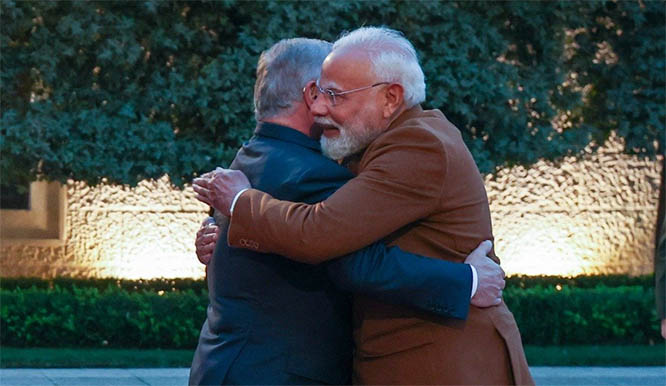
Prime Minister Narendra Modi on Monday held talks with Jordan’s King Abdullah II in Amman, during which the two leaders discussed ways to further strengthen bilateral relations, with the Prime Minister outlining an eight-point vision covering key areas of cooperation.

Describing the meeting as “productive”, PM Modi said he shared a roadmap focused on trade and economy, fertilisers and agriculture, information technology, healthcare, infrastructure, critical and strategic minerals, civil nuclear cooperation, and people-to-people ties.

In a post on social media platform X, the Prime Minister praised King Abdullah II’s personal commitment to advancing India–Jordan relations, particularly as both countries mark the 75th anniversary of the establishment of diplomatic ties this year.

“Held productive discussions with His Majesty King Abdullah II in Amman. His personal commitment towards vibrant India-Jordan relations is noteworthy. This year, we are celebrating the 75th anniversary of our bilateral diplomatic relations,” PM Modi said.

The meeting took place at the Al Husseiniya Palace, where the two leaders also exchanged views on regional and global issues of mutual interest. According to the Ministry of External Affairs (MEA), both sides agreed to further deepen cooperation in areas including trade and investment, defence and security, counter-terrorism and de-radicalisation, fertilisers and agriculture, infrastructure, renewable energy, tourism, and heritage.

The MEA said both leaders reaffirmed their united stand against terrorism.

PM Modi arrived in Amman earlier on Monday and was received by Jordanian Prime Minister Jafar Hassan, who accorded him a formal welcome. Following the talks, King Abdullah II hosted a banquet dinner in honour of the Prime Minister, reflecting the warmth of bilateral ties.

Jordan is the first leg of PM Modi’s three-nation tour. From Amman, the Prime Minister will travel to Ethiopia at the invitation of Prime Minister Abiy Ahmed Ali, marking his first official visit to the African nation. The tour will conclude with a visit to Oman.

Comments

Add new comment

  • Coastaldigest.com reserves the right to delete or block any comments.
  • Coastaldigset.com is not responsible for its readers’ comments.
  • Comments that are abusive, incendiary or irrelevant are strictly prohibited.
  • Please use a genuine email ID and provide your name to avoid reject.
News Network
December 16,2025

jordan.jpg

Prime Minister Narendra Modi on Monday held talks with Jordan’s King Abdullah II in Amman, during which the two leaders discussed ways to further strengthen bilateral relations, with the Prime Minister outlining an eight-point vision covering key areas of cooperation.

Describing the meeting as “productive”, PM Modi said he shared a roadmap focused on trade and economy, fertilisers and agriculture, information technology, healthcare, infrastructure, critical and strategic minerals, civil nuclear cooperation, and people-to-people ties.

In a post on social media platform X, the Prime Minister praised King Abdullah II’s personal commitment to advancing India–Jordan relations, particularly as both countries mark the 75th anniversary of the establishment of diplomatic ties this year.

“Held productive discussions with His Majesty King Abdullah II in Amman. His personal commitment towards vibrant India-Jordan relations is noteworthy. This year, we are celebrating the 75th anniversary of our bilateral diplomatic relations,” PM Modi said.

The meeting took place at the Al Husseiniya Palace, where the two leaders also exchanged views on regional and global issues of mutual interest. According to the Ministry of External Affairs (MEA), both sides agreed to further deepen cooperation in areas including trade and investment, defence and security, counter-terrorism and de-radicalisation, fertilisers and agriculture, infrastructure, renewable energy, tourism, and heritage.

The MEA said both leaders reaffirmed their united stand against terrorism.

PM Modi arrived in Amman earlier on Monday and was received by Jordanian Prime Minister Jafar Hassan, who accorded him a formal welcome. Following the talks, King Abdullah II hosted a banquet dinner in honour of the Prime Minister, reflecting the warmth of bilateral ties.

Jordan is the first leg of PM Modi’s three-nation tour. From Amman, the Prime Minister will travel to Ethiopia at the invitation of Prime Minister Abiy Ahmed Ali, marking his first official visit to the African nation. The tour will conclude with a visit to Oman.

Comments

Add new comment

  • Coastaldigest.com reserves the right to delete or block any comments.
  • Coastaldigset.com is not responsible for its readers’ comments.
  • Comments that are abusive, incendiary or irrelevant are strictly prohibited.
  • Please use a genuine email ID and provide your name to avoid reject.
News Network
December 6,2025

pilot.jpg

New Delhi: IndiGo, India’s largest airline, faced major operational turbulence this week after failing to prepare for new pilot-fatigue regulations issued by the Directorate General of Civil Aviation (DGCA). The stricter rules—designed to improve flight safety—took effect in phases through 2024, with the latest implementation on November 1. IndiGo has acknowledged that inadequate roster planning led to widespread cancellations and delays.

Below are the key DGCA rules that affected IndiGo’s operations:

1. Longer Mandatory Weekly Rest

Weekly rest for pilots has been increased from 36 hours to 48 hours.

The government says the extended break is essential to curb cumulative fatigue. This rule remains in force despite the current crisis.

2. Cap on Night Landings

Pilots can now perform only two night landings per week—a steep reduction from the earlier limit of six.

Night hours, defined as midnight to early morning, are considered the least alert period for pilots.

Given the disruptions, this rule has been temporarily relaxed for IndiGo until February 10.

3. Reduced Maximum Night Flight Duty

Flight duty that stretches into the night is now capped at 10 hours.

This measure has also been kept on hold for IndiGo until February 10 to stabilize operations.

4. Weekly Rest Cannot Be Replaced With Personal Leave

Airlines can no longer count a pilot’s personal leave as part of the mandatory 48-hour rest.

Pilots say this closes a loophole that previously reduced actual rest time.

Currently, all airlines are exempt from this rule to normalise travel.

5. Mandatory Fatigue Monitoring

Airlines must submit quarterly fatigue reports along with corrective actions to DGCA.

This system aims to create a transparent fatigue-tracking framework across the industry.

The DGCA has stressed that these rules were crafted to strengthen flight safety and align India with global fatigue-management standards. The temporary relaxations are expected to remain until February 2025, giving IndiGo time to stabilise its schedules and restore normal air travel.

Comments

Add new comment

  • Coastaldigest.com reserves the right to delete or block any comments.
  • Coastaldigset.com is not responsible for its readers’ comments.
  • Comments that are abusive, incendiary or irrelevant are strictly prohibited.
  • Please use a genuine email ID and provide your name to avoid reject.
