



Major blow to BJP in bypolls, worst hit in UP

September 16, 2014

New Delhi, Sep 16: The BJP today suffered a major blow in in the Assembly by-elections in Uttar Pradesh, Rajasthan and Gujarat,the states it had swept in the Lok Sabha polls four months ago, losing 13 of the 24 seats held by it.
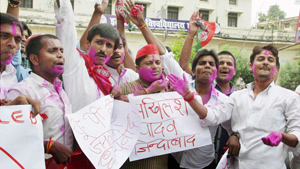
Bypoll Celebration

Considered yet another test of popularity of Prime Minister Narendra Modi, today's reverses in the by-elections come after the party's disappointing performance in the assembly by-elections in Bihar, Uttarakhand, Karnataka and Madhya Pradesh in the last two months.

Out of the 32 Assembly seats across nine states for which counting of votes was taken up today, BJP won 10, Congress seven and Samajwadi Party seven while TDP, Trinamool Congress, AIUDF and CPI(M) bagged one each. One seat in Sikkim was won by an Independent. In three seats in UP where results were awaited, BJP was leading in two and Samajwadi Party in one.

It was Uttar Pradesh, where the BJP was on a high after a near-total sweep of the 80 Lok Sabha seats, that delivered a humiliating blow to the saffron party as it lost seven of the 11 seats held by it, including one held by its ally Apna Dal. BSP's absence in the by-elections had made it a virtual straight fight between SP and BJP in the politically crucial state.

Equally crushing was the defeat in Rajasthan where BJP conceded three of the four seats to Congress, which also managed to wrest three of the nine seats in Gujarat, where the elections were held for the first time in 12 years sans Narendra Modi.

All the seats in Uttar Pradesh (11), Gujarat (9) and Rajasthan (4) were held by BJP and the bypolls were necessitated after the MLAs were elected to the Lok Sabha.

Gloating over BJP's reverses, the Congress and Samajwadi Party called it as a defeat of the communal forces. They said people had rejected the Narendra Modi Government and BJP's "politics of polarisation".

The BJP, which is hoping to do well in the coming assembly elections in Maharashtra and Haryana, conceded that the bypoll results were not up to expectations and said that people had voted on local issues.

The only solace for BJP on an otherwise dismal day was its entry in West Bengal Assembly. BJP candidate Shamik Bhattacharya won the Basirhat Dakshin seat in North 24 parganas district by a margin of 1,742 votes against its nearest Trinamool Congress rival and former Indian soccer captain Dipendu Biswas. The seat was earlier held by CPI(M).

BJP retained the Vadodara Lok Sabha seat, vacated by Prime Minister Modi, albeit with a reduced margin. Ranjanben Bhatt thumped her Congress rival Narendra Rawat by over 3.29 lakh votes. Modi had won the seat by 5.7 lakh votes.

In the other two Lok Sabha bye-elections, Mainpuri in Uttar Pradesh, the stronghold of ruling SP, Tej Pratap Singh, the grand nephew of Mulayam Singh Yadav, defeated BJP's Prem Singh Skahkya by a margin of more than 3.21 lakh votes. Mulayam had vacated the seat after he chose to retain Azamgarh.

In Medak Lok Sabha constituency in Telangana, the ruling TRS retained the seat vacated by party chief K Chandrasekhar Rao. Its candidate K Prabhakar Reddy won by 3,61,277 votes.

In Uttar Pradesh, out of 11 assembly seats, Samajwadi Party won seven seats and BJP one. In Gujarat, BJP won six seats and Congress three, while in Rajasthan Congress bagged three and BJP one. In Andhra Pradesh, ruling TDP retained the Nandigama seat.

In West Bengal, Trinamool and BJP won one seat each. The BJP also made other advances in eastern region wresting Silchar constituency in Assam from the Congress. The All India United Democratic Front and the ruling Congress retained Jamunamukh and Lakhipur seats respectively in the state.

CPI-M won the Manu (ST) Assembly constituency in Tripura while Independent candidate R N Chamling, brother of Chief Minister Pawan Kumar Chamling, won Rangang-Yangang assembly seat in Sikkim by 708 votes defeating his nearest Sikkim Democratic Front (SDF) nominee.

Last month, the saffron party suffered a 4-6 defeat at the hands of the RJD-JD(U)-Congress alliance in Bihar and yielded two strongholds to Congress in Karnataka and Madhya Pradesh in the by-elections. In July, it lost all the three assembly seats in Uttarakhand to Congress in the by-elections. @Body:

In UP, among the seats lost by BJP were Bijnor, Thakurdwara, Nighasan, Hamirpur, Charkhari, Sirathu, Balha. It retained Saharapur (city seat).

Charkhari was earlier held by Union Minister Uma Bharati.

In Gujarat, BJP lost Dessa, Mangrol and Khambalia seats to Congress. It managed to retain Maninagar, Tankara, Talaja, Anand, Kheda and Limkheda assembly seats.

In Rajasthan, BJP lost in Nasirabad, Weir and Surajgarh Assembly constituencies. It retained Kota city.

In West Benagl, whereas Trinamool Congress bagged the prestigious Chowringhee seat. TMC candidate Nayana Bandopadhyay won by a margin of 14344 votes against her nearest rival BJP's Ritesh Tiwari.

AIDUF's Abdur Rahim Ajmal won the Jamunamukh seat defeating Congress' Bashir Uddin Laskar by 22,959 votes in Assam.

AIUDF President Badruddin Ajmal's son Abdur Rahim Ajmal retained the seat polling 62,153 votes.

The ruling Congress retained Lakhipur seat as its candidate Rajdeep Goala defeated his nearest BJP rival Sanjay Thakur by 9172 votes garnering 40,090 votes, while Thakur got 30918 votes.

In Silchar, however, BJP's Dilip Kumar Paul is ahead of Arun Dutta Majumdar of Congress.

Telugu Desam Party's Tangirala Sowmya won the Nandigama Assembly bypoll in Andhra Pradesh by 74,827 votes.

Riding on the sympathy wave, Sowmya, a software engineer, got 99,748 votes. The by-election was necessitated following the death of Sowmya's father due to a cardiac arrest.

CPI-M candidate Prabhat Chowdhury trounced his nearest INC candidate Mailafru Mog in Manu (ST) constituency in Tripura. The constituency fell vacant after former Idustries and Commerce Minister Jitendra Chowdhury was elected to the Lok Sabha.

Comments

Add new comment

  • Coastaldigest.com reserves the right to delete or block any comments.
  • Coastaldigset.com is not responsible for its readers’ comments.
  • Comments that are abusive, incendiary or irrelevant are strictly prohibited.
  • Please use a genuine email ID and provide your name to avoid reject.
News Network
December 6,2025

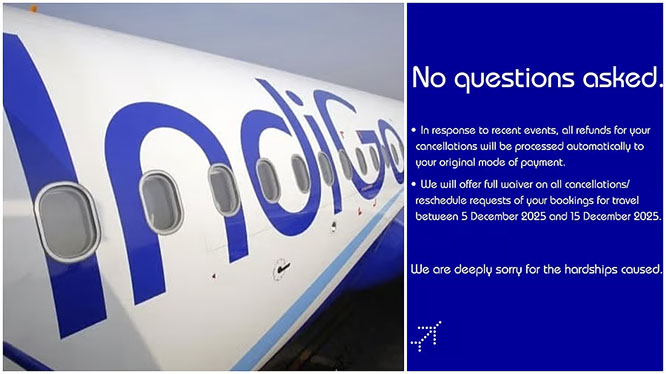
indigoticket.jpg

With IndiGo flight disruptions impacting thousands of passengers, the airline on Saturday said that it will offer full waiver on all cancellations/reschedule requests for travel bookings between December 5, 2025 and December 15, 2025.

Earlier in the day, the civil aviation ministry had directed the airline to complete the ticket refund process for the cancelled flights by Sunday evening, as well as ensure baggage separated from the travellers are delivered in the next two days.

In a post on X, titled 'No questions asked', IndiGo wrote, "In response to recent events, all refunds for your cancellations will be processed automatically to your original mode of payment."

"We are deeply sorry for the hardships caused," it further added.

Several passengers, however, complained of not getting full refund as promised by the airline.

Netizens have shared screenchots of getting charged for airline cancellation fee and convenience fee.

"Please tell me why u have did this airline cancellation charges when u say full amount will be refunded (sic)," a user wrote sharing a screenshot of the refund page.

"Well, but you have still debited the convenience charges," wrote another.

Passengers have also raised concerns about the "cancel" option being disabled on the IndiGo app. "First enable the 'Cancel' button on your App & offer full refund on tickets cancelled by customers between the said dates," wrote a user.

A day after the country's largest airline, IndiGo, cancelled more than 1,000 flights and caused disruptions for the fifth day on Saturday, the ministry said that any delay or non-compliance in refund processing will invite immediate regulatory action.

The refund process for all cancelled or disrupted flights must be completed by 8 pm on Sunday, the ministry said in a statement.

"Airlines have also been instructed not to levy any rescheduling charges for passengers whose travel plans were affected by cancellations," it said.

On Saturday, more than 400 flights were cancelled at various airports.

IndiGo has also been instructed to set up dedicated passenger support and refund facilitation cells.

Comments

Add new comment

  • Coastaldigest.com reserves the right to delete or block any comments.
  • Coastaldigset.com is not responsible for its readers’ comments.
  • Comments that are abusive, incendiary or irrelevant are strictly prohibited.
  • Please use a genuine email ID and provide your name to avoid reject.
News Network
December 13,2025

New Delhi: School-going children are picking up drug and smoking habits and engaging in consumption of alcohol, with the average age of introduction to such harmful substances found to be around 13 years, suggesting a need for earlier interventions as early as primary school, a multi-city survey by AIIMS-Delhi said.

The findings also showed substance use increased in higher grades, with grade XI/XII students two times more likely to report use of substances when compared with grade VIII students. This emphasised the importance of continued prevention and intervention through middle and high school.

The study led by Dr Anju Dhawan of AIIMS's National Drug Dependence Treatment Centre, published in the National Medical Journal of India this month, looks at adolescent substance use across diverse regions.

The survey included 5,920 students from classes 8, 9, 11 and 12 in urban government, private and rural schools across 10 cities -- Bengaluru, Chandigarh, Delhi, Dibrugarh, Hyderabad, Imphal, Jammu, Lucknow, Mumbai, and Ranchi. The data were collected between May 2018 and June 2019.

The average age of initiation for any substance was 12.9 (2.8) years. It was lowest for inhalants (11.3 years) followed by heroin (12.3 years) and opioid pharmaceuticals (without prescription; 12.5 years).

Overall, 15.1 per cent of participants reported lifetime use, 10.3 per cent reported past year use, and 7.2 per cent reported use in the past month of any substance, the study found.

The most common substances used in the past year, after tobacco (4 per cent) and alcohol (3.8 per cent), were opioids (2.8 per cent), followed by cannabis (2 per cent) and inhalants (1.9 per cent). Use of non-prescribed pharmaceutical opioids was most common among opioid users (90.2 per cent).

On being asked, 'Do you think this substance is easily available for a person of your age' separately for each substance category, nearly half the students (46.3 per cent) endorsed that tobacco products and more than one-third of the students (36.5 per cent) agreed that a person of their age can easily procure alcohol products.

Similarly, for Bhang (21.9 per cent), ganja/charas (16.1 per cent), inhalants (15.2 per cent), sedatives (13.7 per cent), opium and heroin (10 per cent each), the students endorsed that these can be easily procured.

About 95 per cent of the children, irrespective of their grade, agreed with the statement that 'drug use is harmful'.

The rates of substance use (any) among boys were significantly higher than those of girls for substance use (ever), use in the past year and use in the past 30 days. Compared to grade VIII students, grade IX students were more likely, and grade XI/XII students were twice as likely to have used any substance (ever).

The likelihood of past-year use of any substance was also higher for grade IX students and for grade XI/XII students as compared to grade VIII students.

About 40 per cent of students mentioned that they had a family member who used tobacco or alcohol each. The use of cannabis (any product) and opioid (any product) by a family member was reported by 8.2 per cent and 3.9 per cent of students, respectively, while the use of other substances, such as inhalants/sedatives by family was 2-3 per cent, the study found.

A relatively smaller percentage of students reported use of tobacco or alcohol among peers as compared to among family members, while a higher percentage reported inhalants, sedatives, cannabis or opioid use among peers.

Children using substances (past year) compared to non-users reported significantly higher any substance use by their family members and peers.

There were 25.7 per cent students who replied 'yes' to the question 'conflicts/fights often occur in your family'. Most students also replied affirmatively to 'family members are aware of how their time is being spent' and 'damily members are aware of with whom they spend their time'.

Comments

Add new comment

  • Coastaldigest.com reserves the right to delete or block any comments.
  • Coastaldigset.com is not responsible for its readers’ comments.
  • Comments that are abusive, incendiary or irrelevant are strictly prohibited.
  • Please use a genuine email ID and provide your name to avoid reject.