



Malegaon: Purohit moves SC against Bombay HC order rejecting bail

April 28, 2017

New Delhi, Apr 28: Malegaon blast accused Shrikant Purohit today moved the Supreme Court against the Bombay High Court order rejecting his bail plea in the case. A bench headed by Chief Justice J S Khehar said that the petition will come up in regular course while rejecting the former lieutenant colonel's plea for an urgent hearing.
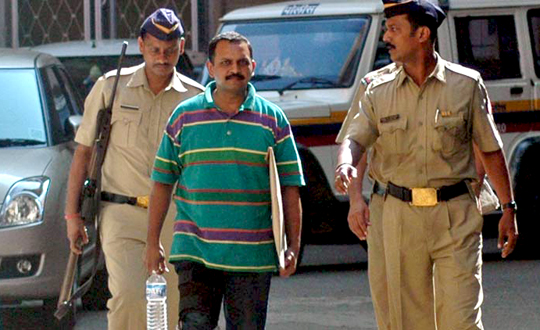
purohit

The Bombay High Court had on April 25 granted bail to Sadhvi Pragya Singh Thakur, accused of plotting the September 2008 Malegaon blast, but rejected the bail plea of co-accused Purohit saying the charges against him were of grave nature. Six persons were killed and nearly 100 others injured when a bomb strapped to a motorcycle had exploded in Malegaon town of Nashik district on September 29, 2008.

Sadhvi Pragya and 44-year-old Purohit were arrested in 2008. While Sadhvi Pragya, 44, who is suffering from cancer, is undergoing treatment a Madhya Pradesh hospital, Purohit is lodged in Taloja jail in Maharashtra. The High Court had said that prima facie no case was made out against Pragya and asked her to furnish a cash surety of Rs five lakh and surrender her passport to the National Investigation Agency (NIA).

The NIA, which was handed over the probe from ATS, had given a clean chit to Sadhvi Pragya but had opposed Purohit's bail plea noting that the charges levelled against Purohit are of serious and grave nature. Referring to the report filed by the NIA, the HC had said, "Purohit was the one who prepared a separate 'Constitution' for 'Hindu Rashtra' with a separate saffron colour flag. He also discussed about taking revenge for the atrocities committed by the Muslims on Hindus."

The HC had refused to accept Purohit's contention that he had attended the meetings as part of a "covert military intelligence operation." The court pointed out the statements of the witnesses that it was Purohit who said their right-wing group Abhinav Bharat should not be just a political party but should work as an organisation of extremists, having the capacity to eliminate persons opposing the same. According to the investigating agencies, the blast was allegedly carried out by right-wing group Abhinav Bharat.

The NIA had opposed Purohit's bail plea and argued that there was evidence in the form of audio and video recordings, call data records and the statements of the witnesses which prove his involvement in the case. According to the NIA, Purohit had allegedly taken active part in the conspiracy meetings and even agreed to arrange explosives to be used in the blast. Purohit had argued that the NIA was "selective" in exonerating some accused persons and that the agency made him a "scapegoat" in the case.

Comments

Add new comment

  • Coastaldigest.com reserves the right to delete or block any comments.
  • Coastaldigset.com is not responsible for its readers’ comments.
  • Comments that are abusive, incendiary or irrelevant are strictly prohibited.
  • Please use a genuine email ID and provide your name to avoid reject.
News Network
December 13,2025

New Delhi: School-going children are picking up drug and smoking habits and engaging in consumption of alcohol, with the average age of introduction to such harmful substances found to be around 13 years, suggesting a need for earlier interventions as early as primary school, a multi-city survey by AIIMS-Delhi said.

The findings also showed substance use increased in higher grades, with grade XI/XII students two times more likely to report use of substances when compared with grade VIII students. This emphasised the importance of continued prevention and intervention through middle and high school.

The study led by Dr Anju Dhawan of AIIMS's National Drug Dependence Treatment Centre, published in the National Medical Journal of India this month, looks at adolescent substance use across diverse regions.

The survey included 5,920 students from classes 8, 9, 11 and 12 in urban government, private and rural schools across 10 cities -- Bengaluru, Chandigarh, Delhi, Dibrugarh, Hyderabad, Imphal, Jammu, Lucknow, Mumbai, and Ranchi. The data were collected between May 2018 and June 2019.

The average age of initiation for any substance was 12.9 (2.8) years. It was lowest for inhalants (11.3 years) followed by heroin (12.3 years) and opioid pharmaceuticals (without prescription; 12.5 years).

Overall, 15.1 per cent of participants reported lifetime use, 10.3 per cent reported past year use, and 7.2 per cent reported use in the past month of any substance, the study found.

The most common substances used in the past year, after tobacco (4 per cent) and alcohol (3.8 per cent), were opioids (2.8 per cent), followed by cannabis (2 per cent) and inhalants (1.9 per cent). Use of non-prescribed pharmaceutical opioids was most common among opioid users (90.2 per cent).

On being asked, 'Do you think this substance is easily available for a person of your age' separately for each substance category, nearly half the students (46.3 per cent) endorsed that tobacco products and more than one-third of the students (36.5 per cent) agreed that a person of their age can easily procure alcohol products.

Similarly, for Bhang (21.9 per cent), ganja/charas (16.1 per cent), inhalants (15.2 per cent), sedatives (13.7 per cent), opium and heroin (10 per cent each), the students endorsed that these can be easily procured.

About 95 per cent of the children, irrespective of their grade, agreed with the statement that 'drug use is harmful'.

The rates of substance use (any) among boys were significantly higher than those of girls for substance use (ever), use in the past year and use in the past 30 days. Compared to grade VIII students, grade IX students were more likely, and grade XI/XII students were twice as likely to have used any substance (ever).

The likelihood of past-year use of any substance was also higher for grade IX students and for grade XI/XII students as compared to grade VIII students.

About 40 per cent of students mentioned that they had a family member who used tobacco or alcohol each. The use of cannabis (any product) and opioid (any product) by a family member was reported by 8.2 per cent and 3.9 per cent of students, respectively, while the use of other substances, such as inhalants/sedatives by family was 2-3 per cent, the study found.

A relatively smaller percentage of students reported use of tobacco or alcohol among peers as compared to among family members, while a higher percentage reported inhalants, sedatives, cannabis or opioid use among peers.

Children using substances (past year) compared to non-users reported significantly higher any substance use by their family members and peers.

There were 25.7 per cent students who replied 'yes' to the question 'conflicts/fights often occur in your family'. Most students also replied affirmatively to 'family members are aware of how their time is being spent' and 'damily members are aware of with whom they spend their time'.

Comments

Add new comment

  • Coastaldigest.com reserves the right to delete or block any comments.
  • Coastaldigset.com is not responsible for its readers’ comments.
  • Comments that are abusive, incendiary or irrelevant are strictly prohibited.
  • Please use a genuine email ID and provide your name to avoid reject.