



Mangaluru, May 10: Astronomy enthusiasts in this coastal city on Monday observed a rare astronomical phenomenon, Mercury's transit of the Sun, that occurs only 13 times in a century as planet Mercury was seen navigating as dot on the solar disc.
The next transit of Mercury will take place on November 11, 2019 but the event cannot be seen from India as the same will begin after the sunset time of all places in the country. “The transit of Mercury on November 13, 2032 will be visible again from India,” said an expert.
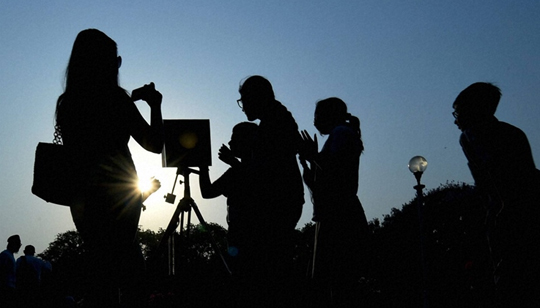
The Amateur Astronomers' Association and the Pilikula Regional Science Centre, here had made arrangements on the terrace of the Mangaluru City Corporation complex for people to watch the spectacle.
The former professor of St. Agnes College, H. Jayanata, had brought his telescope. Directing the telescope towards the Sun, Mr. Jayanta's daughter Amruta made the image of the Sun from the view finder fall on a plain drawing sheet. “Watching the Sun directly will hurt the retina. Hence, we made this arrangement,” K.V. Rao, director of Pilikula Science Centre, said.
Though the transit across the Sun from east to west started at 4.42 p.m., it was only around 5 p.m. that the movement of Mercury was noticed. Mercury was seen as a small dot on the image reflected on the paper. This small dot was seen slowly moving diagonally down from left to the right.
“We can only see this till the Sun sets. Those in the U.S. and African continent can get a complete view of the transit,” Mr. Jayanta said.
The transit of Mercury was visible from most parts of Asia (except south eastern parts and Japan), Europe, Africa, Greenland, South America, North America, Arctic, North Atlantic Ocean and much of the Pacific Ocean area.
The entire transit, from beginning to end, was visible from eastern North America, northern South America, the Arctic, Greenland, extreme northwestern Africa, western Europe, and the North Atlantic Ocean. The last transit of Mercury had occurred on November 6, 2006 when just the end of the event was visible from the extreme north-eastern parts of India at sunrise.

Comments
Add new comment