Mass Iftar at Masjids revive spirit of equality and fraternity

[email protected] (CD Network)
August 4, 2011

Mangalore, August 4: Breaking fast in congregations in Masjids is one of the phenomenon that has become popular across Mangalore over the last few years.

Hundreds of believers throng different Masjids during Ramadan evenings for Iftar and over the years the arrangements for such congregation has significantly improved with respective Masjid committees taking extra interest in organizing such get-togethers.

Iftar is breaking fast at sunset after a day of fasting. Traditionally this meal is shared by families, neighbors and friends who get together to break-fast and enjoy each-others company.

But over the years, for various reasons, the Iftar get-togethers in Masjids have become a norm. Tens of thousands of fasting Muslims benefit because of this noble practice and this comes as a big relief for those who cannot get back to their respective homes for Iftar due to a number of reasons.

There is a large chunk of Muslim population who come to Mangalore for work and cannot return home in time for Iftar because of duty timings and other factors. There is also a sizeable number of Muslim students and employees who live in hostels and can't make their own arrangements for breaking fast. For such people, the Iftar gatherings at Masjids come as a big relief.

Eidgah Masjid in Mangalore is believed to have pioneered the concept of mass Iftar in the city. But, the practice of breaking fast at Masjids had been in vogue for a long time. People used to come to Masjids with their Iftar food and break-fast in the Masjid. People of different strata of the society used to come with their food and sit in separate small groups and share the food. Although the sense of sharing would be high on each one's mind, there used to be some amount of separation based on economic and social status of the people.

“The rich and affluent would come with their basket of food and share it with their own group. The working class and the commoners would sit separately with their own small plates. Although everyone came to the Masjid with noble intention of sharing and joining Magrib Namaz on time, the divisions were far too visible to be ignored,” said a volunteer who is associated with the Iftar arrangements ever since it started in 1996.

The arrangement for Iftar at the Masjid has come for special praise from the people who have been there. “There are about 10 items served every day. Apart from fruits like apple, musambi, sapota, papaya, we also get samosas, soji, sharbat and tea,” says Mohammed Nayeem, a daily wage worker from Talapady, who is a regular at the Iftar gathering.

The expenses of the Iftar works out to Rs. 5,000 per day and philanthropists come forward to take up sponsorship for a day or two. “There is a noble hearted person, who takes care of the expenses of 10 days. We don't go after people seeking sponsorships. People approach us on their own. Nearly 400 to 450 people come to the Masjid for breaking fast,” says the volunteer.

Since the Masjid is situated close to a number of colleges and other educational institutions, the number of non-resident students are more at the gatherings.

The management of Taqwa Masjid has also taken special efforts in organizing collective Ifthar meets. Nearly 500 believers partake in the Iftar on a daily basis. Since, the Masjid is situated on the Highway, the number of wayfarers is more compared to other Majids.

The following pictures bring glimpses of the mass-Iftar scenes at Eidgah Masjid, Light House Hill, and Taqwa Masjid, Pumpwell.

TQ_1

TQ_2

TQ_3

TQ_4

TQ_5

TQ_6

TQ_7

TQ_8

TQ_9

TQ_10

Comments

Add new comment

  • Coastaldigest.com reserves the right to delete or block any comments.
  • Coastaldigset.com is not responsible for its readers’ comments.
  • Comments that are abusive, incendiary or irrelevant are strictly prohibited.
  • Please use a genuine email ID and provide your name to avoid reject.
coastaldigest.com news network
January 19,2026

badriya.jpg

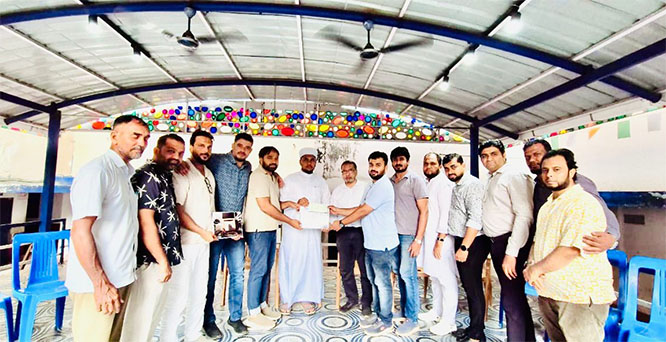
Mangaluru: The Phase I project of Badria Vision 2028 was formally launched at a ceremony held at the Badria Campus on January 17, marking an important step in the institution’s long-term development roadmap.

The programme was attended by P.B. Abdul Hameed, Secretary of the MEA, and P.C. Hasir, Correspondent of the MEA, who presided over the event and underscored the institution’s commitment to growth and academic excellence.

Office-bearers of the Badria Alumni Association were present in large numbers, including A.K. Sajid (President), Shamsuddin and S.M. Farooq (Vice-Presidents), Shaheed (General Secretary), and Khaleel (Treasurer), reflecting strong alumni engagement in the initiative.

The gathering was blessed by Sayyid Shamsuddeen Basith Thangal Kukkaje, Qateeb of Zeenat Yatheem Bakshi, who led a special dua seeking divine guidance and success for the project.

The ceremony also witnessed the participation of prominent alumnus and local corporate professional Abdul Latheef, along with alumni members Naushad, Kalandar, Safwan, members of the core committee, and several other former students.

A key moment of the event was the formal handover of a cheque to Ameen Woodland Architect, signalling the immediate commencement of construction work under Phase I of the project.

Organisers said the launch of Phase I reflects a shared vision, institutional unity, and collective resolve to realise the objectives of Badria Vision 2028.

Comments

Add new comment

  • Coastaldigest.com reserves the right to delete or block any comments.
  • Coastaldigset.com is not responsible for its readers’ comments.
  • Comments that are abusive, incendiary or irrelevant are strictly prohibited.
  • Please use a genuine email ID and provide your name to avoid reject.
News Network
January 23,2026

Karnataka Governor Thaawarchand Gehlot read only three lines from the 122-paragraph address prepared by the Congress-led state government while addressing the joint session of the Legislature on Thursday, effectively bypassing large sections critical of the BJP-led Union government.

The omitted portions of the customary Governor’s address outlined what the state government described as a “suppressive situation in economic and policy matters” under India’s federal framework. The speech also sharply criticised the Centre’s move to replace the Mahatma Gandhi National Rural Employment Guarantee Act (MGNREGA) with the Viksit Bharat–Guarantee for Rozgar and Ajeevika Mission (Gramin) Act, commonly referred to as the VB-GRAM (G) Act.

Governor Gehlot had earlier conveyed his objection to several paragraphs that were explicitly critical of the Union government. On Thursday, he confined himself to the opening lines — “I extend a warm welcome to all of you to the joint session of the State legislature. I am extremely pleased to address this august House” — before jumping directly to the concluding sentence of the final paragraph.

He ended the address by reading the last line of paragraph 122: “Overall, my government is firmly committed to doubling the pace of the State’s economic, social and physical development. Jai Hind — Jai Karnataka.”

According to the prepared speech, the Karnataka government demanded the scrapping of the VB-GRAM (G) Act, describing it as “contractor-centric” and detrimental to rural livelihoods, and called for the full restoration of MGNREGA. The state government argued that the new law undermines decentralisation, weakens labour protections, and centralises decision-making in violation of constitutional norms.

Key points from the unread sections of the speech:

•    Karnataka facing a “suppressive” economic and policy environment within the federal system

•    Repeal of MGNREGA described as a blow to rural livelihoods

•    VB-GRAM (G) Act accused of protecting corporate and contractor interests

•    New law alleged to weaken decentralised governance

•    Decision-making said to be imposed by the Centre without consulting states

•    Rights of Adivasis, women, backward classes and agrarian communities curtailed

•    Labourers allegedly placed under contractor control

•    States facing mounting fiscal stress due to central policies

•    VB-GRAM (G) Act accused of enabling large-scale corruption

Comments

Add new comment

  • Coastaldigest.com reserves the right to delete or block any comments.
  • Coastaldigset.com is not responsible for its readers’ comments.
  • Comments that are abusive, incendiary or irrelevant are strictly prohibited.
  • Please use a genuine email ID and provide your name to avoid reject.
coastaldigest.com news network
January 19,2026

rizwanzameer.jpg

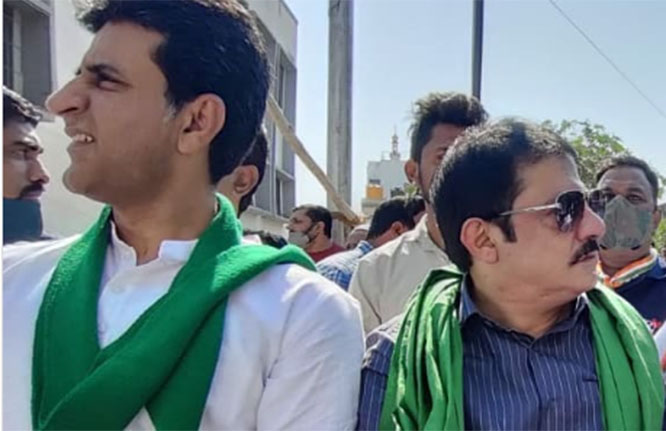
Bengaluru: As the dust settles on the recent legislative session, the corridors of Vidhana Soudha are buzzing with more than just policy talk. A high-stakes game of political musical chairs has begun, exposing a deepening rift within the Congress party’s Muslim leadership as a major Cabinet reshuffle looms.

With the party hierarchy signaling a "50% refresh" to gear up for the 2028 Assembly elections, the race to fill three projected Muslim ministerial berths has transformed from a strategic discussion into an all-out turf war.

The "Star Son" Spark

The internal friction turned public this week following provocative remarks by Zaid Khan, actor and son of Wakf Minister Zameer Ahmed Khan. Zaid’s claim—that his father "helped" secure a ticket for Shivajinagar MLA Rizwan Arshad in 2023—has acted as a lightning rod for resentment.

Rizwan’s camp was quick to fire back, dismissing the comment as a desperate attempt by Zameer to manufacture seniority. "Rizwan’s political pedigree was forged in the NSUI and Youth Congress long before Zameer even stepped into the party," a supporter noted, highlighting Rizwan’s tenure as an AICC secretary and his two-term presidency of the State Youth Congress.

A Tale of Two Loyalists

While both Zameer Ahmed Khan and Rizwan Arshad are staunch allies of Chief Minister Siddaramaiah and represent Bengaluru strongholds, their political DNA could not be more different:

•    Zameer Ahmed Khan: A four-time MLA who crossed over from JD(S) in 2018. Known for his "overzealous" and often polarizing outreach during communal flashpoints—from the DJ Halli riots to the recent Wakf land notice controversy—his style has frequently left the Congress high command in a state of "discomfort."

•    Rizwan Arshad: A homegrown organizational man. Seen as a "quiet performer," Arshad represents the sophisticated, moderate face of the party, preferred by those who find Zameer’s brand of politics too volatile.

The Outsiders Looking In

The bickering isn't limited to a duo. The "Beary" community, represented by leaders like N A Haris and Saleem Ahmed, is demanding its pound of flesh. Saleem Ahmed, the Chief Whip in the Legislative Council, has dropped the veil of diplomacy, openly declaring his ministerial aspirations.

"I was the only working president not included in the Cabinet last time," Saleem noted pointedly, signaling that the "loyalty quota" is no longer enough to keep the peace.

As Chief Minister Siddaramaiah prepares to finalize the list, he faces a delicate balancing act: rewarding the aggressive grassroots mobilization of Zameer’s camp without alienating the organizational stalwarts and minority sub-sects who feel increasingly sidelined by the "Chamarajpet-Shivajinagar" binary.

Comments

Add new comment

  • Coastaldigest.com reserves the right to delete or block any comments.
  • Coastaldigset.com is not responsible for its readers’ comments.
  • Comments that are abusive, incendiary or irrelevant are strictly prohibited.
  • Please use a genuine email ID and provide your name to avoid reject.