#MeToo launched by "perverted" minds, says minister

Agencies
October 18, 2018

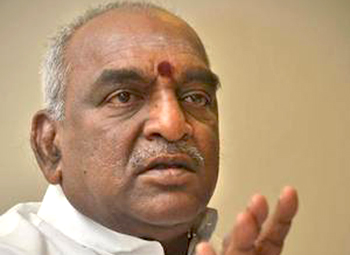
Karur, Oct 18: In potentially controversial remarks that could provoke a backlash, Union Minister Pon Radhakrishnan has said the #MeToo movement was started by "people with perverted minds" and wondered if it was fair to level accusations over incidents that happened years ago.

The BJP leader made the comments in response to questions by reporters Wednesday amid the raging #MeToo storm which has demolished the carefully cultivated reputations of many distinguished personalities in the field of media and entertainment industry including celebrated journalist M J Akbar.

Akbar, who edited many mainstream publications before joining politics, resigned as Union Minister of State for External Affairs on Wednesday after a host of his former women journalist colleagues accused him of sexual harassment.

"If someone makes an allegation that such a thing happened.....when the incident happened we were playing together while in class 5....Would it be fair?

"This (MeToo movement) is the result of the behaviour of some people who have perverted minds," Radhakrishnan, Union Minister of State for Shipping and Finance said.

Noting that the 'MeToo' movement had sullied the image of the country and women, he wondered if it would be right for men to start "making similar accusations like them".

"That will be such a big insult....Will it be acceptable?" Radhakrishnan said.

The #MeToo movement has gathered steam over the past few days with a number of women speaking about sexual harassment at workplace and outed their alleged tormentors.

Several celebrities including actors Nana Patekar, Alok Nath, filmmaker Subhash Ghai, author Chetan Bhagat, singer Kailash Kher and Tamil lyricist Vairamuthu are among the few who have been called out by their alleged victims.

Comments

Add new comment

  • Coastaldigest.com reserves the right to delete or block any comments.
  • Coastaldigset.com is not responsible for its readers’ comments.
  • Comments that are abusive, incendiary or irrelevant are strictly prohibited.
  • Please use a genuine email ID and provide your name to avoid reject.
News Network
December 16,2025

jordan.jpg

Prime Minister Narendra Modi on Monday held talks with Jordan’s King Abdullah II in Amman, during which the two leaders discussed ways to further strengthen bilateral relations, with the Prime Minister outlining an eight-point vision covering key areas of cooperation.

Describing the meeting as “productive”, PM Modi said he shared a roadmap focused on trade and economy, fertilisers and agriculture, information technology, healthcare, infrastructure, critical and strategic minerals, civil nuclear cooperation, and people-to-people ties.

In a post on social media platform X, the Prime Minister praised King Abdullah II’s personal commitment to advancing India–Jordan relations, particularly as both countries mark the 75th anniversary of the establishment of diplomatic ties this year.

“Held productive discussions with His Majesty King Abdullah II in Amman. His personal commitment towards vibrant India-Jordan relations is noteworthy. This year, we are celebrating the 75th anniversary of our bilateral diplomatic relations,” PM Modi said.

The meeting took place at the Al Husseiniya Palace, where the two leaders also exchanged views on regional and global issues of mutual interest. According to the Ministry of External Affairs (MEA), both sides agreed to further deepen cooperation in areas including trade and investment, defence and security, counter-terrorism and de-radicalisation, fertilisers and agriculture, infrastructure, renewable energy, tourism, and heritage.

The MEA said both leaders reaffirmed their united stand against terrorism.

PM Modi arrived in Amman earlier on Monday and was received by Jordanian Prime Minister Jafar Hassan, who accorded him a formal welcome. Following the talks, King Abdullah II hosted a banquet dinner in honour of the Prime Minister, reflecting the warmth of bilateral ties.

Jordan is the first leg of PM Modi’s three-nation tour. From Amman, the Prime Minister will travel to Ethiopia at the invitation of Prime Minister Abiy Ahmed Ali, marking his first official visit to the African nation. The tour will conclude with a visit to Oman.

Comments

Add new comment

  • Coastaldigest.com reserves the right to delete or block any comments.
  • Coastaldigset.com is not responsible for its readers’ comments.
  • Comments that are abusive, incendiary or irrelevant are strictly prohibited.
  • Please use a genuine email ID and provide your name to avoid reject.
News Network
December 22,2025

saudisnow.jpg

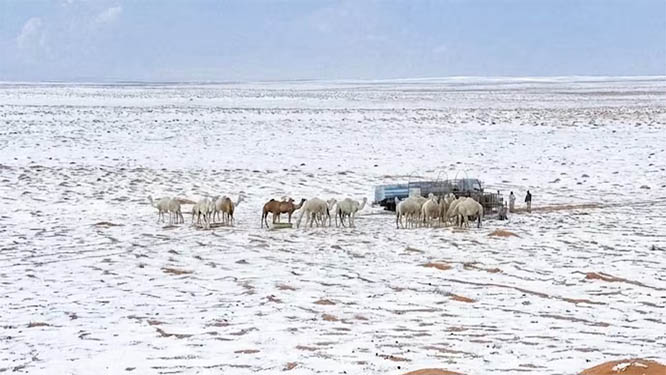
Saudi Arabia has witnessed rare snowfall in several parts of the country, including the northern regions, where such an event has been reported for the first time in 30 years, leaving residents in awe. 

The white blanket of snow covered vast desert areas, from the Tuwaiq mountain range in the west to regions near Riyadh. The rare event has sparked excitement and disbelief among residents, who have shared videos and photos of the Gulf nation blanketed in white.

A video shared on X captured an unusual scene: a group of camels standing in a desert area covered in snow, with dark clouds looming overhead.

Snowfall transformed parts of the country into an unexpected winter playground. Another video showed adults enjoying the snow by skiing, celebrating, and capturing a scene rarely seen in the Kingdom.

Local TV channels have described the snowfall as historic, while many residents have expressed concerns over the cold conditions and icy roads. The National Meteorology Center (NCM) had earlier warned of a sharp drop in temperatures and urged the public to take safety precautions.

Additionally, the Trojena Highlands and parts of the Tabuk region experienced unusually low temperatures due to snow last week. Jabal Al-Lawz in Tabuk reported heavy snowfall on Wednesday, accompanied by thick fog and strong winds, according to the Saudi Gazette.

The NCM has forecast a high chance of snow in the Qassim region and northern parts of Riyadh on Thursday, as an intense weather system continues to affect large areas of the kingdom. Authorities have cautioned the public to exercise extreme care during the severe weather.

While snow in Saudi Arabia is rare, it is not unprecedented. Last February, the Trojena Mountains saw snowfall and sub-zero temperatures, and parts of Al-Jawf reportedly experienced snow for the first time.

Comments

Add new comment

  • Coastaldigest.com reserves the right to delete or block any comments.
  • Coastaldigset.com is not responsible for its readers’ comments.
  • Comments that are abusive, incendiary or irrelevant are strictly prohibited.
  • Please use a genuine email ID and provide your name to avoid reject.
News Network
December 13,2025

New Delhi: School-going children are picking up drug and smoking habits and engaging in consumption of alcohol, with the average age of introduction to such harmful substances found to be around 13 years, suggesting a need for earlier interventions as early as primary school, a multi-city survey by AIIMS-Delhi said.

The findings also showed substance use increased in higher grades, with grade XI/XII students two times more likely to report use of substances when compared with grade VIII students. This emphasised the importance of continued prevention and intervention through middle and high school.

The study led by Dr Anju Dhawan of AIIMS's National Drug Dependence Treatment Centre, published in the National Medical Journal of India this month, looks at adolescent substance use across diverse regions.

The survey included 5,920 students from classes 8, 9, 11 and 12 in urban government, private and rural schools across 10 cities -- Bengaluru, Chandigarh, Delhi, Dibrugarh, Hyderabad, Imphal, Jammu, Lucknow, Mumbai, and Ranchi. The data were collected between May 2018 and June 2019.

The average age of initiation for any substance was 12.9 (2.8) years. It was lowest for inhalants (11.3 years) followed by heroin (12.3 years) and opioid pharmaceuticals (without prescription; 12.5 years).

Overall, 15.1 per cent of participants reported lifetime use, 10.3 per cent reported past year use, and 7.2 per cent reported use in the past month of any substance, the study found.

The most common substances used in the past year, after tobacco (4 per cent) and alcohol (3.8 per cent), were opioids (2.8 per cent), followed by cannabis (2 per cent) and inhalants (1.9 per cent). Use of non-prescribed pharmaceutical opioids was most common among opioid users (90.2 per cent).

On being asked, 'Do you think this substance is easily available for a person of your age' separately for each substance category, nearly half the students (46.3 per cent) endorsed that tobacco products and more than one-third of the students (36.5 per cent) agreed that a person of their age can easily procure alcohol products.

Similarly, for Bhang (21.9 per cent), ganja/charas (16.1 per cent), inhalants (15.2 per cent), sedatives (13.7 per cent), opium and heroin (10 per cent each), the students endorsed that these can be easily procured.

About 95 per cent of the children, irrespective of their grade, agreed with the statement that 'drug use is harmful'.

The rates of substance use (any) among boys were significantly higher than those of girls for substance use (ever), use in the past year and use in the past 30 days. Compared to grade VIII students, grade IX students were more likely, and grade XI/XII students were twice as likely to have used any substance (ever).

The likelihood of past-year use of any substance was also higher for grade IX students and for grade XI/XII students as compared to grade VIII students.

About 40 per cent of students mentioned that they had a family member who used tobacco or alcohol each. The use of cannabis (any product) and opioid (any product) by a family member was reported by 8.2 per cent and 3.9 per cent of students, respectively, while the use of other substances, such as inhalants/sedatives by family was 2-3 per cent, the study found.

A relatively smaller percentage of students reported use of tobacco or alcohol among peers as compared to among family members, while a higher percentage reported inhalants, sedatives, cannabis or opioid use among peers.

Children using substances (past year) compared to non-users reported significantly higher any substance use by their family members and peers.

There were 25.7 per cent students who replied 'yes' to the question 'conflicts/fights often occur in your family'. Most students also replied affirmatively to 'family members are aware of how their time is being spent' and 'damily members are aware of with whom they spend their time'.


Comments

Add new comment

  • Coastaldigest.com reserves the right to delete or block any comments.
  • Coastaldigset.com is not responsible for its readers’ comments.
  • Comments that are abusive, incendiary or irrelevant are strictly prohibited.
  • Please use a genuine email ID and provide your name to avoid reject.