



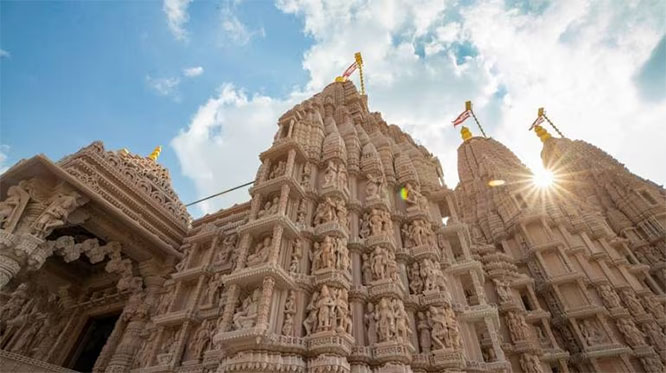
Abu Dhabi's first Hindu stone temple to open for public on March 1

News Network
February 27, 2024

templeabudhabi.jpg

Abu Dhabi, Feb 27: The first Hindu stone temple in Abu Dhabi, which was inaugurated by Prime Minister Narendra Modi earlier this month, will be opened to the public from March 1, according to the temple authorities.

The temple has been built by the Bochasanwasi Shri Akshar Purushottam Swaminarayan Sanstha (BAPS) Swaminarayan Sanstha on a 27-acre site in Abu Mureikhah, near Al Rahba off the Dubai-Abu Dhabi Sheikh Zayed Highway, at a cost of around Rs 700 crore.

The grand temple was inaugurated by Prime Minister Modi on February 14 during a dedication ceremony attended by over 5,000 invitees. From February 15 to 29, overseas devotees who had registered in advance or VIP guests were allowed to visit the temple.

“The temple will be open to the public from March 1 from 9 AM to 8 PM. The temple will remain closed for visitors every Monday,” a temple spokesperson said.

Constructed with 18 lakh bricks and 1.8 lakh cubic metres of sandstone sourced directly from Rajasthan, the temple has been made in the Nagara style of architecture, just like the recently inaugurated Ram Temple in Ayodhya.

According to the temple authorities, the grand temple has been built as per an ancient style of construction and creation mentioned in the Shilpa and Sthapathya Shastras, Hindu scriptures which describe the art for mandir design and construction.

The United Arab Emirates (UAE) has at least 3.5 million Indians who are part of the Indian workforce in the Gulf. The land for the temple was donated by the UAE government.

The BAPS Hindu Mandir is the largest in the entire Gulf region. The UAE has three other Hindu temples in Dubai.

Seven spires representing the seven Emirates of the UAE, carvings of camels, and national bird falcon, are part of the architecture of the stone temple, to give equal representation to the host country.

“The seven spires have idols of deities, including Lord Ram, Lord Shiv, Lord Jagannath, Lord Krishna, Lord Swaminarayan (considered a reincarnation of Lord Krishna), Tirupati Balaji and Lord Ayappa. The seven shikhars represent the seven Emirates of the UAE,” Swami Brahmaviharidas, head of international relations for BAPS, had told PTI.

To give equal representation to the host country, along with animals like elephants, camels and lions that occupy an important place in Indian mythology, the UAE’s national bird, the falcon, has also been included in the temple design.

Apart from 15 tales from India, including the Ramayana and Mahabharata, stories from Mayan, Aztec, Egyptian, Arabic, European, Chinese and African civilisations have also been depicted in the temple.

While the outer walls of the temple are made using sandstone from India, the interior, made of white Italian marble, is adorned with intricately designed and carved columns and walls.

Other noteworthy architectural elements include two ghumats (domes), 12 samrans (dome-like structures) and 402 pillars. The two ghumats are the “Dome of Peace” and “Dome of Harmony”.
On the two sides of the temple, holy water flows from Ganga and Yamuna, which was brought from India in huge containers.

The temple’s facade features exquisite marble carvings set against a sandstone backdrop, crafted from more than 25,000 pieces of stone by skilled artisans from Rajasthan and Gujarat. A substantial number of pink sandstone were transported from northern Rajasthan to Abu Dhabi for the temple.

Comments

Add new comment

  • Coastaldigest.com reserves the right to delete or block any comments.
  • Coastaldigset.com is not responsible for its readers’ comments.
  • Comments that are abusive, incendiary or irrelevant are strictly prohibited.
  • Please use a genuine email ID and provide your name to avoid reject.
News Network
December 7,2025

envoy.jpg

Since 1946, the United States has attempted 93 coups or “regime change” operations across the world — including two in Iran, US Special Envoy for Syria Tom Barrack has admitted.

Speaking to the UAE-based IMI Media Group, in remarks published by The National, Barrack said Washington tried twice to overthrow the Iranian government but failed both times. 

“For (Trump) then to be imputed with regime change — we had two regime changes in Iran already. Neither one worked. So I think wisely leave it to the region to solve,” said Barrack, who also serves as the US ambassador to Turkey.

His comments come six months after the US joined Israel in airstrikes against Iran during ongoing indirect nuclear negotiations between Tehran and Washington.

On June 13, Israel launched an attack on Iran that killed at least 1,064 people and hit civilian infrastructure. Days later, the United States targeted three nuclear facilities — Fordow, Natanz and Isfahan — in what Iran called a clear violation of international law. Iranian retaliation eventually forced a halt to the assault on June 24.

Barrack further claimed that US President Donald Trump and Foreign Secretary Marco Rubio are “not into regime change” and prefer a regional approach driven by Middle Eastern countries themselves. According to him, regional dialogue and non-interference by outside powers offer a more durable path forward.

He added that Washington is still open to an agreement with Tehran if Iranian authorities show “seriousness” and willingness to engage constructively.

However, Iran maintains the US has not shown readiness for meaningful talks. In an interview with Japan’s Kyodo News, Iranian Foreign Minister Abbas Araghchi said negotiations could advance only if Washington acknowledges Iran’s right to peaceful nuclear energy and lifts unilateral sanctions.

Comments

Add new comment

  • Coastaldigest.com reserves the right to delete or block any comments.
  • Coastaldigset.com is not responsible for its readers’ comments.
  • Comments that are abusive, incendiary or irrelevant are strictly prohibited.
  • Please use a genuine email ID and provide your name to avoid reject.
News Network
December 3,2025

indigo.jpg

IndiGo, India’s largest airline, is battling one of its worst operational disruptions in recent years, with hundreds of delays and cancellations throwing domestic travel into chaos.

Government data on Tuesday showed its on-time performance plunging to 35%, an unusual dip for a carrier long associated with punctuality.

By Wednesday afternoon, airports in Delhi, Mumbai, Bengaluru and Hyderabad had collectively reported close to 200 cancellations, stranding travellers across the country.

Crew Shortage After New Duty Norms

A major trigger behind the meltdown is a severe crew shortage, especially among pilots, following the rollout of revised Flight Duty Time Limitation (FDTL) norms last month.

The rules mandate longer rest hours and more humane rosters — a shift IndiGo has struggled to incorporate across its vast network.

Sources said several flights were grounded due to lack of cabin crew, while some delays stretched upwards of eight hours.

With IndiGo controlling over 60% of India’s domestic aviation market, the ripple effect has impacted airports nationwide.

IndiGo Issues Apology, Lists “Compounding Factors”

In a statement, IndiGo acknowledged the large-scale disruption:

“We sincerely apologise to customers. A series of unforeseen operational challenges — technology glitches, winter schedule changes, adverse weather, system congestion and updated FDTL norms — created a compounding impact that could not have been anticipated.”

To stabilise operations, the airline has begun calibrated schedule adjustments for the next 48 hours, aiming to restore punctuality. Affected passengers are being offered refunds or alternate travel arrangements, IndiGo said.

What the FDTL Rules Require

The FDTL norms, designed to reduce pilot fatigue, cap duty and flying hours as follows:
•    Maximum 8 hours of flying per day
•    35 hours per week
•    125 hours per month
•    1,000 hours per year

Crew must also receive rest equalling twice the flight duration, with a minimum 10-hour rest period in any 24-hour window.

The DGCA introduced these limits to enhance flight safety.

Hyderabad: 33 Flights Cancelled, Long Queues Reported

Hyderabad’s Rajiv Gandhi International Airport saw heavy early-morning crowds as 33 IndiGo flights (arrivals and departures) were cancelled.

The airport clarified on X that operations were normal, advising passengers to contact IndiGo directly for latest flight status.

Cancellations included flights to and from Visakhapatnam, Goa, Ahmedabad, Delhi, Bengaluru, Chennai, Madurai, Hubli, Bhopal and Bhubaneswar.

Bengaluru: 42 Flights Disrupted

Bengaluru’s Kempegowda International Airport recorded 42 cancellations — 22 arrivals and 20 departures — affecting routes to Delhi, Mumbai, Chennai, Hyderabad, Goa, Kolkata and Lucknow.

Passengers Vent on Social Media

Irate travellers took to X to share their experiences. One passenger stranded in Hyderabad wrote: “I have been here since 3 a.m. and missed an important meeting.”

Another said: “My flight was pushed from 1:55 PM to 2:55 PM and now 4:35 PM. I was informed only three minutes before entering the airport.”

Delhi Airport Hit by Tech Glitch

At Delhi Airport, the disruption deepened due to a slowdown in the Amadeus system — used for reservations, check-ins and departure control.

The technical issue led to longer queues and sluggish processing, adding to delays already worsened by staff shortages.

Comments

Add new comment

  • Coastaldigest.com reserves the right to delete or block any comments.
  • Coastaldigset.com is not responsible for its readers’ comments.
  • Comments that are abusive, incendiary or irrelevant are strictly prohibited.
  • Please use a genuine email ID and provide your name to avoid reject.
News Network
December 2,2025

Mangaluru, Dec 2: Mangaluru International Airport responded to a medical emergency late on Monday night. Air India Express flight IX 522, travelling from Riyadh to Thiruvananthapuram, was diverted to Mangaluru Airport after a passenger in his late 30s experienced a medical emergency on board.

The Airport’s Operations Control Centre received an alert regarding the passenger’s health condition. The airport activated its emergency response protocol, mobilising the airport medical team and coordinating with stakeholders including CISF, immigration, and customs. 

Upon landing, airport medical personnel attended to the passenger, assessed his condition, and arranged to shift him to a local tertiary-care hospital for further treatment. The passenger’s relatives accompanied the passenger, who incidentally received necessary medical care on board, which helped stabilise the situation.

Following the handling of the emergency, the flight departed for Thiruvananthapuram at 2:05 am on Tuesday.

"We appreciate the cooperation of all parties involved, and this incident reaffirms our ongoing commitment to prioritising passenger safety and readiness to respond to unforeseen emergencies with professionalism and care," the Airport spokesperson said. 

Comments

Add new comment

  • Coastaldigest.com reserves the right to delete or block any comments.
  • Coastaldigset.com is not responsible for its readers’ comments.
  • Comments that are abusive, incendiary or irrelevant are strictly prohibited.
  • Please use a genuine email ID and provide your name to avoid reject.