



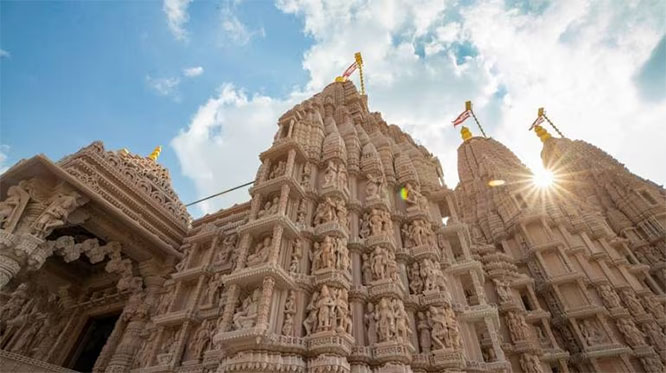
Abu Dhabi's first Hindu stone temple to open for public on March 1

News Network
February 27, 2024

templeabudhabi.jpg

Abu Dhabi, Feb 27: The first Hindu stone temple in Abu Dhabi, which was inaugurated by Prime Minister Narendra Modi earlier this month, will be opened to the public from March 1, according to the temple authorities.

The temple has been built by the Bochasanwasi Shri Akshar Purushottam Swaminarayan Sanstha (BAPS) Swaminarayan Sanstha on a 27-acre site in Abu Mureikhah, near Al Rahba off the Dubai-Abu Dhabi Sheikh Zayed Highway, at a cost of around Rs 700 crore.

The grand temple was inaugurated by Prime Minister Modi on February 14 during a dedication ceremony attended by over 5,000 invitees. From February 15 to 29, overseas devotees who had registered in advance or VIP guests were allowed to visit the temple.

“The temple will be open to the public from March 1 from 9 AM to 8 PM. The temple will remain closed for visitors every Monday,” a temple spokesperson said.

Constructed with 18 lakh bricks and 1.8 lakh cubic metres of sandstone sourced directly from Rajasthan, the temple has been made in the Nagara style of architecture, just like the recently inaugurated Ram Temple in Ayodhya.

According to the temple authorities, the grand temple has been built as per an ancient style of construction and creation mentioned in the Shilpa and Sthapathya Shastras, Hindu scriptures which describe the art for mandir design and construction.

The United Arab Emirates (UAE) has at least 3.5 million Indians who are part of the Indian workforce in the Gulf. The land for the temple was donated by the UAE government.

The BAPS Hindu Mandir is the largest in the entire Gulf region. The UAE has three other Hindu temples in Dubai.

Seven spires representing the seven Emirates of the UAE, carvings of camels, and national bird falcon, are part of the architecture of the stone temple, to give equal representation to the host country.

“The seven spires have idols of deities, including Lord Ram, Lord Shiv, Lord Jagannath, Lord Krishna, Lord Swaminarayan (considered a reincarnation of Lord Krishna), Tirupati Balaji and Lord Ayappa. The seven shikhars represent the seven Emirates of the UAE,” Swami Brahmaviharidas, head of international relations for BAPS, had told PTI.

To give equal representation to the host country, along with animals like elephants, camels and lions that occupy an important place in Indian mythology, the UAE’s national bird, the falcon, has also been included in the temple design.

Apart from 15 tales from India, including the Ramayana and Mahabharata, stories from Mayan, Aztec, Egyptian, Arabic, European, Chinese and African civilisations have also been depicted in the temple.

While the outer walls of the temple are made using sandstone from India, the interior, made of white Italian marble, is adorned with intricately designed and carved columns and walls.

Other noteworthy architectural elements include two ghumats (domes), 12 samrans (dome-like structures) and 402 pillars. The two ghumats are the “Dome of Peace” and “Dome of Harmony”.
On the two sides of the temple, holy water flows from Ganga and Yamuna, which was brought from India in huge containers.

The temple’s facade features exquisite marble carvings set against a sandstone backdrop, crafted from more than 25,000 pieces of stone by skilled artisans from Rajasthan and Gujarat. A substantial number of pink sandstone were transported from northern Rajasthan to Abu Dhabi for the temple.


Comments

Add new comment

  • Coastaldigest.com reserves the right to delete or block any comments.
  • Coastaldigset.com is not responsible for its readers’ comments.
  • Comments that are abusive, incendiary or irrelevant are strictly prohibited.
  • Please use a genuine email ID and provide your name to avoid reject.
News Network
November 26,2025

students.jpg

Bengaluru, Nov 26: Karnataka is taking its first concrete steps towards lifting a three-decade-old ban on student elections in colleges and universities. Deputy Chief Minister D.K. Shivakumar announced Wednesday that the state government will form a small committee to study the reintroduction of campus polls, a practice halted in 1989 following incidents of violence.

Speaking at a 'Constitution Day' event organised by the Karnataka Congress, Mr. Shivakumar underscored the move's aim: nurturing new political leadership from the grassroots.

"Recently, (Leader of the Opposition in Lok Sabha) Rahul Gandhi wrote a letter to me and Chief Minister (Siddaramaiah) asking us to think about restarting student elections," Shivakumar stated. "I'm announcing today that we'll form a small committee and seek a report on this."

Student elections were banned in Karnataka in 1989, largely due to concerns over violence and the infiltration of political party affiliates into campus life. The ban effectively extinguished vibrant student bodies and the pipeline of young leaders they often produced.

Mr. Shivakumar, who also serves as the Karnataka Congress president, said that former student leaders will be consulted to "study the pros and cons" of the re-introduction.

Acknowledging the history of the ban, he added, "There were many criminal activities taking place back then. We’ll see how we can conduct (student) elections by regulating such criminal activities."

The Deputy CM reminisced about his own journey, which began on campus. He recalled his political activism at Sri Jagadguru Renukacharya College leading to his first Assembly ticket in 1985 at the age of 23. "That's how student leadership was at the time. Such leadership has gone today. College elections have stopped," he lamented, adding that for many, college elections were "like a big movement" where leaders were forged.

The move, driven by the Congress high command's push to cultivate young talent, will face scrutiny from academics and university authorities who have, in the past, expressed concern that the return of polls could disrupt the peaceful academic environment and turn campuses into political battlegrounds.

Comments

Add new comment

  • Coastaldigest.com reserves the right to delete or block any comments.
  • Coastaldigset.com is not responsible for its readers’ comments.
  • Comments that are abusive, incendiary or irrelevant are strictly prohibited.
  • Please use a genuine email ID and provide your name to avoid reject.
News Network
December 4,2025

Udupi: A 40-year-old NRI from Udupi has reportedly lost more than Rs 12.25 lakh in an online investment scam operated through Telegram.

According to a complaint filed at the CEN police station, Leo Jerome Mendonsa, who has been working in Dubai for the past 15 years in computer accessories sales, maintains NRI accounts in Karkala and Nitte.

On November 12, 2025, Mendonsa was added to a Telegram group called Instaflow Earnings by unknown individuals. Users identified as Priya and Dipannita persuaded him to invest in “Revenue Tasks.” Initially, Mendonsa transferred Rs 1,100 multiple times and received the promised returns, encouraging him to continue.

On November 14, another user, Nishmitha Shetty, directed him to register on a website, digitvisionuoce.cc, and invest Rs 4 lakh in various shares. Over the next few days, he made multiple transfers totaling Rs 12,25,000, including Rs 50,000 via Google Pay, believing the scheme was legitimate.

After receiving the money, the alleged handlers stopped responding, and neither the invested amount nor the promised profits were returned.

The CEN police have registered a case under Sections 66(C) and 66(D) of the IT Act and Section 318(4) of the Bharatiya Nyaya Sanhita (BNS), and investigations are ongoing.

Comments

Add new comment

  • Coastaldigest.com reserves the right to delete or block any comments.
  • Coastaldigset.com is not responsible for its readers’ comments.
  • Comments that are abusive, incendiary or irrelevant are strictly prohibited.
  • Please use a genuine email ID and provide your name to avoid reject.
News Network
November 21,2025

israel.jpg

Local authorities say the Israeli military has expanded the so-called “yellow line” truce demarcation in Gaza City and repositioned its forces deeper into the territory in violation of a ceasefire agreement that came into force on October 10, besieging dozens of Palestinian families.

Gaza’s Government Media Office announced in a statement on Thursday that Israeli forces widened the boundary by shifting the markers, and advanced roughly 300 meters (984 feet) into the neighborhoods of Ash-Shaaf, An-Nazzaz and Baghdad Street.

The move pushed further into civilian areas, trapping families who were unable to flee as tanks rolled forward, it added.

“The fate of many of these families remains unknown amidst the shelling that targeted the area,” the office said, adding that the expansion of the yellow line shows a “blatant disregard” for the ceasefire deal.

On Friday, sources said the Israeli military carried out continued air and artillery strikes inside the so-called “yellow line” east of Khan Younis in the southern Gaza Strip.

According to the reports, Israeli warplanes and tanks targeted areas within the zone. One Palestinian was reported killed and several others wounded in the strikes, the sources said.

The fresh aggression came only a day after 25 Palestinians were killed in Israeli airstrikes on Gaza City and Khan Younis on Wednesday.

The media office reported that Israel has consistently violated the truce deal since its implementation last month, with near-daily attacks by air, artillery and direct shootings.

The office said over 400 violations have been documented. These breaches have resulted in the deaths of more than 300 Palestinians and left hundreds injured.

The Government Media Office in Gaza urged the guarantors of the ceasefire — the US, Egypt, Qatar and Turkey — to take swift action to halt the ongoing violations and facilitate the delivery of food, shelter materials, medical aid, and infrastructure equipment.

The so-called “yellow line,” set out in the agreement between Israel and Hamas resistance movement, refers to a non-physical partition where the Israeli military repositioned itself when the truce deal took effect.

It has allowed Israel, which routinely fires at Palestinians who approach the line, to retain control over more than half of the Gaza Strip.

International bodies, including the UN Independent International Commission of Inquiry, the International Association of Genocide Scholars, Amnesty International, Human Rights Watch, B’Tselem, and other rights groups, have concluded that the Israeli war on Gaza amounts to genocide.

In the attacks in Gaza since October 2023, Israel has killed at least 69,546 people and injured 170,833 others, leveling large swaths of the territory and displacing almost all of the population. 

Comments

Add new comment

  • Coastaldigest.com reserves the right to delete or block any comments.
  • Coastaldigset.com is not responsible for its readers’ comments.
  • Comments that are abusive, incendiary or irrelevant are strictly prohibited.
  • Please use a genuine email ID and provide your name to avoid reject.
