Abu Dhabi's first Hindu stone temple to open for public on March 1

News Network
February 27, 2024

templeabudhabi.jpg

Abu Dhabi, Feb 27: The first Hindu stone temple in Abu Dhabi, which was inaugurated by Prime Minister Narendra Modi earlier this month, will be opened to the public from March 1, according to the temple authorities.

The temple has been built by the Bochasanwasi Shri Akshar Purushottam Swaminarayan Sanstha (BAPS) Swaminarayan Sanstha on a 27-acre site in Abu Mureikhah, near Al Rahba off the Dubai-Abu Dhabi Sheikh Zayed Highway, at a cost of around Rs 700 crore.

The grand temple was inaugurated by Prime Minister Modi on February 14 during a dedication ceremony attended by over 5,000 invitees. From February 15 to 29, overseas devotees who had registered in advance or VIP guests were allowed to visit the temple.

“The temple will be open to the public from March 1 from 9 AM to 8 PM. The temple will remain closed for visitors every Monday,” a temple spokesperson said.

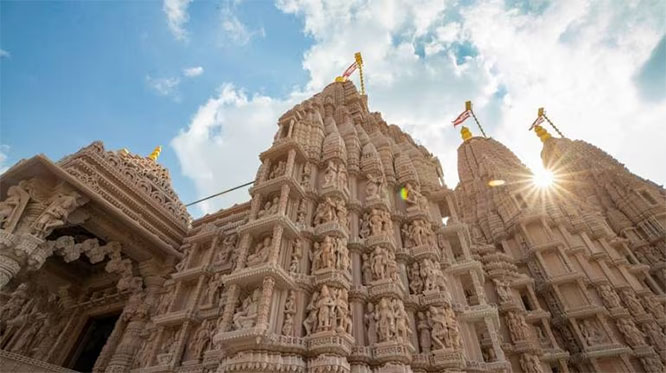
Constructed with 18 lakh bricks and 1.8 lakh cubic metres of sandstone sourced directly from Rajasthan, the temple has been made in the Nagara style of architecture, just like the recently inaugurated Ram Temple in Ayodhya.

According to the temple authorities, the grand temple has been built as per an ancient style of construction and creation mentioned in the Shilpa and Sthapathya Shastras, Hindu scriptures which describe the art for mandir design and construction.

The United Arab Emirates (UAE) has at least 3.5 million Indians who are part of the Indian workforce in the Gulf. The land for the temple was donated by the UAE government.

The BAPS Hindu Mandir is the largest in the entire Gulf region. The UAE has three other Hindu temples in Dubai.

Seven spires representing the seven Emirates of the UAE, carvings of camels, and national bird falcon, are part of the architecture of the stone temple, to give equal representation to the host country.

“The seven spires have idols of deities, including Lord Ram, Lord Shiv, Lord Jagannath, Lord Krishna, Lord Swaminarayan (considered a reincarnation of Lord Krishna), Tirupati Balaji and Lord Ayappa. The seven shikhars represent the seven Emirates of the UAE,” Swami Brahmaviharidas, head of international relations for BAPS, had told PTI.

To give equal representation to the host country, along with animals like elephants, camels and lions that occupy an important place in Indian mythology, the UAE’s national bird, the falcon, has also been included in the temple design.

Apart from 15 tales from India, including the Ramayana and Mahabharata, stories from Mayan, Aztec, Egyptian, Arabic, European, Chinese and African civilisations have also been depicted in the temple.

While the outer walls of the temple are made using sandstone from India, the interior, made of white Italian marble, is adorned with intricately designed and carved columns and walls.

Other noteworthy architectural elements include two ghumats (domes), 12 samrans (dome-like structures) and 402 pillars. The two ghumats are the “Dome of Peace” and “Dome of Harmony”.
On the two sides of the temple, holy water flows from Ganga and Yamuna, which was brought from India in huge containers.

The temple’s facade features exquisite marble carvings set against a sandstone backdrop, crafted from more than 25,000 pieces of stone by skilled artisans from Rajasthan and Gujarat. A substantial number of pink sandstone were transported from northern Rajasthan to Abu Dhabi for the temple.


Comments

Add new comment

  • Coastaldigest.com reserves the right to delete or block any comments.
  • Coastaldigset.com is not responsible for its readers’ comments.
  • Comments that are abusive, incendiary or irrelevant are strictly prohibited.
  • Please use a genuine email ID and provide your name to avoid reject.
News Network
November 28,2025

fire.jpg

Several Syrians were killed and more than two dozen others injured in Israeli strikes on the outskirts of Damascus, amid intensified incursions by the occupying regime since the fall of former president Bashar al-Assad and the rise of Hayat Tahrir al-Sham (HTS) rule.

Syrian state TV reported that the casualties occurred during an overnight Israeli assault involving helicopters and drones on the town of Beit Jinn in the Damascus countryside. The attack followed an Israeli military unit’s entry into the town, where they were surrounded by local residents, leading to gunfire and direct confrontations.

According to the report, “The occupation army’s helicopters and artillery shelled Beit Jinn, located at the foothills of Mount Hermon, resulting in 13 martyrs and 25 injured civilians.” The broadcaster did not specify the full extent of damage.

Al-Ikhbariyah Syria confirmed that the shelling coincided with Israeli soldiers entering Beit Jinn, while artillery pounded surrounding areas. The broadcaster stated that the escalation began after local residents clashed with an Israeli patrol that had infiltrated the southern town and “kidnapped” three young men.

Following a two-hour exchange of heavy fire, Israeli forces withdrew and repositioned on the hill of Butt al-Warda at the town’s outskirts.

Israeli media acknowledged that six soldiers were wounded in the clashes—three of them seriously—describing the confrontation as a “sudden ambush” that forced the deployment of reserve units and air support to secure an exit route. No further details were provided.

The aggression has fueled renewed displacement from Beit Jinn, with residents fleeing to nearby villages amid increasingly frequent Israeli attacks.

The raid came just a day after Israeli troops carried out another ground incursion into Umm al-Luqas village in Quneitra province. According to SANA, an Israeli unit in four vehicles entered the village, raided several homes, and later withdrew.

Syria condemned the repeated incursions as violations of the 1974 Disengagement Agreement and UN resolutions, urging the international community to enforce compliance and pressure Israel to halt its operations and withdraw fully.

Israel has expanded its attacks across Syrian territory following the collapse of the Assad government last year. Prime Minister Benjamin Netanyahu has reportedly instructed his forces to push deeper into Syrian territory and seize strategic positions.

Meanwhile, critics say the HTS-led interim government’s inaction and growing normalization gestures toward Israel have emboldened Tel Aviv to intensify its military operations. HTS, formerly linked to al-Qaeda, seized control of Damascus last December, formally ending Assad’s rule.

Comments

Add new comment

  • Coastaldigest.com reserves the right to delete or block any comments.
  • Coastaldigset.com is not responsible for its readers’ comments.
  • Comments that are abusive, incendiary or irrelevant are strictly prohibited.
  • Please use a genuine email ID and provide your name to avoid reject.
News Network
December 3,2025

indigo.jpg

IndiGo, India’s largest airline, is battling one of its worst operational disruptions in recent years, with hundreds of delays and cancellations throwing domestic travel into chaos.

Government data on Tuesday showed its on-time performance plunging to 35%, an unusual dip for a carrier long associated with punctuality.

By Wednesday afternoon, airports in Delhi, Mumbai, Bengaluru and Hyderabad had collectively reported close to 200 cancellations, stranding travellers across the country.

Crew Shortage After New Duty Norms

A major trigger behind the meltdown is a severe crew shortage, especially among pilots, following the rollout of revised Flight Duty Time Limitation (FDTL) norms last month.

The rules mandate longer rest hours and more humane rosters — a shift IndiGo has struggled to incorporate across its vast network.

Sources said several flights were grounded due to lack of cabin crew, while some delays stretched upwards of eight hours.

With IndiGo controlling over 60% of India’s domestic aviation market, the ripple effect has impacted airports nationwide.

IndiGo Issues Apology, Lists “Compounding Factors”

In a statement, IndiGo acknowledged the large-scale disruption:

“We sincerely apologise to customers. A series of unforeseen operational challenges — technology glitches, winter schedule changes, adverse weather, system congestion and updated FDTL norms — created a compounding impact that could not have been anticipated.”

To stabilise operations, the airline has begun calibrated schedule adjustments for the next 48 hours, aiming to restore punctuality. Affected passengers are being offered refunds or alternate travel arrangements, IndiGo said.

What the FDTL Rules Require

The FDTL norms, designed to reduce pilot fatigue, cap duty and flying hours as follows:
•    Maximum 8 hours of flying per day
•    35 hours per week
•    125 hours per month
•    1,000 hours per year

Crew must also receive rest equalling twice the flight duration, with a minimum 10-hour rest period in any 24-hour window.

The DGCA introduced these limits to enhance flight safety.

Hyderabad: 33 Flights Cancelled, Long Queues Reported

Hyderabad’s Rajiv Gandhi International Airport saw heavy early-morning crowds as 33 IndiGo flights (arrivals and departures) were cancelled.

The airport clarified on X that operations were normal, advising passengers to contact IndiGo directly for latest flight status.

Cancellations included flights to and from Visakhapatnam, Goa, Ahmedabad, Delhi, Bengaluru, Chennai, Madurai, Hubli, Bhopal and Bhubaneswar.

Bengaluru: 42 Flights Disrupted

Bengaluru’s Kempegowda International Airport recorded 42 cancellations — 22 arrivals and 20 departures — affecting routes to Delhi, Mumbai, Chennai, Hyderabad, Goa, Kolkata and Lucknow.

Passengers Vent on Social Media

Irate travellers took to X to share their experiences. One passenger stranded in Hyderabad wrote: “I have been here since 3 a.m. and missed an important meeting.”

Another said: “My flight was pushed from 1:55 PM to 2:55 PM and now 4:35 PM. I was informed only three minutes before entering the airport.”

Delhi Airport Hit by Tech Glitch

At Delhi Airport, the disruption deepened due to a slowdown in the Amadeus system — used for reservations, check-ins and departure control.

The technical issue led to longer queues and sluggish processing, adding to delays already worsened by staff shortages.

Comments

Add new comment

  • Coastaldigest.com reserves the right to delete or block any comments.
  • Coastaldigset.com is not responsible for its readers’ comments.
  • Comments that are abusive, incendiary or irrelevant are strictly prohibited.
  • Please use a genuine email ID and provide your name to avoid reject.
News Network
December 2,2025

Puttur: The long-cherished dream of a government medical college in Puttur has moved a decisive step closer to reality, with the Karnataka State Finance Department granting its official approval for the construction of a new 300-bed hospital.

Puttur MLA Ashok Kumar Rai announced the crucial development to reporters on Monday, confirming that the official communication from the finance department was issued on November 27. This 300-bed facility is intended to be the cornerstone for the establishment of the government medical college, a project announced in the state budget.

Fast-Track Implementation

The MLA outlined an aggressive timeline for the project:

•    A Detailed Project Report (DPR) for the hospital is expected to be ready within 45 days.

•    The tender process for the construction will be completed within two months.

Following the completion of the tender process, Chief Minister Siddaramaiah is scheduled to lay the foundation stone for the project.

"Setting up a medical college in Puttur is a historical decision by the Congress government in Karnataka," Rai stated. The project has an estimated budget allocation of Rs 1,000 crore for the medical college.

Focus on Medical Education Department

The MLA highlighted a key strategic move: requesting the government to implement the hospital construction through the Medical Education Department instead of the Health and Family Welfare Department. This is intended to streamline the entire process of establishing the full medical college, ensuring the facilities—including labs, operation theatres, and other necessary infrastructure—adhere to the strict guidelines set by the Medical Council of India (MCI). The proposed site for the project is in Bannur.

Rai also took the opportunity to address political criticism, stating that the government has fulfilled its promise despite "apprehensions" and "mocking and criticising" from opposition parties who had failed to take similar initiatives when they were in power. "Chief Minister Siddaramaiah has kept his word," he added.

Comments

Add new comment

  • Coastaldigest.com reserves the right to delete or block any comments.
  • Coastaldigset.com is not responsible for its readers’ comments.
  • Comments that are abusive, incendiary or irrelevant are strictly prohibited.
  • Please use a genuine email ID and provide your name to avoid reject.