Amidst growing India-UAE ties, Sangh Parivar seeks to promote Hindu culture in Arab land

News Network
February 13, 2024

hinduabudhabi.jpg

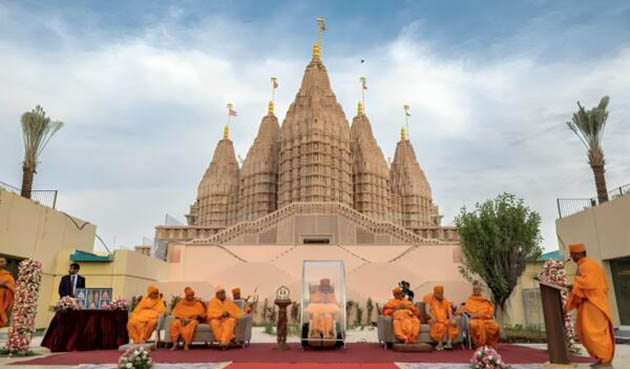
Prime Minister Narendra Modi, who last month opened the doors to a controversial Ayodhya temple in India where a centuries-old mosque once stood, is all set to inaugurate another Hindu religious site this week— in the Arab land. 

The pink sandstone temple in the United Arab Emirates has been built on a 27-acre plot granted on lease by President Sheikh Mohammed bin Zayed Al Nahyan for as long as “the sun shines.” In an election year, the imposing edifice offers Modi a headline-grabbing opportunity to portray himself as a global leader with the ability to draw big foreign investments.

Interestingly, Indian expatriate Hindus are the third largest Religious group in the UAE and constitute around 6.6%-15% of the population in the nation. 

Most of the Hindu diaspora in UAE are Indian, especially from Tamil Nadu, Kerala, Maharashtra, and Punjab. The other Hindus are from Nepal, Pakistan, Bangladesh, Sri Lanka, and Bhutan.

Meanwhile, the Sangh Parivar (the Rashtriya Swayamsevak Sangh and its affiliates), which has been trying to promote Hindu culture in Arab land for decades through Indian expats, has seized the opportunity of growing friendship between the rulers of two countries to achieve its goals.

Investment pledges or memorandums of understanding between the two countries are expected to be announced during Modi’s visit. The prime minister will also address more than 40,000 people from the South Asian nation in a stadium in Abu Dhabi on February 13.

It’s a unique mix of religion, politics and money. Throngs of people waving flags gathered to greet the UAE president, known as MBZ, as he was welcomed by Modi at the airport of his home state Gujarat last month.

While Islam is the UAE’s state religion, Bharatiya Janata Party (BJP) has long had a strained relationship with India’s Muslim population. Still, Emirati officials said there is a growing appreciation in Abu Dhabi of India’s rising geopolitical importance as well as its position as the world’s fastest growing major economy. That would make it strategically important for the UAE to navigate around any differences in opinion with New Delhi, they said.

Modi has said that MBZ is like a brother to him, Brahmaviharidas Swami, the Hindu priest heading the temple said on a zoom call, standing in front of the site clad in saffron robes. “The relationship between India and the region has never been stronger.”

There are big business considerations. India is one of the largest customers of Middle Eastern oil. The country is also buying more liquefied natural gas from the region.

Meanwhile, sovereign wealth funds in the UAE and other parts of the Gulf have emerged as prominent investors in the South Asian nation. Royal Group — the private investment firm of UAE national security adviser Sheikh Tahnoon bin Zayed Al Nahyan — has long had an affinity for India, with executives there calling it the potential growth engine of the coming decade. In recent days, his artificial intelligence firm set up a new entity called G42 India Enterprises Holding RSC Ltd. within Abu Dhabi Global Market, filings show.

The UAE is weighing provisional pledges to invest as much as $50 billion in India, its second-largest trading partner, people familiar with the matter told Bloomberg News last year. While it’s unclear if all those investments will ultimately come through and when any agreements might be announced, they would offer Modi another opportunity showcase the international ties.

“These funds are coming into India not as an assistance but on a bet that India will do really well over the next few decades,” said Rajeev Misra, an Indian-born financier, who has over the years been entrusted with billions of dollars from Middle Eastern funds. “To tap this golden opportunity a system has to be put into place in India, which can guide the money to the right opportunities.”

Close Connections

Politically, the countries have grown closer in recent years. Modi’s latest visit will mark his seventh trip to the Gulf nation since he took over as prime minister in 2014. The last Indian premier to visit the UAE before him was Indira Gandhi in 1981.

In 2021, the Gulf nation helped broker a peace deal between India and Pakistan. More recently, the UAE was one of the countries invited to join the BRICS bloc, of which India is a part. Modi is increasingly being courted by global leaders, including US President Joe Biden.

“Both UAE and India stand to gain economically and geopolitically from the close relationship built over the recent years,” said Thomas Mathew, a New Delhi-based retired bureaucrat and international relations analyst. “The US and western bloc is also pushing to strengthen the bond as it helps in containing China which has ambitions in the region.”

Other Middle Eastern countries have also looked to strengthen ties with India. Saudi Arabia announced its intention to invest $100 billion in the country in 2019 and during a September visit Crown Prince Mohammed bin Salman discussed ways to quicken the implementation of those plans.

The UAE and India have historically enjoyed close ties. A third of the Gulf country’s population hails from India and Dubai counts Indians as among the top buyers of real estate in the city. The UAE was expected to be the top destination for migrating high net worth Indians in 2023, according to immigration firm Henley & Partners.

Billionaires Gautam Adani and Mukesh Ambani are among India’s wealthy to have made big investments in the Middle Eastern country. In turn, they’ve also managed to draw funding from state-backed entities in the region.

Against this backdrop, the treatment of Muslims in the country is an issue that “Abu Dhabi should voice behind closed doors,” said Abdulkhaleq Abdulla, an Emirati academic. “It’s not enough to encroach on the broader economic ties, security partnerships and overall national interest.”

To be sure, many of the pledges or MOUs from Middle Eastern countries remain promises and limited amounts have actually reached Indian shores so far.

Other big plans for deepening ties have also been slow to take off on the ground. The India-Middle East-Europe Economic Corridor — a project that envisages building new rail links across the Arabian peninsula — was intended to further strengthen the relationship between the countries.

Comments

Add new comment

  • Coastaldigest.com reserves the right to delete or block any comments.
  • Coastaldigset.com is not responsible for its readers’ comments.
  • Comments that are abusive, incendiary or irrelevant are strictly prohibited.
  • Please use a genuine email ID and provide your name to avoid reject.
News Network
November 22,2025

Mangaluru: Police Commissioner Sudheer Kumar Reddy C H has warned of strict action against individuals spreading rumours and attempting to create insecurity within the Muslim community and fuel hatred between Hindus and Muslims through social media.

Referring to a recent social media post alleging that police personnel had entered a masjid premises to check whether beef was being cooked, the commissioner said miscreants were attempting to push their communal agenda. 

“A group of people, both from Mangaluru and abroad, are trying hard to spread rumours. For the past 10 days, they have been attempting to rake up old issues, highlight routine matters as controversies, or fabricate news altogether,” he said.

He reiterated that any such attempts to disturb communal harmony would invite legal action. “Cases will be registered and the accused will be brought to book,” he stated.

Comments

Add new comment

  • Coastaldigest.com reserves the right to delete or block any comments.
  • Coastaldigset.com is not responsible for its readers’ comments.
  • Comments that are abusive, incendiary or irrelevant are strictly prohibited.
  • Please use a genuine email ID and provide your name to avoid reject.
News Network
November 26,2025

students.jpg

Bengaluru, Nov 26: Karnataka is taking its first concrete steps towards lifting a three-decade-old ban on student elections in colleges and universities. Deputy Chief Minister D.K. Shivakumar announced Wednesday that the state government will form a small committee to study the reintroduction of campus polls, a practice halted in 1989 following incidents of violence.

Speaking at a 'Constitution Day' event organised by the Karnataka Congress, Mr. Shivakumar underscored the move's aim: nurturing new political leadership from the grassroots.

"Recently, (Leader of the Opposition in Lok Sabha) Rahul Gandhi wrote a letter to me and Chief Minister (Siddaramaiah) asking us to think about restarting student elections," Shivakumar stated. "I'm announcing today that we'll form a small committee and seek a report on this."

Student elections were banned in Karnataka in 1989, largely due to concerns over violence and the infiltration of political party affiliates into campus life. The ban effectively extinguished vibrant student bodies and the pipeline of young leaders they often produced.

Mr. Shivakumar, who also serves as the Karnataka Congress president, said that former student leaders will be consulted to "study the pros and cons" of the re-introduction.

Acknowledging the history of the ban, he added, "There were many criminal activities taking place back then. We’ll see how we can conduct (student) elections by regulating such criminal activities."

The Deputy CM reminisced about his own journey, which began on campus. He recalled his political activism at Sri Jagadguru Renukacharya College leading to his first Assembly ticket in 1985 at the age of 23. "That's how student leadership was at the time. Such leadership has gone today. College elections have stopped," he lamented, adding that for many, college elections were "like a big movement" where leaders were forged.

The move, driven by the Congress high command's push to cultivate young talent, will face scrutiny from academics and university authorities who have, in the past, expressed concern that the return of polls could disrupt the peaceful academic environment and turn campuses into political battlegrounds.

Comments

Add new comment

  • Coastaldigest.com reserves the right to delete or block any comments.
  • Coastaldigset.com is not responsible for its readers’ comments.
  • Comments that are abusive, incendiary or irrelevant are strictly prohibited.
  • Please use a genuine email ID and provide your name to avoid reject.
News Network
November 29,2025

DKSsiddu.jpg

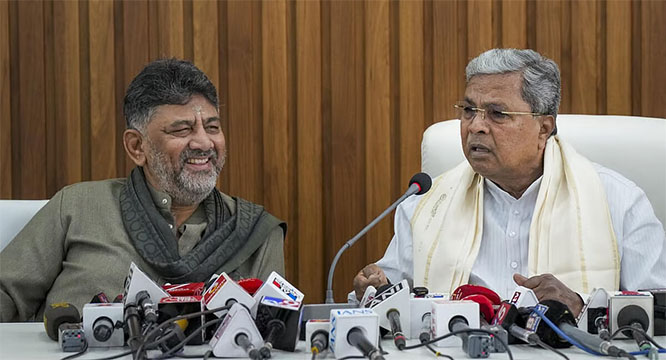
New Delhi: Karnataka chief minister Siddaramaiah and deputy CM DK Shivakumar on Saturday put up a dramatic display of unity at a closely watched joint press briefing, firmly dismissing weeks of speculation about a power-sharing tussle within the Congress. With the high command nudging both leaders to sit together and settle the dust, the meeting became a political spectacle, ending with the duo declaring that there was “no confusion, no differences.”

Calling the reports of a rift “manufactured confusion,” Siddaramaiah said the talks had gone smoothly, even joking about their breakfast. “Breakfast was very good. All three of us enjoyed it,” he said. “We want to end this confusion once and for all. For local elections and for 2028, our mission is clear — Congress must return to power. There is no difference between me and DKS, not now, not before.”

He blamed the media for fuelling rumours and reiterated absolute adherence to the party leadership. “From tomorrow, let there be no confusion. What the high command says, we will follow.”

Siddaramaiah also assured that the Assembly session starting December 8 would run smoothly and vowed that Congress would take on the BJP and JD(S) “together.”

Shivakumar echoed the chief minister word for word, stressing loyalty and discipline. “People have given us a massive mandate. It is our duty to deliver,” he said. “This government was formed under Siddaramaiah’s leadership. We both have complete trust in the high command. If they tell me to wait, I will wait.”

He added that the two leaders had discussed strategy for the 2028 Assembly elections. “Whatever the CM says, I agree. We are loyal soldiers of the party. The party may be facing challenges nationally, but we will keep it strong in Karnataka.”

Shivakumar also said Siddaramaiah would soon visit his home for lunch or dinner — another symbolic gesture meant to underline their unity.

Both leaders later posted on social media describing the breakfast meeting as “productive” and focused on “Karnataka’s priorities.”

The BJP, however, rejected the show of camaraderie as “pure bunkum,” accusing Congress of trying to paper over an internal power struggle. But Siddaramaiah and Shivakumar insisted their united front would continue — and that there was “no confusion” within the state leadership.

Comments

Add new comment

  • Coastaldigest.com reserves the right to delete or block any comments.
  • Coastaldigset.com is not responsible for its readers’ comments.
  • Comments that are abusive, incendiary or irrelevant are strictly prohibited.
  • Please use a genuine email ID and provide your name to avoid reject.