Celebration of ‘progress and unity’ marks Saudi Arabia’s 93rd National Day

Agencies
September 23, 2023

saudi.jpg

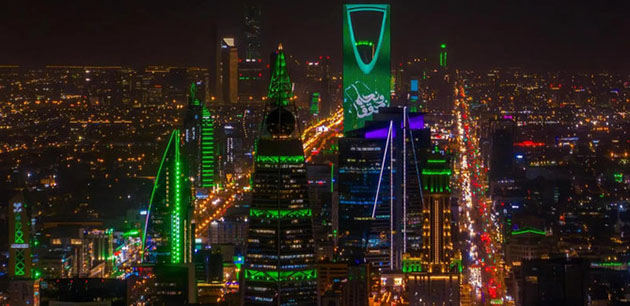
Riyadh, Sept 23: This day marks the 93rd National Day of Saudi Arabia, a day of pride and celebration for both its citizens and residents. Under the visionary leadership that prioritizes the well-being and prosperity of the people, this joyous occasion reflects upon the nation's remarkable journey toward a promising future.

As we commemorate this historic day, the Saudi Press Agency (SPA) takes us on a reflective journey through the life of a true statesman, King Abdulaziz bin Abdulrahman Al-Faisal Al Saud. On September 23, 1932, he achieved the monumental task of unifying the disparate tribes and scattered regions of the Arabian Peninsula, establishing the Kingdom of Saudi Arabia. This Islamic state, with Riyadh as its capital, adopted the Holy Qur'an and the Prophet's Sunnah as its constitution.

King Abdulaziz's remarkable journey began in Riyadh in 1293 Hijri. At the tender age of seven, he began learning to read and write, and at ten, his father, Imam Abdulrahman Al-Faisal, gathered scholars and tutors to instill in him the fundamentals of Islam and equestrian skills. His upbringing was greatly influenced by his courageous father and wise mother, Princess Sarah Al-Sudairi. King Abdulaziz shared a close bond with his siblings, including his sister, Princess Noura.

Throughout his life, King Abdulaziz encountered numerous challenges that shaped his character and instilled in him qualities of patience, strength, and statesmanship. One of the most trying moments was his forced departure from Riyadh in 1308 Hijri when he and his family settled in various locations, including the Yabrin oasis, Bahrain, and Kuwait. Despite these hardships, his determination to reclaim Riyadh, a city with deep historical significance for his family, remained unwavering.

In his twenties, King Abdulaziz embarked on a journey back to Riyadh, leading an army. His arrival in Al-Shaqib district marked the beginning of a pivotal chapter. Following a brief but intense battle, he restored order, ushering in a period of political stability that laid the foundation for Riyadh's growth and prosperity.

In 1320 Hijri, the people and notables of Riyadh pledged allegiance to him as Emir of Najd and Imam of its people. This victory brought much-needed stability after years of turmoil, setting the stage for Riyadh's transformation.

King Abdulaziz's tireless efforts to unite the nation, restore security, and combat the chaos of the Arabian Peninsula culminated in him becoming the revered leader of a newly constructed nation, securing a respected place for it on the world stage.

On September 23, 1932, King Abdulaziz issued a royal decree, renaming the state from the Kingdom of Hejaz and Najd and its annexes as the Kingdom of Saudi Arabia.

With the nation-building process well underway, King Abdulaziz turned his attention to expanding the Two Holy Mosques to serve pilgrims and establishing schools, hospitals, villages, and irrigation systems to support agriculture. These ambitious endeavors required substantial funding.

In the fall of 1933, oil exploration efforts began, initially yielding no results. However, persistence paid off when oil was discovered 5,000 feet underground in the "Ain Jet" area in 1939. This discovery marked a turning point, opening the doors to major state projects.

King Abdulaziz's interest extended beyond domestic affairs; he maintained diplomatic relations with countries worldwide, prioritizing the Kingdom's independence while fostering relations irrespective of religious, cultural, or civilizational differences. His approach garnered admiration from world leaders and media alike.

In Muharram 1373 Hijri, King Abdulaziz fell seriously ill in Taif, and he passed away on November 9, 1953. He was laid to rest in Al-Oud Cemetery, Riyadh.

As he built his nation, King Abdulaziz's commitment to education was unwavering. He avidly read Arabic books on various sciences, printing and distributing them freely. He sought the counsel of his citizens, guided by Islamic principles, fostering cooperation between the ruler and the governed.

King Abdulaziz's righteous approach, continued by his sons, laid the groundwork for the Kingdom's remarkable development, characterized by collaboration between the leadership and the people.

In a historic gathering on Muharram 25, 1355 Hijri, King Abdulaziz emphasized his desire for close ties with the people, stating, "My door is always open to anyone who wants to talk."

Under his leadership, Saudi Arabia forged strong relationships with Arab and Muslim nations and engaged the international community with transparency and pragmatism.

King Abdulaziz's legacy was the culmination of a rich history. The First Saudi State, founded by Imam Mohammed bin Saud in 1139 Hijri, laid the foundation for the nation's development. The Second Saudi State, initiated by Turki bin Abdullah bin Mohammed bin Saud, continued this legacy for approximately 68 years.

However, the true turning point came on the fifth day of Shawwal, 1319 Hijri, when King Abdulaziz reclaimed Riyadh with valor, establishing a state grounded in the principles of the Holy Qur'an and Prophet Mohammad's Sunnah.

Subsequent leaders, including King Saud, King Faisal, King Khalid, King Fahd, and King Abdullah, each contributed to the nation's progress and development, with a focus on education, healthcare, industry, and economic growth.

Today, under the wise leadership of Custodian of the Two Holy Mosques King Salman, Saudi Arabia continues its journey of growth, development, and global influence. The Kingdom boasts a strong economy that ranks among the world's top 20.

As we celebrate Saudi Arabia's National Day, we reflect on the nation's remarkable accomplishments, secure in the knowledge that its legacy of progress and unity will continue to thrive under the leadership of King Salman. Saudi Arabia stands as a testament to what can be achieved with vision, determination, and the unwavering commitment to the welfare of its people.

Comments

Add new comment

  • Coastaldigest.com reserves the right to delete or block any comments.
  • Coastaldigset.com is not responsible for its readers’ comments.
  • Comments that are abusive, incendiary or irrelevant are strictly prohibited.
  • Please use a genuine email ID and provide your name to avoid reject.
News Network
November 26,2025

students.jpg

Bengaluru, Nov 26: Karnataka is taking its first concrete steps towards lifting a three-decade-old ban on student elections in colleges and universities. Deputy Chief Minister D.K. Shivakumar announced Wednesday that the state government will form a small committee to study the reintroduction of campus polls, a practice halted in 1989 following incidents of violence.

Speaking at a 'Constitution Day' event organised by the Karnataka Congress, Mr. Shivakumar underscored the move's aim: nurturing new political leadership from the grassroots.

"Recently, (Leader of the Opposition in Lok Sabha) Rahul Gandhi wrote a letter to me and Chief Minister (Siddaramaiah) asking us to think about restarting student elections," Shivakumar stated. "I'm announcing today that we'll form a small committee and seek a report on this."

Student elections were banned in Karnataka in 1989, largely due to concerns over violence and the infiltration of political party affiliates into campus life. The ban effectively extinguished vibrant student bodies and the pipeline of young leaders they often produced.

Mr. Shivakumar, who also serves as the Karnataka Congress president, said that former student leaders will be consulted to "study the pros and cons" of the re-introduction.

Acknowledging the history of the ban, he added, "There were many criminal activities taking place back then. We’ll see how we can conduct (student) elections by regulating such criminal activities."

The Deputy CM reminisced about his own journey, which began on campus. He recalled his political activism at Sri Jagadguru Renukacharya College leading to his first Assembly ticket in 1985 at the age of 23. "That's how student leadership was at the time. Such leadership has gone today. College elections have stopped," he lamented, adding that for many, college elections were "like a big movement" where leaders were forged.

The move, driven by the Congress high command's push to cultivate young talent, will face scrutiny from academics and university authorities who have, in the past, expressed concern that the return of polls could disrupt the peaceful academic environment and turn campuses into political battlegrounds.

Comments

Add new comment

  • Coastaldigest.com reserves the right to delete or block any comments.
  • Coastaldigset.com is not responsible for its readers’ comments.
  • Comments that are abusive, incendiary or irrelevant are strictly prohibited.
  • Please use a genuine email ID and provide your name to avoid reject.
Agencies
November 22,2025

indiapak.jpg

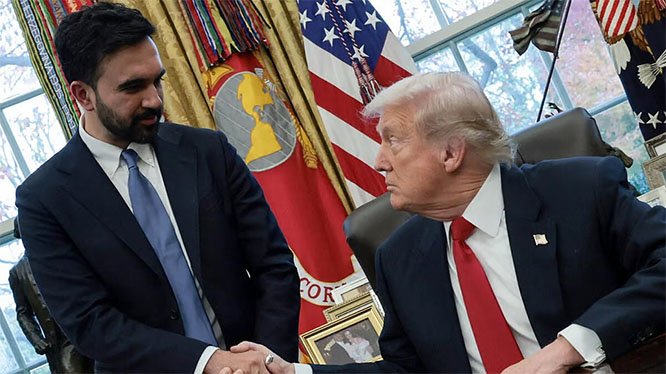
New York/Washington: US President Donald Trump has again claimed to have solved the conflict between India and Pakistan, repeating his assertion during a meeting with New York City Mayor-elect Zohran Mamdani in the Oval Office.

Mamdani flew to Washington DC for his first meeting with Trump in the White House on Friday. Trump said he “enjoyed” the meeting, which he described as “great.”

During remarks in the Oval Office, with Mamdani standing next to him, Trump repeated his claim that he solved the May conflict between India and Pakistan.

"I did eight peace deals of countries, including India and Pakistan,” he said.

On Wednesday, Trump had said he threatened to put 350 per cent tariffs on India and Pakistan if they did not end their conflict, repeating his claim that he solved the fighting between the nuclear-armed neighbours and that Prime Minister Narendra Modi had called him to say “we're not going to go to war.”

Since May 10, when Trump announced on social media that India and Pakistan had agreed to a “full and immediate” ceasefire after a “long night” of talks mediated by Washington, he has repeated his claim over 60 times that he “helped settle” the tensions between India and Pakistan.

India has consistently denied any third-party intervention. India launched Operation Sindoor on May 7, targeting terror infrastructure in Pakistan and Pakistan-occupied Kashmir in retaliation for the April 22 Pahalgam attack that killed 26 civilians. India and Pakistan reached an understanding on May 10 to end the conflict after four days of intense cross-border drone and missile strikes.

Mamdani emerged victorious in the closely-watched battle for New York City Mayor, becoming the first South Asian and Muslim to be elected to sit at the helm of the largest city in the US.

He had been the front-runner in the NYC Mayoral election for months and defeated Republican nominee Curtis Sliwa and political heavyweight former New York State Governor Andrew Cuomo, who ran as an independent candidate and was officially endorsed by Trump just hours before the elections.

Indian-descent Mamdani is the son of renowned filmmaker Mira Nair and Columbia University professor Mahmood Mamdani. He was born and raised in Kampala, Uganda and moved to New York City with his family when he was 7. Mamdani became a naturalised US citizen only recently, in 2018.

Comments

Add new comment

  • Coastaldigest.com reserves the right to delete or block any comments.
  • Coastaldigset.com is not responsible for its readers’ comments.
  • Comments that are abusive, incendiary or irrelevant are strictly prohibited.
  • Please use a genuine email ID and provide your name to avoid reject.
News Network
December 3,2025

indigo.jpg

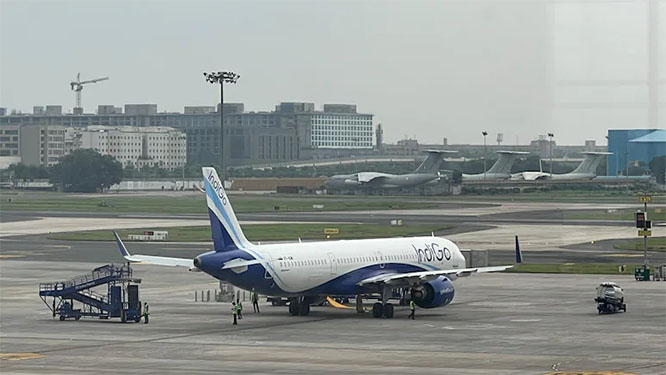
IndiGo, India’s largest airline, is battling one of its worst operational disruptions in recent years, with hundreds of delays and cancellations throwing domestic travel into chaos.

Government data on Tuesday showed its on-time performance plunging to 35%, an unusual dip for a carrier long associated with punctuality.

By Wednesday afternoon, airports in Delhi, Mumbai, Bengaluru and Hyderabad had collectively reported close to 200 cancellations, stranding travellers across the country.

Crew Shortage After New Duty Norms

A major trigger behind the meltdown is a severe crew shortage, especially among pilots, following the rollout of revised Flight Duty Time Limitation (FDTL) norms last month.

The rules mandate longer rest hours and more humane rosters — a shift IndiGo has struggled to incorporate across its vast network.

Sources said several flights were grounded due to lack of cabin crew, while some delays stretched upwards of eight hours.

With IndiGo controlling over 60% of India’s domestic aviation market, the ripple effect has impacted airports nationwide.

IndiGo Issues Apology, Lists “Compounding Factors”

In a statement, IndiGo acknowledged the large-scale disruption:

“We sincerely apologise to customers. A series of unforeseen operational challenges — technology glitches, winter schedule changes, adverse weather, system congestion and updated FDTL norms — created a compounding impact that could not have been anticipated.”

To stabilise operations, the airline has begun calibrated schedule adjustments for the next 48 hours, aiming to restore punctuality. Affected passengers are being offered refunds or alternate travel arrangements, IndiGo said.

What the FDTL Rules Require

The FDTL norms, designed to reduce pilot fatigue, cap duty and flying hours as follows:
•    Maximum 8 hours of flying per day
•    35 hours per week
•    125 hours per month
•    1,000 hours per year

Crew must also receive rest equalling twice the flight duration, with a minimum 10-hour rest period in any 24-hour window.

The DGCA introduced these limits to enhance flight safety.

Hyderabad: 33 Flights Cancelled, Long Queues Reported

Hyderabad’s Rajiv Gandhi International Airport saw heavy early-morning crowds as 33 IndiGo flights (arrivals and departures) were cancelled.

The airport clarified on X that operations were normal, advising passengers to contact IndiGo directly for latest flight status.

Cancellations included flights to and from Visakhapatnam, Goa, Ahmedabad, Delhi, Bengaluru, Chennai, Madurai, Hubli, Bhopal and Bhubaneswar.

Bengaluru: 42 Flights Disrupted

Bengaluru’s Kempegowda International Airport recorded 42 cancellations — 22 arrivals and 20 departures — affecting routes to Delhi, Mumbai, Chennai, Hyderabad, Goa, Kolkata and Lucknow.

Passengers Vent on Social Media

Irate travellers took to X to share their experiences. One passenger stranded in Hyderabad wrote: “I have been here since 3 a.m. and missed an important meeting.”

Another said: “My flight was pushed from 1:55 PM to 2:55 PM and now 4:35 PM. I was informed only three minutes before entering the airport.”

Delhi Airport Hit by Tech Glitch

At Delhi Airport, the disruption deepened due to a slowdown in the Amadeus system — used for reservations, check-ins and departure control.

The technical issue led to longer queues and sluggish processing, adding to delays already worsened by staff shortages.

Comments

Add new comment

  • Coastaldigest.com reserves the right to delete or block any comments.
  • Coastaldigset.com is not responsible for its readers’ comments.
  • Comments that are abusive, incendiary or irrelevant are strictly prohibited.
  • Please use a genuine email ID and provide your name to avoid reject.