Christmas cancelled in birthplace of Jesus Christ amid Israel’s genocidal war

News Network
December 25, 2023

Bethlehem.jpg

In the city of Bethlehem in the Israeli-occupied West Bank, Christmas has always been synonymous with festivities, colorful decorations, sumptuous food, and bustling markets.

Christian communities in the city, which is a major pilgrimage destination for Christians for being the birthplace of Jesus Christ, adorn their homes and alleys and flock markets for shopping.

This year, however, a pall of gloom has descended on Bethlehem amid the Israeli regime’s genocidal war against Palestinians in the besieged Gaza Strip as well as the occupied West Bank.

Christian communities in Bethlehem as well as in the Gaza Strip have decided to cancel the annual Christmas festivities in solidarity with the victims of the occupying entity’s unbridled aggression.

Streets in Bethlehem wear a deserted look and markets are also mostly closed these days. The usual hustle and bustle associated with Christmas celebrations is missing in the birthplace of Jesus.

As the death toll in the besieged coastal territory tops 20,000, most of them children and women, both Palestinian Muslims and Christians are in grief and no mood for traditional festivities.

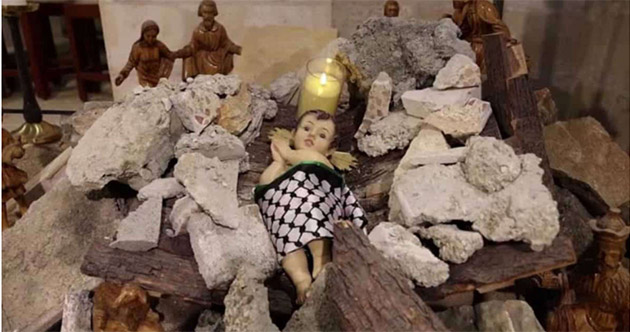
Reverend Isaac Munther, a Palestinian pastor of a Lutheran church in Bethlehem, addressing his congregation earlier this month with the figure of Jesus Christ in a keffiyeh, said Christmas is the “radiance of life from the heart of destruction and death.” 
“If Christ were to be born today, he would be born under the rubble. I invite you to see the image of Jesus in every child killed and pulled from under the rubble, in every child struggling for life in destroyed hospitals, in every child in incubators,” Pastor Munther said, surrounded by rubble.

“Christmas celebrations are canceled this year, but Christmas itself is not and will not be canceled, for our hope cannot be canceled,” he hastened to add.

Last week, Pope Francis slammed the Tel Aviv regime for committing terrorism against Palestinians in Gaza, after an Israeli sniper killed two women at a Catholic church in Gaza where they had taken refuge. 

“Some say, ‘This is terrorism. This is war.’ Yes, it is war. It is terrorism,” the head of the Catholic Church said, urging people not to forget people suffering from the Israeli war.

His statement came after an Israeli attack on the Holy Family Parish in Gaza.

An estimated 1,100 Christians live among 2.3 million people in the Gaza Strip, and an additional 50,000 live in the occupied West Bank, notably in Bethlehem and East Jerusalem.

Both Muslims and Christians have come under ferocious attacks in Gaza since October 7, and many mosques and churches have been vandalized or destroyed by the regime's warplanes.

In late October, an Israeli airstrike targeted the complex of the Church of Saint Porphyrius, the oldest church in Gaza and the third oldest in the world, killing at least 16 people, including 10 from one family.

In a statement at the time, the Greek Orthodox Patriarchate condemned the bombing, stressing that "targeting churches and its affiliated institutions, in addition to the shelters they provide to protect innocent citizens, constitutes a war crime that cannot be ignored."

It came weeks after an attack on an Anglican Al-Ahli Arab Hospital in northern Gaza, founded in 1882 and managed by the Episcopal Church in occupied Jerusalem al-Quds.

Reverend Mitri Raheb, the president of Dar al-Kalima University, speaking to Democracy Now on Friday said he has not experienced “so much sadness” in his entire life.

“You don’t have a Christmas tree in Bethlehem. There are no tourists coming, because of the war. And the people are not up for celebrations, because our people in Gaza, but not only our people in Gaza, also our people in the West Bank, we’re experiencing apartheid, colonization by Jewish settlers,” he said.

“These are the Christmas gifts of Israel for the Christian community in Gaza. And I fear that this is the end of the Christian presence in Gaza.”

In November, the Patriarchs and Heads of Churches in Jerusalem had urged Christians to avoid “unnecessarily festive activities” and donate Christmas funds for humanitarian aid for Gaza.

The churches and municipality of Ramallah in the occupied West Bank also announced the cancellation of Christmas festivities, restricting the annual events to church services, devoid of celebrations.

“At this time every year, we prepare to decorate the city in celebration of Christmas, to welcome the holiday with joy and love. However, today, instead of bringing smiles to the faces of our children, we mourn for them,” it said in a statement.

“Instead of giving them holiday gifts, we can't even send humanitarian aid to them (in Gaza) while they are under bombardment, war, and destruction.”

In solidarity with the Palestinian Muslims and Christians and in protest against the Israeli genocide in Gaza, Christian communities in many countries have announced they will cancel this year’s festival.

“Jesus was a Palestinian revolutionary! This #Christmas, ask yourself ‘What would Jesus do?’ Would he be in the #Resistance,” wrote David Miller, London-based Press TV show host, on his X handle.

Mangingisada, a Philippines-based activist, in a social media post, urged his friends and followers not to wish him Christmas this year.

“As a Christian, I will not accept any fake greetings from terrorist Israelis. I want an end to bombings and killings in Gaza and the West Bank. I want an end to the apartheid and illegal occupation,” he wrote.

Aditya Chakrabortyy, a writer for Guardian, in a post on X, said the world cannot ignore what is unfolding in the besieged Gaza Strip amid the Israeli regime’s bombings.

“When we celebrate the birth of a child in Bethlehem on what is today the West Bank and are supposed to ignore the killing of 10,000 children in Gaza,” he wrote.

Comments

Add new comment

  • Coastaldigest.com reserves the right to delete or block any comments.
  • Coastaldigset.com is not responsible for its readers’ comments.
  • Comments that are abusive, incendiary or irrelevant are strictly prohibited.
  • Please use a genuine email ID and provide your name to avoid reject.
coastaldigest.com news network
January 19,2026

rizwanzameer.jpg

Bengaluru: As the dust settles on the recent legislative session, the corridors of Vidhana Soudha are buzzing with more than just policy talk. A high-stakes game of political musical chairs has begun, exposing a deepening rift within the Congress party’s Muslim leadership as a major Cabinet reshuffle looms.

With the party hierarchy signaling a "50% refresh" to gear up for the 2028 Assembly elections, the race to fill three projected Muslim ministerial berths has transformed from a strategic discussion into an all-out turf war.

The "Star Son" Spark

The internal friction turned public this week following provocative remarks by Zaid Khan, actor and son of Wakf Minister Zameer Ahmed Khan. Zaid’s claim—that his father "helped" secure a ticket for Shivajinagar MLA Rizwan Arshad in 2023—has acted as a lightning rod for resentment.

Rizwan’s camp was quick to fire back, dismissing the comment as a desperate attempt by Zameer to manufacture seniority. "Rizwan’s political pedigree was forged in the NSUI and Youth Congress long before Zameer even stepped into the party," a supporter noted, highlighting Rizwan’s tenure as an AICC secretary and his two-term presidency of the State Youth Congress.

A Tale of Two Loyalists

While both Zameer Ahmed Khan and Rizwan Arshad are staunch allies of Chief Minister Siddaramaiah and represent Bengaluru strongholds, their political DNA could not be more different:

•    Zameer Ahmed Khan: A four-time MLA who crossed over from JD(S) in 2018. Known for his "overzealous" and often polarizing outreach during communal flashpoints—from the DJ Halli riots to the recent Wakf land notice controversy—his style has frequently left the Congress high command in a state of "discomfort."

•    Rizwan Arshad: A homegrown organizational man. Seen as a "quiet performer," Arshad represents the sophisticated, moderate face of the party, preferred by those who find Zameer’s brand of politics too volatile.

The Outsiders Looking In

The bickering isn't limited to a duo. The "Beary" community, represented by leaders like N A Haris and Saleem Ahmed, is demanding its pound of flesh. Saleem Ahmed, the Chief Whip in the Legislative Council, has dropped the veil of diplomacy, openly declaring his ministerial aspirations.

"I was the only working president not included in the Cabinet last time," Saleem noted pointedly, signaling that the "loyalty quota" is no longer enough to keep the peace.

As Chief Minister Siddaramaiah prepares to finalize the list, he faces a delicate balancing act: rewarding the aggressive grassroots mobilization of Zameer’s camp without alienating the organizational stalwarts and minority sub-sects who feel increasingly sidelined by the "Chamarajpet-Shivajinagar" binary.

Comments

Add new comment

  • Coastaldigest.com reserves the right to delete or block any comments.
  • Coastaldigset.com is not responsible for its readers’ comments.
  • Comments that are abusive, incendiary or irrelevant are strictly prohibited.
  • Please use a genuine email ID and provide your name to avoid reject.
News Network
January 23,2026

Mangaluru: The Karnataka Government Polytechnic (KPT), Mangaluru, has achieved autonomous status from the All India Council for Technical Education (AICTE), becoming the first government polytechnic in the country to receive such recognition in its 78-year history. The status was granted by AICTE, New Delhi, and subsequently approved by the Karnataka Board of Technical Education in October last year.

Officials said the autonomy was conferred a few months ago. Until recently, AICTE extended autonomous status only to engineering colleges, excluding diploma institutions. However, with a renewed national focus on skill development, several government polytechnics across India have now been granted autonomy.

KPT, the second-largest polytechnic in Karnataka, was established in 1946 with four branches and has since expanded to offer eight diploma programmes, including computer science and polymer technology. The institution is spread across a 19-acre campus.

Ravindra M Keni, the first dean of the institution, told The Times of India that AICTE had proposed autonomous status for polytechnic institutions that are over 25 years old. “Many colleges applied. In the first round, 100 institutions were shortlisted, which was further narrowed down to 15 in the second round. We have already completed one semester after becoming an autonomous institution,” he said. He added that nearly 500 students are admitted annually across eight three-year diploma courses.

Explaining the factors that helped KPT secure autonomy, Keni said the institution has consistently recorded 100 per cent admissions and placements for its graduates. He also noted its strong performance in sports, with the college emerging champions for 12 consecutive years, along with active student participation in NCC and NSS activities.

Autonomous status allows KPT to design industry-oriented curricula, conduct examinations, prepare question papers, and manage academic documentation independently. The institution can also directly collaborate with industries and receive priority funding from AICTE or the Ministry of Education. While academic autonomy has been granted, financial control will continue to rest with the state government.

“There will be separate committees for examinations, question paper setting, boards of studies, and boards of examiners. The institution will now have the freedom to conduct admissions without government notifications and issue its own marks cards,” Keni said, adding that new academic initiatives would be planned after a year of functioning under the autonomous framework.

Comments

Add new comment

  • Coastaldigest.com reserves the right to delete or block any comments.
  • Coastaldigset.com is not responsible for its readers’ comments.
  • Comments that are abusive, incendiary or irrelevant are strictly prohibited.
  • Please use a genuine email ID and provide your name to avoid reject.
News Network
January 20,2026

iran.jpg

Iranian security and intelligence forces have captured more than 470 individuals in three provinces, identified as key figures behind the recent wave of violent unrest and terrorist activities linked to foreign-backed networks.

The Intelligence Ministry's provincial office in Khorasan Razavi announced on Monday the arrest of 192 armed terrorists, identified as the main agents behind recent riots in the region. 

According to an official statement, the detainees were involved in the killing of several security personnel and civilians, setting fire to mosques, public service facilities, and buses, as well as attacks on military and law enforcement centers.

The seized items from the group include several bulletproof vests, Kalashnikov rifles, hunting weapons, Winchester rifles, and various cold weapons such as daggers, swords, brass knuckles, tactical knives, crossbows, and chains.

Evidence indicates that some of the individuals were tied to hostile movements and terrorist organizations, with links overseas. Others were identified as members of violent criminal gangs, actively taking part in the unrest alongside their associates.

Simultaneously, in the western province of Lorestan, the IRGC announced the arrest of 134 individuals as the main leaders and influential field agents of a US-Israeli terrorist network.

The IRGC statement stated that these individuals formed terrorist cells during the recent unrest, committing "Daesh-like" acts.

They wounded security forces with firearms and cold weapons, and burned and destroyed public and private properties, including mosques, shops, banks, and private and public vehicles.

In the northwestern province of Zanjan, the police reported detaining 150 people identified as principal leaders and agents behind recent riots.

Authorities noted that these individuals were responsible for destroying public and private property and intentionally setting fire to vehicles in the province's squares.

Their crimes include shedding the blood of innocent people, destroying public and private property, attempting to enter military sites, disrupting public order, and spreading terror among citizens.

A variety of cold weapons were reportedly seized from the detainees.

What began late last month as peaceful protests over economic hardship across Iran turned violent after public statements by US and Israeli regime figures encouraged vandalism and disorder.

During the unrest, foreign-backed mercenaries rampaged through cities, killing security forces and civilians and damaging public property.

Comments

Add new comment

  • Coastaldigest.com reserves the right to delete or block any comments.
  • Coastaldigset.com is not responsible for its readers’ comments.
  • Comments that are abusive, incendiary or irrelevant are strictly prohibited.
  • Please use a genuine email ID and provide your name to avoid reject.