



Israeli captives in Hamas-ruled Gaza become a political trap for PM Netanyahu

News Network
October 9, 2023

capture.jpg

Jerusalem: The capture of dozens of Israeli soldiers and settlers by Hamas militants has stirred Israeli emotions more viscerally than any crisis in the country’s recent memory and presented an impossible dilemma for Israeli Prime Minister Benjamin Netanyahu’s far-right government.

The Palestinian freedom fighters’ 2006 seizure of a sole young conscript, Gilad Shalit, consumed Israeli society for years — a national obsession that prompted Israel to heavily bombard the Gaza Strip and ultimately release over 1,000 Palestinian prisoners, many of whom had been convicted of deadly attacks on Israelis, in exchange for Shalit’s freedom.

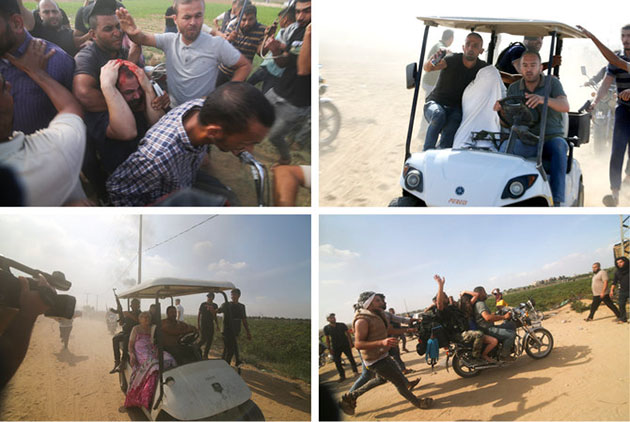
This time, Gaza’s Hamas rulers have captured dozens of Israeli settlers and soldiers as part of a multipronged, shock attack on Saturday, October 7, 2023. Palestinian Islamic Jihad, a smaller group compared to Hamas, said Sunday that it alone had seized 30 hostages.

Their captivity raises the heat on Netanyahu and his hawkish, far-right allies, who are already under intense pressure to respond to the killing of over 700 Israelis in the Hamas attack so far. Netanyahu’s vow to unleash the full force of the Israeli military on Hamas has raised fears for the safety of Israeli civilians spread in undisclosed locations across the densely populated Gaza Strip.

“It will limit the directions and areas that the IDF can be active,” Michael Milstein, a former head of the Palestinian department in Israeli military intelligence, said of the hostage situation. “It will make things much more complicated.”

Locating Israeli hostages in Gaza — something Israeli intelligence agencies failed to do in the case of Shalit — poses further challenges. Although Gaza is tiny, subject to constant aerial surveillance and surrounded by Israeli ground and naval forces, the territory just over an hour from Tel Aviv remains somewhat opaque to Israeli intelligence agencies, experts say.

“We don’t know where Israelis are sheltered,” said Yaakov Amidror, a former national security adviser to Netanyahu. “But this whole issue of captured Israelis will not stop Israel from bombing Gaza until Hamas is destroyed.”

Hamas already has said it seeks the release of all Palestinian prisoners in Israeli jails — some 4,500 detainees, according to Israeli rights group B’Tselem — in exchange for the Israeli captives.

The fate of prisoners for Palestinians is perhaps just as emotional as it is for Israelis. With an estimated 750,000 Palestinians having passed through Israel prisons since Israel captured the West Bank in the 1967 Mideast war, most Palestinians have either spent time in Israeli jail or know someone who has. Israel sees them as “terrorists”, but Palestinians view detainees as heroes. The Palestinian Authority self-rule government, which administers parts of the occupied West Bank, devotes some 8 percent of its budget to supporting them and their families.

“The release of any prisoners would be a huge deal for Hamas,” said Khalil Shikaki, the director of the Palestinian Center for Policy and Survey Research. “It would cement Hamas’ position in the Palestinian street and further diminish the strength and legitimacy” of the Palestinian Authority.

But Netanyahu’s government — with its powerful far-right racist ministers, including West Bank settlers — have fiercely opposed any gestures they view as capitulating to the Palestinians. There is “absolutely no chance” that the current government would agree to the release of Palestinian prisoners, said Gayil Talshir, a political scientist at the Hebrew University of Jerusalem.

“The radicals and extremists in this government want to flatten Gaza,” she said. Netanyahu on Saturday dismissed an offer by Yair Lapid, head of the opposition, to form an emergency national unity government.

It was a clear sign that Netanyahu “has not given up on his extremist nationalist government,” she said.

To win last year’s election while standing trial for corruption, Netanyahu relied on the surging popularity of his far-right allies who seized on perceived threats to Israel’s Jewish identity.

Israel’s powerful finance minister, settler leader Bezalel Smotrich, demanded at the Cabinet meeting late Saturday that the Israeli army “hit Hamas brutally and not take the matter of the captives into significant consideration.”

“In war you have to be brutal,” he was quoted as saying. “We need to deal a blow that hasn’t been seen in 50 years and take down Gaza.”

But the risk of Israeli civilians falling victim to relentless Israeli bombardment or languishing for years in Hamas captivity while Israel gets dragged into an open-ended campaign could also be politically ruinous for Netanyahu.

“This is a serious dilemma,” said veteran Israeli political commentator Ehud Yaari. “The fear is that if and when a ground operation kicks off, Hamas will threaten to execute hostages every hour, every two hours, and that will become a really heated debate.”

Israel’s tumultuous history has revealed the extreme sensitivity of public opinion when it comes to hostages — and therefore what a potent weapon capture can be in a country where 18-year-olds are conscripted for military service, and the army prides itself on never abandoning its own.

“If we allow our people to be taken like this, we have no country, no government and no army,” said 58-year-old Tali Levy in the southern city of Ashdod near the Gaza border, who has several friends missing.

Families of Israelis missing after Saturday’s Hamas attack held a news conference Sunday evening that was televised live during prime time. Shaken relatives, some of them holding back tears or weeping, called on the government to bring home the captives.

In the past, Israeli society’s inability to tolerate its citizens being held captive has ignited massive public pressure campaigns, inducing governments to agree to disproportionate exchanges. This included the Schalit deal in 2011, and Israel’s release of 1,150 jailed Palestinians in exchange for three Israeli prisoners in 1985.

While military analysts remained divided on how Netanyahu would find a way out of his dilemma, the answer was painfully obvious to Israelis whose loved ones were taken hostage.

“I want them to do everything possible, to put their politics and the whole situation aside,” said Adva Adar, whose 85-year-old mother, Yaffa, was captured on video being hustled across the border into Gaza on a golf cart crammed with gunmen. Her voice cracked as she started to cry.

“She doesn’t have a lot of time left without her medicine and she is suffering very much,” she said.


Comments

Add new comment

  • Coastaldigest.com reserves the right to delete or block any comments.
  • Coastaldigset.com is not responsible for its readers’ comments.
  • Comments that are abusive, incendiary or irrelevant are strictly prohibited.
  • Please use a genuine email ID and provide your name to avoid reject.
News Network
January 19,2026

trump.jpg

Donald Trump has linked his repeated threats to seize Greenland to his failure to win the Nobel Peace Prize, in a letter to Norwegian Prime Minister Jonas Gahr Støre.

The authenticity of the letter, in which Trump says he no longer feels obligated to “think purely of peace,” was confirmed by Støre to the Norwegian newspaper VG.

“Considering your country decided not to give me the Nobel Peace Prize for having stopped eight wars plus, I no longer feel an obligation to think purely of peace,” Trump wrote, adding he can now “think about what is good and proper for the United States.”

Støre said Trump’s letter was in response to a short message he had sent earlier, on behalf of himself and Finland’s President Alexander Stubb.

Trump has escalated rhetoric toward Greenland, a self-governing Danish territory, insisting the US will take control “one way or the other.” Over the weekend, he tweeted: “Now it is time, and it will be done!!!”

On Saturday, Trump threatened a 10% tariff on imports from Denmark, Norway, Sweden, France, Germany, the UK, the Netherlands, and Finland from 1 February until the US is allowed to purchase the island. EU diplomats met for emergency talks on possible retaliatory tariffs and sanctions.

In his letter, Trump argued Denmark “cannot protect” Greenland from Russia or China, questioning Danish ownership: “There are no written documents; it’s only that a boat landed there hundreds of years ago.” He added that NATO should support the US, claiming the world is “not secure unless we have complete and total control of Greenland.”

Trump’s stance has unsettled the EU and NATO, as he refused to rule out military action to take control of the mineral-rich island.

The Nobel Peace Prize is awarded by the independent Norwegian Nobel Committee, not the government. Trump had campaigned for last year’s prize, which went to Venezuelan opposition leader María Corina Machado, who dedicated her award to him.

Støre reiterated that the Nobel Prize decision rests solely with the committee.

Comments

Add new comment

  • Coastaldigest.com reserves the right to delete or block any comments.
  • Coastaldigset.com is not responsible for its readers’ comments.
  • Comments that are abusive, incendiary or irrelevant are strictly prohibited.
  • Please use a genuine email ID and provide your name to avoid reject.
News Network
February 1,2026

Bengaluru, Feb 1: For travelers landing at Kempegowda International Airport (KIA), the sleek, wood-paneled curves of Terminal 2 promise a world-class welcome. But the famed “Garden City” charm quickly withers at the curb. As India’s aviation sector swells to record numbers—handling over 43 million passengers in Bengaluru alone this past year—the “last mile” has turned into a marathon of frustration.

The Bengaluru Logjam: Rules vs Reality

While the city awaits the 2027 completion of the Namma Metro Blue Line, the interim has been chaotic. Recent “decongestion” rules at Terminal 1 have pushed app-based cab pickups to distant parking zones, forcing weary passengers into a 20-minute walk with luggage.

“I landed after ten months away and felt like a stranger in my own city,” says Ruchitha Jain, a Koramangala resident. “My driver couldn’t find me, staff couldn’t guide me, and the so-called ‘Premium’ lane is just a fancy tax on convenience.”

•    The Cost of Distance: A 40-km cab ride can now easily cross ₹1,500, driven by demand pricing and airport surcharges.

•    The Bus Gap: While Vayu Vajra remains a lifeline, its ₹300–₹400 fare is often cited as the most expensive airport bus service in the country.

A National Pattern of Disconnect

The struggle is not unique to Karnataka. From Chennai’s coast to Hyderabad’s plateau, India’s airports tell a familiar story: brilliant runways, broken exits.

City:    Primary Issue   |    Recent Development

Bengaluru:    Cab pickup restrictions & distance  |    App-based taxis shifted to far parking zones; long walks and fare spikes reported

Chennai:    Multi-Level Parking (MLCP) hike  |    Passengers report 40-minute walks to reach cab pickup points

Hyderabad:    “Taxi mafia” & touting  |    Over 440 touting cases reported; security presence intensified

Mumbai:    Fare scams  |     Tourists charged ₹18,000 for just 400 metres, triggering police action

In Hyderabad, travelers continue to battle entrenched local groups that intimidate Uber and Ola drivers, pushing passengers toward overpriced private taxis. Chennai flyers, meanwhile, complain that reaching the designated pickup zones now takes longer than short-haul flights from cities like Coimbatore.

The ‘Budget Day’ Hope

As Finance Minister Nirmala Sitharaman presents the Union Budget 2026 today, the aviation sector is watching closely. With the government’s renewed emphasis on multimodal integration, there is cautious hope for funding toward seamless airport-metro-bus hubs.

The vision is clear: a future where planes, trains, and metros speak the same language. Until then, passengers at KIA—and airports across India—will continue to discover that the hardest part of flying isn’t the thousands of kilometres in the air, but the last few on the ground.

Comments

Add new comment

  • Coastaldigest.com reserves the right to delete or block any comments.
  • Coastaldigset.com is not responsible for its readers’ comments.
  • Comments that are abusive, incendiary or irrelevant are strictly prohibited.
  • Please use a genuine email ID and provide your name to avoid reject.
News Network
January 20,2026

iran.jpg

Iranian security and intelligence forces have captured more than 470 individuals in three provinces, identified as key figures behind the recent wave of violent unrest and terrorist activities linked to foreign-backed networks.

The Intelligence Ministry's provincial office in Khorasan Razavi announced on Monday the arrest of 192 armed terrorists, identified as the main agents behind recent riots in the region. 

According to an official statement, the detainees were involved in the killing of several security personnel and civilians, setting fire to mosques, public service facilities, and buses, as well as attacks on military and law enforcement centers.

The seized items from the group include several bulletproof vests, Kalashnikov rifles, hunting weapons, Winchester rifles, and various cold weapons such as daggers, swords, brass knuckles, tactical knives, crossbows, and chains.

Evidence indicates that some of the individuals were tied to hostile movements and terrorist organizations, with links overseas. Others were identified as members of violent criminal gangs, actively taking part in the unrest alongside their associates.

Simultaneously, in the western province of Lorestan, the IRGC announced the arrest of 134 individuals as the main leaders and influential field agents of a US-Israeli terrorist network.

The IRGC statement stated that these individuals formed terrorist cells during the recent unrest, committing "Daesh-like" acts.

They wounded security forces with firearms and cold weapons, and burned and destroyed public and private properties, including mosques, shops, banks, and private and public vehicles.

In the northwestern province of Zanjan, the police reported detaining 150 people identified as principal leaders and agents behind recent riots.

Authorities noted that these individuals were responsible for destroying public and private property and intentionally setting fire to vehicles in the province's squares.

Their crimes include shedding the blood of innocent people, destroying public and private property, attempting to enter military sites, disrupting public order, and spreading terror among citizens.

A variety of cold weapons were reportedly seized from the detainees.

What began late last month as peaceful protests over economic hardship across Iran turned violent after public statements by US and Israeli regime figures encouraged vandalism and disorder.

During the unrest, foreign-backed mercenaries rampaged through cities, killing security forces and civilians and damaging public property.

Comments

Add new comment

  • Coastaldigest.com reserves the right to delete or block any comments.
  • Coastaldigset.com is not responsible for its readers’ comments.
  • Comments that are abusive, incendiary or irrelevant are strictly prohibited.
  • Please use a genuine email ID and provide your name to avoid reject.
