




Kuwait supermarket pulls Indian products as row grows over abusing Prophet

News Network
June 6, 2022

supermarket.jpg

Kuwait City, June 6: A Kuwaiti supermarket pulled Indian products from its shelves and Iran became the latest Middle Eastern country to summon the Indian ambassador as a row grew on Monday over a ruling party official's remarks about the Prophet Mohammed.

Workers at the Al-Ardiya Co-Operative Society store piled Indian tea and other products into trolleys in a protest against comments denounced as "Islamophobic".

Saudi Arabia, Qatar and other countries in the region, as well as the influential Al-Azhar University in Cairo, have condemned the remarks by a spokeswoman for Indian Prime Minister Narendra Modi's party, who has since been suspended.

At the supermarket just outside Kuwait City, sacks of rice and shelves of spices and chilies were covered with plastic sheets. Printed signs in Arabic read: "We have removed Indian products".

"We, as a Kuwaiti Muslim people, do not accept insulting the Prophet," Nasser Al-Mutairi, CEO of the store, told AFP. An official at the chain said a company-wide boycott was being considered.

Comments by Bharatiya Janata Party spokeswoman Nupur Sharma describing the prophet Mohammed's relationship with his youngest wife have sparked a furore among Muslims.

Sharma's remarks during a televised debate last week were blamed for clashes in an Indian state and prompted demands for her arrest.

Anger spread overseas to Muslim countries about the remarks.

Modi's party, which has frequently been accused of acting against the country's Muslim minority, on Sunday suspended Sharma for expressing "views contrary to the party's position" and said it "respects all religions".

Sharma said on Twitter that her comments had been in response to "insults" made against the Hindu god Shiva.

"If my words have caused discomfort or hurt religious feelings of anyone whatsoever, I hereby unconditionally withdraw my statement," she said.

On Sunday, Qatar demanded that India apologise for the "Islamophobic" comments, as India's Vice-President Venkaiah Naidu visited the gas-rich Gulf state in a bid to bolster trade.

Iran followed Qatar and Kuwait by summoning the Indian ambassador to protest in the name of "the government and the people", state news agency IRNA said late on Sunday.

Al-Azhar University, one of Islam's most important institutions, said the comments were "the real terrorism" and "could plunge the entire world into deadly crisis and wars".

The Saudi-based Muslim World League said the remarks could "incite hatred", while Saudi Arabia's General Presidency of the Affairs of the Grand Mosque and the Prophet's Mosque called them a "heinous act".

The row follows anger across the Muslim world in 2020 after French President Emmanuel Macron defended the right of a satirical magazine to publish caricatures of the Prophet Mohammed.

French teacher Samuel Paty was beheaded in October 2020 by a Chechen refugee after showing the cartoons to his class in a lesson on free speech. Images of the Prophet are strictly forbidden in Islam.

In further criticism of the Indian official, the Gulf Cooperation Council, an umbrella group for the six Gulf countries, "condemned, rejected and denounced" her comments.

Bahrain also welcomed the BJP's decision to suspend Sharma over "provocation to Muslims' feelings and incitement to religious hatred".

Gulf countries are a major destination for India's overseas workers, accounting for 8.7 million out of a worldwide total of 13.5 million, Indian foreign ministry figures show.

They are also big importers of produce from India and elsewhere, with Kuwait importing 95 percent of its food according to the trade minister.

Kuwaiti media have reported that the government asked New Delhi for an exemption from India's surprise ban on wheat exports over food security and inflation worries.

Comments

Add new comment

  • Coastaldigest.com reserves the right to delete or block any comments.
  • Coastaldigset.com is not responsible for its readers’ comments.
  • Comments that are abusive, incendiary or irrelevant are strictly prohibited.
  • Please use a genuine email ID and provide your name to avoid reject.
News Network
January 20,2026

DGP.jpg

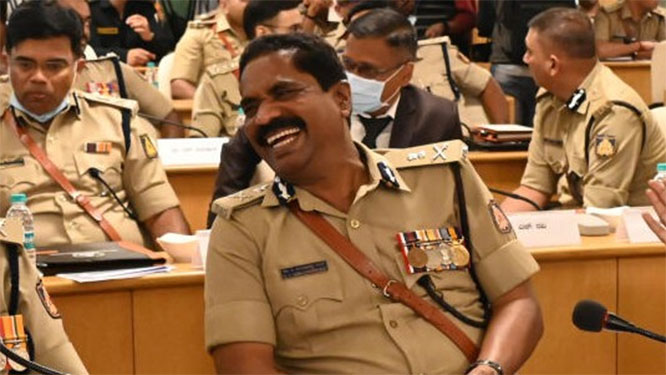
Karnataka DGP (Civil Rights Enforcement) K Ramachandra Rao was suspended with immediate effect, as per a state government order issued on Monday, 19 January. The order cited conduct unbecoming of a government servant and causing embarrassment to the state administration.

The Karnataka government suspended Rao after a purported video showed him in a compromising position with a woman inside his official chamber. The video went viral on social media. Rao rejected the videos outright, terming them "fabricated and false".

Who is K Ramachandra Rao?

Rao is a DGP-rank officer who was heading the Directorate of Civil Rights Enforcement until his suspension. He was promoted to DGP in September 2023 and assumed office in October 2023, the Sunday Guardian reported.

He also served as the Chairman and Managing Director of the Karnataka State Police Housing and Infrastructure Development Corporation Limited.

His stint as the Inspector General of Police (IGP) for the Southern Range was also marred by controversy. In 2014, during a cash seizure near Mysuru’s Yelwal, officials claimed the seized amount was ₹20 lakh, while the accused (Kerala-based merchants) claimed it was around ₹2.27 crore.

Rao, who was present during the seizure, denied all allegations. However, he was transferred soon after.

Allegations of collusion with a businessman surfaced, and a senior police officer was quoted by The Sunday Guardian as saying, “In Rao’s case, the CID has clearly mentioned that there was a great degree of lapse on the part of Rao and a deputy superintendent of police after it was brought to their notice that a few policemen, including a gunman attached to the IGP, were involved in the robbery.”

Rao had denied all wrongdoing in that incident. Despite past controversies, he rose to the state’s top police position, the Sunday Guardian reported.

Ranya Rao’s stepfather

Rao is the stepfather of Kannada actress Harshavardhini Ranya alias Ranya Rao, accused of orchestrating the illegal import of gold worth over ₹12.56 crore from Dubai to India along with two others — businessman Tarun Raju, and jewellery dealer Sahil Jain.

‘Obscene video’ controversy

A viral video showed Rao behaving inappropriately with a woman inside his office while in uniform.

The Karnataka government said in its Monday order that “vide videos and news reports widely broadcast on public news channels and media platforms, it is observed that Dr K Ramachandra Rao has acted in an obscene manner which is unbecoming of a Government Servant and also causing embarrassment to the Government.”

The order said the matter was examined by the state government, which found that the officer's conduct amounted to a violation of Rule 3 of the All India Services (Conduct) Rules, 1968.

The government said it is prima facie satisfied that "it is necessary to place Rao under suspension with immediate effect, pending inquiry".

During the suspension period, Rao will be entitled to subsistence allowance as per Rule 4 of the All India Services (Discipline and Appeal) Rules, 1969.

The order also places restrictions on his movement, stating that during the period of suspension, the officer must not leave headquarters under any circumstances without the written permission of the state government.

Comments

Add new comment

  • Coastaldigest.com reserves the right to delete or block any comments.
  • Coastaldigset.com is not responsible for its readers’ comments.
  • Comments that are abusive, incendiary or irrelevant are strictly prohibited.
  • Please use a genuine email ID and provide your name to avoid reject.
News Network
January 23,2026

Mangaluru: The Karnataka Government Polytechnic (KPT), Mangaluru, has achieved autonomous status from the All India Council for Technical Education (AICTE), becoming the first government polytechnic in the country to receive such recognition in its 78-year history. The status was granted by AICTE, New Delhi, and subsequently approved by the Karnataka Board of Technical Education in October last year.

Officials said the autonomy was conferred a few months ago. Until recently, AICTE extended autonomous status only to engineering colleges, excluding diploma institutions. However, with a renewed national focus on skill development, several government polytechnics across India have now been granted autonomy.

KPT, the second-largest polytechnic in Karnataka, was established in 1946 with four branches and has since expanded to offer eight diploma programmes, including computer science and polymer technology. The institution is spread across a 19-acre campus.

Ravindra M Keni, the first dean of the institution, told The Times of India that AICTE had proposed autonomous status for polytechnic institutions that are over 25 years old. “Many colleges applied. In the first round, 100 institutions were shortlisted, which was further narrowed down to 15 in the second round. We have already completed one semester after becoming an autonomous institution,” he said. He added that nearly 500 students are admitted annually across eight three-year diploma courses.

Explaining the factors that helped KPT secure autonomy, Keni said the institution has consistently recorded 100 per cent admissions and placements for its graduates. He also noted its strong performance in sports, with the college emerging champions for 12 consecutive years, along with active student participation in NCC and NSS activities.

Autonomous status allows KPT to design industry-oriented curricula, conduct examinations, prepare question papers, and manage academic documentation independently. The institution can also directly collaborate with industries and receive priority funding from AICTE or the Ministry of Education. While academic autonomy has been granted, financial control will continue to rest with the state government.

“There will be separate committees for examinations, question paper setting, boards of studies, and boards of examiners. The institution will now have the freedom to conduct admissions without government notifications and issue its own marks cards,” Keni said, adding that new academic initiatives would be planned after a year of functioning under the autonomous framework.

Comments

Add new comment

  • Coastaldigest.com reserves the right to delete or block any comments.
  • Coastaldigset.com is not responsible for its readers’ comments.
  • Comments that are abusive, incendiary or irrelevant are strictly prohibited.
  • Please use a genuine email ID and provide your name to avoid reject.