In rare public Jum’a sermon, Iran’s supreme leader urges ‘Islamic Ummah’ to overcome plots of 'enemies'

News Network
October 4, 2024

khamenei.jpg

Leader of the Islamic Revolution Ayatollah Seyyed Ali Khamenei has hailed “the brilliant work of our armed forces” in launching a missile strike on the Tel Aviv area, saying it was “completely legal and legitimate”.

Ayatollah Khamenei delivered a public sermon at the weekly Friday (Jum’a) prayer to a huge number of worshipers gathered at the Imam Khomeini Grand Mosalla mosque in central Tehran.

“The brilliant work of our armed forces was completely legal and legitimate. What our armed forces did was the least punishment for the usurping Zionist regime over the astonishing crimes of this wolf-like regime and rabid dog of America," he said.

Ayatollah Khamenei, “Whatever duty the Islamic Republic has in this regard, it will fulfill with strength and fortitude. We will neither delay nor hurry in carrying out the task."

“What is logical and reasonable and the opinion of the political and military decision makers will be done in the future if necessary just like it was done” on Tuesday, he added.

The prayer in Tehran followed a commemoration ceremony for Hezbollah leader Sayyed Hassan Nasrallah who was assassinated in an Israeli airstrike in Beirut. Ayatollah Khamenei last led Friday prayers in January 2020 after Iran fired missiles at a US army base in Iraq, in response to a strike that martyred anti-terror commander Brigadier General Qassem Soleimani.

Ayatollah Khamenei described Nasrallah "my brother, my dear and my pride, the beloved face of the Islamic world, and the eloquent voice of the nations of the region, [and] the shining jewel of Lebanon".

“I felt it necessary to pay tribute to Mr. Sayyed Hassan Nasrallah (May God bless him and grant him peace) in the Friday prayer in Tehran, and to convey some notifications to everyone,” the Leader said.

“The audience of this sermon is the whole Islamic world, but it is specially addressed to the dear nation of Lebanon and Palestine.

“We are all saddened and mournful for the martyrdom of Dear Sayyed. This is a great loss and we are deeply saddened, but our mourning does not mean depression, distress and despair.

“It is a kind of mourning for the Master of Martyrs Hussein ibn Ali. It is enlivening, instructive, motivating, and hopeful,” the Leader said, referring to Imam Hussein (AS), the third Imam of Shia Muslims.

Ayatollah Khamenei said though Nasrallah's body has left this world, “his true personality, his soul, his way, and his expressive voice are still among us and will be with us forever”.

“He was the high flag of resistance against oppressive and predatory demons - an eloquent voice and a brave defender of the oppressed. He was a source of encouragement and valor for fighters and rights seekers. His popularity and influence had gone beyond Lebanon, Iran and Arab countries, and now his martyrdom will increase this influence.”

Ayatollah Khamenei said all Muslims are bound to “pay their debt to the wounded and bloody Lebanon”.

“Hezbollah and the Martyr Sayyed, by defending Gaza and Jihad for Al-Aqsa Mosque and striking the usurping and tyrannical regime, took a step in the path of vital service to the entire region and the entire Islamic world,” the Leader said.

The relentless defense of the Lebanese people for the Palestinians, he said, is “legal, reasonable, logical and legitimate, and no one has the right to criticize them for entering this battle”.

By the same token, the Al-Aqsa Storm operation of Palestinian fighters inside the Israeli occupied territories in October 2023 was “right and internationally legal”, he added.

“The Palestinian nation has the right to stand against the aggressors, and no court has the right to protest to the Palestinian nation for standing against the usurping enemy of Palestine.”

Ayatollah Khamenei said the adamance of the US and its allies on protecting Israel is a “cover for the deadly policy of turning the usurping regime into their tool to take over all the resources of this region and use it in major global conflicts”.

“Their policy is to turn the regime into a gateway for the export of energy from the region to the Western world and the import of goods and technology from the West to the region.

“This tells us that every attack on the regime by anyone and every group is a service to the entire region and to the entire humanity.

“This Zionist and American dream is definitely a false and impossible fantasy. The regime is the evil tree uprooted from the earth, which according to divine truth has no abode,” he added.

The Zionist regime, the Leader said, has kept itself afloat simply by being injected American support, adding the situation will not last long.

“Today, the Zionist criminal gang itself has come to the conclusion that they will never win over Hamas and Hezbollah."

The Leader called on Muslims to unite against the world’s arrogant powers and transgressors who are still following their policy of divide and conquer with all kinds of tricks in the Islamic states.

“The policy of the Qur'an is that Muslim nations and groups should have solidarity, and if you have this solidarity, divine wisdom will support you and you will overcome all obstacles and win over all enemies."

The Leader said the time has come for the Islamic Ummah to overcome the plots of the enemies.

"The enemy of the Iranian nation is the same enemy of the Palestinian nation, the Lebanese nation, the Iraqi nation, the Egyptian nation, the Syrian nation and the Yemeni nation. The enemy is one.”


Comments

Add new comment

  • Coastaldigest.com reserves the right to delete or block any comments.
  • Coastaldigset.com is not responsible for its readers’ comments.
  • Comments that are abusive, incendiary or irrelevant are strictly prohibited.
  • Please use a genuine email ID and provide your name to avoid reject.
coastaldigest.com news network
November 28,2025

roadshow.jpg

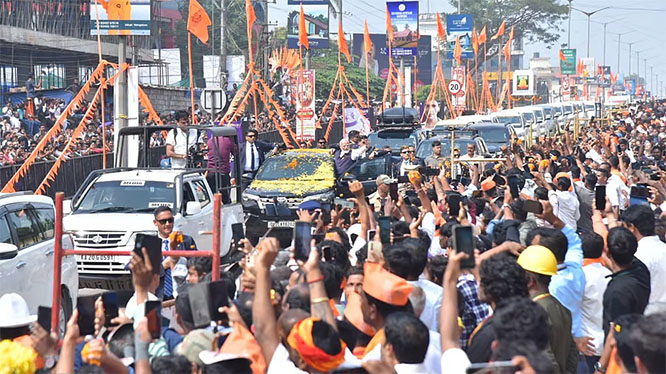
Udupi district transformed into a sea of saffron and celebration on Friday, November 28, as Prime Minister Narendra Modi’s roadshow swept through the coastal temple town. Thousands of residents lined the streets, turning the event into a vibrant public spectacle filled with cheers, flags, and festive energy.

The procession route—from the helipad to the historic Sri Krishna Math—was decked with buntings, saffron flags, and multilayered security barricades. One of the district’s largest-ever security deployments was put in place for the high-profile visit, with over 3,000 police personnel on duty. The arrangement included ten SPs, 27 DSPs, 49 inspectors, 127 sub-inspectors, 232 assistant sub-inspectors, 1,608 constables, and 39 women staff.

Six platoons of the Karnataka State Reserve Police, six Quick Response Teams, bomb detection units, and dog squads were stationed across Udupi. Enhanced surveillance covered Adi Udupi, Bannanje bus stand, and the Sri Krishna Math parking zone, with combing operations carried out along the roadshow corridor.

At the 800-year-old Sri Krishna Math, preparations reached a ceremonial peak. Paryaya Puttige Math seer Sugunendra Teertha Swamiji said the Prime Minister would take part in the Laksha Kantha Geetha Parayana, a mass chanting of the Bhagavad Gita by one lakh devotees, and inaugurate the new Suvarna Teertha Mantapa.

“He will first offer floral tributes to saint-poet Kanakadasa and then unveil the golden covering over the Kanakana Kindi,” the seer said.

The Prime Minister will also receive a Poorna Kumbha welcome and have darshan of Lord Sri Krishna, Mukhyaprana Devaru, and the Suvarna Paduke. Union Minister Pralhad Joshi, Karnataka Governor Thaawarchand Gehlot, Minister Bairathi Suresh, Dharmadhikari D. Veerendra Heggade, and seers from the Ashta Maths are expected to join the ceremony.

Ahead of his arrival, the Prime Minister posted on X that he felt “honoured” to attend the spiritually significant gathering. “This is a special occasion that brings together people from different sections of society for a recital of the Gita. This Matha has a very special significance in our cultural life,” he wrote, noting the institution’s long-standing legacy rooted in the teachings of Sri Madhvacharya.

roadshow2.jpg

Comments

Add new comment

  • Coastaldigest.com reserves the right to delete or block any comments.
  • Coastaldigset.com is not responsible for its readers’ comments.
  • Comments that are abusive, incendiary or irrelevant are strictly prohibited.
  • Please use a genuine email ID and provide your name to avoid reject.
News Network
December 4,2025

indigocrisis.jpg

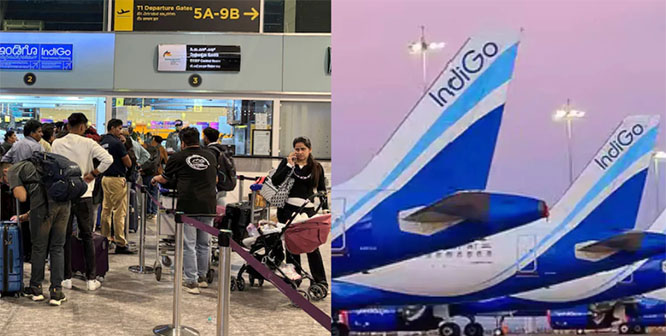
Angry outbursts, long queues, and desperate appeals filled airports across India today as IndiGo grappled with a severe operational breakdown. Hundreds of flights have been cancelled or delayed, leaving thousands of passengers stranded through the night and forcing many to spend long hours at helpdesks.

Social media was flooded with videos of fliers pleading for assistance, accusing the airline of misleading updates, and demanding accommodation after being stuck for 10 to 12 hours at airports such as Hyderabad and Bengaluru.

What Triggered the Meltdown?

IndiGo has attributed the widespread disruption to “a multitude of unforeseen operational challenges.” These include:

•    Minor technology glitches
•    Winter-season schedule adjustments
•    Bad weather
•    Congestion in the aviation network
•    New crew rostering rules (Flight Duty Time Limitations or FDTL)

Among these, the most disruptive has been the implementation of the updated FDTL norms introduced by the Directorate General of Civil Aviation (DGCA) in January 2024.

These rules were designed to reduce pilot fatigue and improve passenger safety. Key changes include:

•    Longer weekly rest periods for flight crew
•    A revised definition of “night,” extending it by an extra hour
•    Tighter caps on flight duty timing and night landings
•    Cutting night shifts for pilots and crew from six per roster cycle to just two

Once these norms became fully enforceable, airlines were required to overhaul rosters well in advance. For IndiGo, this triggered a sudden shortage of crew available for duty, leading to cascading delays and cancellations.

Why IndiGo Was Hit the Hardest

IndiGo is India’s largest airline by a wide margin, operating over 2,200 flights daily. That’s roughly double the number operated by Air India.

When an airline of this size experiences even a 10–20% disruption, it translates to 200–400 flights being delayed or grounded — producing massive spillover effects across the country.

IndiGo also relies heavily on high-frequency overnight operations, a model typical of low-cost carriers that aim to maximise aircraft utilisation and reduce downtime. The stricter FDTL norms clash with these overnight-heavy schedules, forcing the airline to pull back services.

Aviation bodies have also criticised IndiGo’s preparedness. The Airline Pilots' Association of India (ALPA) said airlines were given a two-year window to plan for the new rules but “started preparing rather late.” IndiGo, it said, failed to rebuild crew rosters 15 days in advance as required.

The Federation of Indian Pilots (FIP) went further, calling the crisis the result of IndiGo’s “prolonged and unorthodox lean manpower strategy,” and alleging that the airline adopted a hiring freeze even as it knew the new rules would require more careful staffing.

How Many Flights Are Affected?

In the past 48 hours, over 300 flights have been cancelled. At least 100 more are expected to be cancelled today.

City-wise impact:

•    Hyderabad: 33 expected cancellations; several fliers stranded overnight
•    Bengaluru: over 70 expected cancellations
•    Delhi, Mumbai, Chennai, Kolkata: widespread delays and missed connections

Passengers shared distressing accounts online.

One customer at Hyderabad airport said they waited from 6 PM to 9 AM with “no action taken” regarding their delayed Pune flight. Another said IndiGo repeatedly told them the crew was “arriving soon,” only for the delay to stretch over 12 hours.

IndiGo has apologised for the disruption and promised that operations will stabilise within 48 hours, adding that “calibrated adjustments” are being made to contain the chaos.

What Should Passengers Do Now?

For those flying in the next few days, especially with IndiGo, here are key precautions:

1. Keep Checking Flight Status
Monitor your flight closely before leaving for the airport, as delays may be announced last-minute.

2. Arrive Early
Expect long queues at counters and security due to crowding and rescheduling.

3. Carry Essentials
Pack snacks, water, basic medicines, chargers, and items for children or senior citizens. Extended waiting times should be anticipated.

4. Use Flexible Booking Options
If you booked tickets with a free-date-change or cancellation option, consider using them.
If you haven’t booked yet, prefer refundable or flexible fares, or even consider alternate airlines.

5. Follow IndiGo’s Updates
Keep an eye on IndiGo’s official social media channels and contact customer support for rebooking and refund queries.

What Needs to Change?

Pilot groups have raised concerns not just about staffing but also the planning practices behind it.
The Federation of Indian Pilots accused IndiGo of:

•    Imposing an unexplained hiring freeze despite knowing the FDTL changes were coming
•    Entering non-poaching agreements that limited talent movement
•    Keeping pilot pay frozen
•    Underestimating the need to restructure operations in advance

They have urged DGCA to approve seasonal schedules only after airlines prove they have adequate pilot strength under the new norms.

ALPA also warned that some airlines might be using the delays as an “immature pressure tactic” to push DGCA for relaxations in the new rules — which, if granted, could compromise the very safety standards the norms were meant to protect.

Both pilot bodies stressed that no exemption should dilute safety, and any deviations should be based solely on scientific risk assessment.

Is a Solution in Sight?

While IndiGo says normalcy will return within two days, aviation experts believe that fully stabilising operations could take longer, depending on how quickly the airline can:
•    Re-align rosters
•    Mobilise rested crew
•    Boost staffing
•    Adjust its winter schedule to match regulatory requirements
Passengers are advised to remain prepared for continued delays over the next few days as the airline works through its backlog. 

Comments

Add new comment

  • Coastaldigest.com reserves the right to delete or block any comments.
  • Coastaldigset.com is not responsible for its readers’ comments.
  • Comments that are abusive, incendiary or irrelevant are strictly prohibited.
  • Please use a genuine email ID and provide your name to avoid reject.
News Network
November 26,2025

students.jpg

Bengaluru, Nov 26: Karnataka is taking its first concrete steps towards lifting a three-decade-old ban on student elections in colleges and universities. Deputy Chief Minister D.K. Shivakumar announced Wednesday that the state government will form a small committee to study the reintroduction of campus polls, a practice halted in 1989 following incidents of violence.

Speaking at a 'Constitution Day' event organised by the Karnataka Congress, Mr. Shivakumar underscored the move's aim: nurturing new political leadership from the grassroots.

"Recently, (Leader of the Opposition in Lok Sabha) Rahul Gandhi wrote a letter to me and Chief Minister (Siddaramaiah) asking us to think about restarting student elections," Shivakumar stated. "I'm announcing today that we'll form a small committee and seek a report on this."

Student elections were banned in Karnataka in 1989, largely due to concerns over violence and the infiltration of political party affiliates into campus life. The ban effectively extinguished vibrant student bodies and the pipeline of young leaders they often produced.

Mr. Shivakumar, who also serves as the Karnataka Congress president, said that former student leaders will be consulted to "study the pros and cons" of the re-introduction.

Acknowledging the history of the ban, he added, "There were many criminal activities taking place back then. We’ll see how we can conduct (student) elections by regulating such criminal activities."

The Deputy CM reminisced about his own journey, which began on campus. He recalled his political activism at Sri Jagadguru Renukacharya College leading to his first Assembly ticket in 1985 at the age of 23. "That's how student leadership was at the time. Such leadership has gone today. College elections have stopped," he lamented, adding that for many, college elections were "like a big movement" where leaders were forged.

The move, driven by the Congress high command's push to cultivate young talent, will face scrutiny from academics and university authorities who have, in the past, expressed concern that the return of polls could disrupt the peaceful academic environment and turn campuses into political battlegrounds.

Comments

Add new comment

  • Coastaldigest.com reserves the right to delete or block any comments.
  • Coastaldigset.com is not responsible for its readers’ comments.
  • Comments that are abusive, incendiary or irrelevant are strictly prohibited.
  • Please use a genuine email ID and provide your name to avoid reject.