



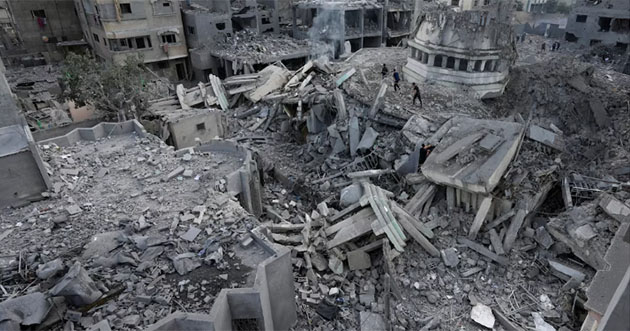
Unprecedented Israeli bombardment lays Gaza City’s upscale Rimal to waste

News Network
October 11, 2023

gazacity.jpg

Gaza City, Oct 11: Collapsed buildings, mangled infrastructure, streets turned into fields of rubble.

Scenes of violence and destruction in the long-blockaded Gaza Strip have filled the world’s airwaves throughout four wars and countless rounds of hostilities between Israel and Hamas. But this conflict, Palestinians say, is different.

On Tuesday, following a night of intense bombardment, residents were struggling to grasp the sheer scale of damage inflicted on Gaza City’s upscale Rimal neighborhood, with its shopping malls, restaurants, residential buildings and offices belonging to aid groups and international media far from the territory’s hard-hit border towns and impoverished refugee camps.

Israel has hit Rimal, also home to Hamas government ministries, in the 2021 war, but never like this.

Israeli bombs blew out walls and ripped off roofs of upper-class apartment towers. They toppled trees that had lined the sidewalks. They uprooted streets that had teemed with businessmen hustling to work and vendors hawking roasted nuts. They leveled mosques and university buildings and wrecked high-rise offices of companies and organizations like Gaza’s main telecommunications company and Bar Association.

Among those broad boulevards full of beauty salons, falafel shops and pizzerias beat the heart of Gaza City. For many, the magnitude of the devastation there, affecting the territory’s middle and upper classes, had symbolic significance.

“Israel has destroyed the center of everything,” said Palestinian businessman Ali Al-Hiyak from his home near Rimal. “That is the space of our public life, our community.”

“They are breaking us,” he added.

After Gaza’s Hamas rulers mounted the deadliest attack on Israel in decades, killing over 1,000 people and taking dozens hostage in a multi-pronged offensive, Israel unleashed what Gaza residents described as the most intense bombing campaign in recent memory, with hundreds of airstrikes Monday night.

“These sounds are different,” 30-year-old Saman Ashour in Gaza City texted as she lay awake in a neighborhood north of Rimal, listening to the roar of explosions. “It’s the sound of revenge.”

Residents said the Israeli military struck some buildings without first firing warning missiles as a precaution. The civilian death toll has been rapidly rising. Overall, Gaza health officials have reported the airstrikes have killed over 800 people and wounded thousands more. Israel has also cut off Gaza’s water supplies and electricity, worsening the territory’s already abysmal humanitarian conditions.

The Israeli military’s Arabic spokesperson, Avichay Adraee, said that Israel was trying to “evacuate civilian populations from areas where Hamas has a military presence” before unleashing “powerful destruction.”

That tactic is evident from staggering drone footage that shows vast swaths of central Gaza City reduced to nothing but dirt craters and ruins from demolished buildings.

But most Palestinian civilians did not evacuate. There are no bomb shelters. Israel and Egypt tightly control the enclave’s borders and have not let anyone out. UN shelters are rapidly filling up.

After the Hamas’ unprecedented attack on Israeli civilians and soldiers, which stunned and terrorized a country long seen as invincible, analysts said it was clear the group bet all of its chips no matter the consequences. Israel was now waging a war not to repel Hamas, like in past rounds, but to destroy it.

“The strategic prospect is to annihilate, destroy and demolish the military capacity of Hamas,” said Kobi Michael, a senior fellow at the Institute for National Security Studies, an Israeli think tank. “Hamas brought this on the heads of the Gazans.”

“If Israel is not aggressive enough,” he added, “that will only drag us to another front and to another conflict.”

But Palestinians in Gaza see the Israeli military’s wrath as collective punishment.

“We’re talking about damage to hospitals that can’t even run without fuel, the total demolition of homes and infrastructure,” said Iyad Bozum, spokesman for Gaza’s Interior Ministry. “At the end of this there will be nothing left to even reconstruct. It will be impossible to live here.”

The strikes on Rimal early Tuesday killed ordinary residents like shopkeepers and local journalists and destroyed dozens of homes.

Issa Abu Salim, 60, was seething as he stood amid the debris of his home, his clothes filthy with the dust of the destruction.

“Our money is gone. My identity cards are lost. The entire house, all four floors, is lost,” he said. “The most beautiful area, they destroyed it.”

Comments

Add new comment

  • Coastaldigest.com reserves the right to delete or block any comments.
  • Coastaldigset.com is not responsible for its readers’ comments.
  • Comments that are abusive, incendiary or irrelevant are strictly prohibited.
  • Please use a genuine email ID and provide your name to avoid reject.
News Network
January 23,2026

Mangaluru: The Karnataka Government Polytechnic (KPT), Mangaluru, has achieved autonomous status from the All India Council for Technical Education (AICTE), becoming the first government polytechnic in the country to receive such recognition in its 78-year history. The status was granted by AICTE, New Delhi, and subsequently approved by the Karnataka Board of Technical Education in October last year.

Officials said the autonomy was conferred a few months ago. Until recently, AICTE extended autonomous status only to engineering colleges, excluding diploma institutions. However, with a renewed national focus on skill development, several government polytechnics across India have now been granted autonomy.

KPT, the second-largest polytechnic in Karnataka, was established in 1946 with four branches and has since expanded to offer eight diploma programmes, including computer science and polymer technology. The institution is spread across a 19-acre campus.

Ravindra M Keni, the first dean of the institution, told The Times of India that AICTE had proposed autonomous status for polytechnic institutions that are over 25 years old. “Many colleges applied. In the first round, 100 institutions were shortlisted, which was further narrowed down to 15 in the second round. We have already completed one semester after becoming an autonomous institution,” he said. He added that nearly 500 students are admitted annually across eight three-year diploma courses.

Explaining the factors that helped KPT secure autonomy, Keni said the institution has consistently recorded 100 per cent admissions and placements for its graduates. He also noted its strong performance in sports, with the college emerging champions for 12 consecutive years, along with active student participation in NCC and NSS activities.

Autonomous status allows KPT to design industry-oriented curricula, conduct examinations, prepare question papers, and manage academic documentation independently. The institution can also directly collaborate with industries and receive priority funding from AICTE or the Ministry of Education. While academic autonomy has been granted, financial control will continue to rest with the state government.

“There will be separate committees for examinations, question paper setting, boards of studies, and boards of examiners. The institution will now have the freedom to conduct admissions without government notifications and issue its own marks cards,” Keni said, adding that new academic initiatives would be planned after a year of functioning under the autonomous framework.

Comments

Add new comment

  • Coastaldigest.com reserves the right to delete or block any comments.
  • Coastaldigset.com is not responsible for its readers’ comments.
  • Comments that are abusive, incendiary or irrelevant are strictly prohibited.
  • Please use a genuine email ID and provide your name to avoid reject.
News Network
January 19,2026

New Delhi: Setting speculation to the rest, the CPI(M) has made it clear that it is open to have an electoral understanding with the Congress “to defeat” the Trinamool Congress and the BJP in West Bengal Assembly election even as it is all set to take on the grand old party in Kerala accusing it of “found wanting” in fighting the Hindutva forces.

The CPI(M) also said that it will contest the Tamil Nadu election “with DMK and its allies to defeat the BJP and its allies”, amid a section in the Congress triggering confusion about its participation in the M K Stalin-led coalition over demand over power-sharing and more seats. It is also willing to join hands with Congress and others in Assam and Puducherry to defeat the BJP.

The decisions came at a three-day meeting of the CPI(M) Central Committee in Thiruvananthapuram, which ended on Sunday after reviewing the poll preparations in the poll-bound states.

The CPI(M)'s decision came even as a section led by West Bengal Congress president Subhankar Sarkar is averse to tying up with the Left Front, claiming that their party is not benefitted by the electoral understanding. Both Congress and CPI(M)-led Left Front had electoral understanding in 2016 and 2021 Assembly elections and 2024 Lok Sabha polls.

Congress and the Left Front fought together for the first time in 2016 when Congress won 44 seats and the CPI(M) got 26. In 2021, the Left Front and the Congress drew a blank. In the 2024 Lok Sabha polls, Congress managed to win one seat while the Left did not win any. In the 2019 Lok Sabha polls, both fought against each other with Congress winning two and the Left none.

“In Bengal, the party will work for the defeat of both the TMC and the BJP, which are trying to polarise the society. We will try to rally all the forces that are ready to work against them,” the CPI(M) said in a statement without naming Congress by name. Senior leaders said there is no change in its strategy of pooling all non-BJP, non-TMC votes.

However, the party was critical of the Congress in Kerala where both will fight against each other.

The CPI(M) said it would "expose the BJP-led Union government’s denial of rightful dues to Kerala, the fiscal constraints imposed and the overall attack on federalism" as also "expose the failure of the Congress to effectively counter this attack on federalism, as the largest opposition party in the Parliament".

"The Congress, especially in Kerala, was found wanting in the fight against communal RSS-BJP, ideologically and this will also be exposed before the people," it added.

In Assam, it said, the CPI(M) will work for the mobilisation of all the anti-BJP parties and forces and defeat the rabidly communal and divisive BJP government. The Left parties are cooperating with Congress in the north-eastern state. In Puducherry, it said it will work for the defeat of the BJP alliance government.

Comments

Add new comment

  • Coastaldigest.com reserves the right to delete or block any comments.
  • Coastaldigset.com is not responsible for its readers’ comments.
  • Comments that are abusive, incendiary or irrelevant are strictly prohibited.
  • Please use a genuine email ID and provide your name to avoid reject.
News Network
February 1,2026

Bengaluru: Karnataka Deputy Chief Minister D K Shivakumar on Sunday criticised the Union Budget presented by Finance Minister Nirmala Sitharaman, claiming it offered no tangible benefit to the state.

Though he said he was yet to study the budget in detail, Shivakumar asserted that Karnataka had gained little from it. “There is no benefit for our state from the central budget. I was observing it. They have now named a programme after Mahatma Gandhi, after repealing the MGNREGA Act that was named after him,” he said.

Speaking to reporters here, the Deputy Chief Minister demanded the restoration of MGNREGA, and made it clear that the newly enacted rural employment scheme — VB-G RAM G — which proposes a 60:40 fund-sharing formula between the Centre and the states, would not be implemented in Karnataka.

“I don’t see any major share for our state in this budget,” he added.

Shivakumar, who also holds charge of Bengaluru development, said there were high expectations for the city from the Union Budget. “The Prime Minister calls Bengaluru a ‘global city’, but what has the Centre done for it?” he asked.

He also drew attention to the problems faced by sugar factories, particularly those in the cooperative sector, alleging a lack of timely decisions and support from the central government.

Noting that the Centre has the authority to fix the minimum support price (MSP) for agricultural produce, Shivakumar said the Union government must take concrete steps to protect farmers’ interests.

Comments

Add new comment

  • Coastaldigest.com reserves the right to delete or block any comments.
  • Coastaldigset.com is not responsible for its readers’ comments.
  • Comments that are abusive, incendiary or irrelevant are strictly prohibited.
  • Please use a genuine email ID and provide your name to avoid reject.