Urgency and Equity in South Asia's Environmental Justice Struggle against Climate Colonialism

Press Release
December 13, 2023

Dubai2.jpg

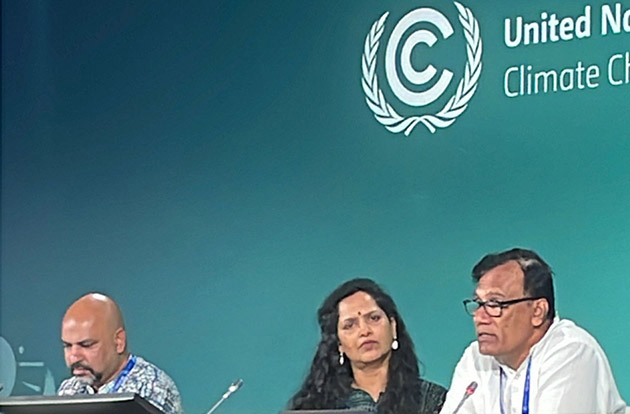
Dubai: The culmination of the Just Transition in South Asia press conference, which took place on December 11, 2023, at COP-28 in Dubai, has illuminated the pressing need for immediate action to confront the impending climate crisis. The event delivered a stark call for decisive decisions and collaborative endeavors by major economies to ensure an equitable and just transition in South Asia.

Key insights from the conference include a global south's call for urgent action, emphasizing concrete decisions to curb excessive emissions and meet the 1.5-degree goal by 2050, as outlined in the Paris Agreement. The conference underscored that 83% of the carbon budget has already been exhausted, leaving a precarious 50:50 chance of achieving the Paris Agreement goals by 2030.

Further, the Climate Risk Index revealed that six South Asian nations, including Bangladesh, India, Nepal, Pakistan, and Sri Lanka, are among the top 10 most vulnerable countries impacted by climate change. The region bore witness to the devastating impact of seven cyclones in 2023 alone, resulting in loss of lives, destruction of homes, and severe economic repercussions.

Hasan Mehedi from CLEAN (Coastal Livelihood and Environmental Action Network), Bangladesh, firmly stated, "The people of South Asia are bearing the brunt of climate change impacts, and their plea for urgent action is a call to the global community. The decisions we make today will determine the fate of vulnerable communities and the sustainability of our planet."

Recognizing the challenges faced by South Asian countries, representing a quarter of the global population and nearly a third of the world's poor, the conference shed light on the intricacies of energy poverty. The imperative to decarbonize the energy sector is acknowledged, yet challenges persist in meeting basic electricity needs and overcoming economic crises, particularly in Sri Lanka, Pakistan, and Bangladesh.

A positive development emerged with the signing of the Global Renewables and Energy Efficiency Pledge (GREEP) by 123 countries, including Bangladesh, Bhutan, and Maldives. However, concerns were voiced about the adequacy of the target, considering the escalating global electricity demand and the need for more ambitious goals to achieve a just transition by 2030.

The event underscored challenges such as the concentration of renewable energy technologies in specific countries, giving rise to a form of 'Climate Colonialism.' The dominance of large corporations in renewable energy projects, notably hydropower, raised serious environmental and human rights issues, with indigenous communities facing the imminent threat of displacement.

Hemantha Withanage from the Centre for Environmental Justice (CEJ), Sri Lanka, shared, "South Asian nations face a delicate balancing act: meeting the basic electricity needs of their citizens while navigating economic challenges. Big economies must acknowledge and support our transition efforts, ensuring a just and equitable pathway towards sustainability."

Opposition was against false solutions like hydrogen, ammonia, and carbon capture and storage (CCS) technologies. The conference emphasized the need for proven, affordable, and sustainable alternatives, rejecting the promotion of unproven technologies.

In the aftermath of the conference, key demands were outlined to address the climate crisis in South Asia. Organizers called for an ambitious target to generate at least 60% of global electricity demand from renewable sources, a cut-off date for using coal, gas, and petroleum in the power sector, cessation of financing for LNG as a transition fuel, and support for South Asian countries in building national renewable energy institutions. 

"The concentration of renewable energy technologies in specific countries is a form of 'Climate Colonialism.' We must shift focus towards community-owned decentralized systems to ensure not just environmental sustainability but also uphold the rights of local communities," says Vidya Dinker of Growthwatch, India,

Furthermore, the demands included financing for community-owned distributed renewable energy systems, ensuring local communities' human and environmental rights during the energy transition, and discontinuing the promotion of false solutions like hydrogen, ammonia, and CCS technologies.


Dubai.jpg

Comments

Add new comment

  • Coastaldigest.com reserves the right to delete or block any comments.
  • Coastaldigset.com is not responsible for its readers’ comments.
  • Comments that are abusive, incendiary or irrelevant are strictly prohibited.
  • Please use a genuine email ID and provide your name to avoid reject.
News Network
November 30,2025

The United Nations Committee against Torture (CAT) has condemned the Israeli regime for enforcing a policy of “organized torture” against Palestinians.

In a report published on Friday, CAT stated that the occupying regime enforces a deliberate policy of “organized and widespread torture and ill-treatment” against Palestinian abductees, particularly since October 7, 2023, when Israel launched its genocidal war on Gaza.

The committee expressed “deep concern over repeated severe beatings, dog attacks, electrocution, water-boarding, use of prolonged stress positions [and] sexual violence” inflicted on Palestinians.

Palestinian prisoners were degraded by “being made to act like animals or being urinated on,” systematically denied medical care, and subjected to excessive restraints, “in some cases resulting in amputation,” the report added.

CAT also condemned the routine application of “unlawful combatants law” to justify the prolonged detention without trial of thousands of Palestinian men, women, and children.

More than 10,000 Palestinians, including women and children, are currently held in Israeli prisons, according to Palestinian and international human rights groups, with 3,474 Palestinians in “administrative detention,” meaning they are imprisoned without trial for indefinite periods.

The report highlighted the “high proportion of children who are currently detained without charge or on remand,” noting that while Israel sets the age of criminal responsibility at 12, even younger children have been abducted.

Children designated as security prisoners face severe restrictions on family contact, may be subjected to solitary confinement, and are denied access to education, in clear violation of international law.

The committee further suggested that Israel’s policies across the Occupied Territories constitute collective torture against the Palestinian population.

“A range of policies adopted by Israel in the course of its continued unlawful presence in the Occupied Palestinian Territory amounts to cruel, inhuman or degrading living conditions for the Palestinian population,” the report said.

On Thursday, the Palestinian resistance movement Hamas condemned the systematic killing and torture of Palestinian abductees in Israeli prisons, urging international action to halt these abuses.

Citing human rights data, Hamas stated that 94 Palestinians have been killed in Israeli prisons since the start of Tel Aviv’s genocidal war on Gaza.

“This reflects an organized criminal approach that has turned these prisons into direct killing grounds to eliminate our people,” the resistance movement said.

Hamas called on the international community, the UN, and human rights organizations to immediately pressure Israel to end crimes against prisoners and uphold their rights as guaranteed by all international conventions and norms.

Comments

Add new comment

  • Coastaldigest.com reserves the right to delete or block any comments.
  • Coastaldigset.com is not responsible for its readers’ comments.
  • Comments that are abusive, incendiary or irrelevant are strictly prohibited.
  • Please use a genuine email ID and provide your name to avoid reject.
News Network
November 24,2025

lebanon.jpg

Israel has launched a new act of aggression on a residential neighborhood in Lebanon's capital, Beirut, killing and injuring about two dozen civilians.

The Israeli regime's military said in a statement that its forces carried out a so-called precise strike in a residential apartment in Dahiyeh in the southern suburbs of Beirut on Sunday.

The aggression targeted residential areas, killing at least five people and injuring more than 28 people, Lebanon's Health Ministry said. 

Hezbollah announced the martyrdom of senior Hezbollah commander Haytham Ali Tabatabai and four resistance fighters.

Lebanese President Michel Aoun condemned the airstrike, calling it a clear demonstration of Tel Aviv’s disregard for repeated international calls to halt violations on Lebanese soil.

“Israel refuses to implement international resolutions and all efforts aimed at ending the escalation and restoring stability,” Aoun said, urging the international community to take action to prevent further aggression.

The Palestinian Islamic Jihad movement also condemned the attack, holding the international community accountable. 

“The international community bears responsibility and continues to provide cover for these attacks as long as it does not restrain the occupiers,” said Ali Abu Shahin, a member of the group’s political bureau.

Israeli prime minister Benjamin Netanyahu’s office announced that the Israeli army carried out a strike “in the heart of Beirut."

Netanyahu reportedly approved the operation following recommendations from top Israeli security officials.

Two senior US officials commented on the Israeli strike.

The first official said that Israel did not notify Americans in advance about the attack. "We were informed immediately after the strike was carried out."

The second senior official said that the "US knew for several days that Israel was planning to escalate its strikes in Lebanon, but did not know in advance the timing, location, or target of the strike."

Speaking from the site of the Israeli strike, Lebanese MP Ali Ammar condemned the attack as part of a broader campaign of aggression that has targeted "all of Lebanon since the Washington-sponsored ceasefire."

He stated that "any attack on Lebanon is a violation of red lines; this aggression is part and parcel of the entity that targets Lebanon's dignity, sovereignty, and security of citizens."

Ammar went on to say the resistance is responding with "utmost wisdom, patience, and will confront the enemy at the appropriate time."

"Unfortunately, the enemy is emboldened to commit its aggression by voices within Lebanon that have turned themselves into tools that support its aggression," he added.

The Israeli attack on the southern suburbs of the Lebanese capital is the latest blatant violation of the ceasefire Israel signed with Hezbollah in November 2024, which was intended to end hostilities that had escalated into full-scale war.

An Israeli strike on the Ain al-Hilweh camp near Sidon in southern Lebanon late Tuesday killed at least 14 people. It wounded several others, including young students, according to the Lebanese health ministry.

The military claimed the attack targeted “a Hamas training compound” used to plan and carry out attacks against the regime -- a claim that has frequently been made without evidence.

Hamas rejected the allegations as “a blatant lie aimed at justifying the massacre,” stating it had “no military installations in the Palestinian camps in Lebanon” and that the targeted site was merely “an open sports field.”

According to Lebanese authorities, Israeli attacks have killed approximately 4,000 people and displaced more than 1.2 million residents across the country since October 2023.

Comments

Add new comment

  • Coastaldigest.com reserves the right to delete or block any comments.
  • Coastaldigset.com is not responsible for its readers’ comments.
  • Comments that are abusive, incendiary or irrelevant are strictly prohibited.
  • Please use a genuine email ID and provide your name to avoid reject.
News Network
November 21,2025

israel.jpg

Local authorities say the Israeli military has expanded the so-called “yellow line” truce demarcation in Gaza City and repositioned its forces deeper into the territory in violation of a ceasefire agreement that came into force on October 10, besieging dozens of Palestinian families.

Gaza’s Government Media Office announced in a statement on Thursday that Israeli forces widened the boundary by shifting the markers, and advanced roughly 300 meters (984 feet) into the neighborhoods of Ash-Shaaf, An-Nazzaz and Baghdad Street.

The move pushed further into civilian areas, trapping families who were unable to flee as tanks rolled forward, it added.

“The fate of many of these families remains unknown amidst the shelling that targeted the area,” the office said, adding that the expansion of the yellow line shows a “blatant disregard” for the ceasefire deal.

On Friday, sources said the Israeli military carried out continued air and artillery strikes inside the so-called “yellow line” east of Khan Younis in the southern Gaza Strip.

According to the reports, Israeli warplanes and tanks targeted areas within the zone. One Palestinian was reported killed and several others wounded in the strikes, the sources said.

The fresh aggression came only a day after 25 Palestinians were killed in Israeli airstrikes on Gaza City and Khan Younis on Wednesday.

The media office reported that Israel has consistently violated the truce deal since its implementation last month, with near-daily attacks by air, artillery and direct shootings.

The office said over 400 violations have been documented. These breaches have resulted in the deaths of more than 300 Palestinians and left hundreds injured.

The Government Media Office in Gaza urged the guarantors of the ceasefire — the US, Egypt, Qatar and Turkey — to take swift action to halt the ongoing violations and facilitate the delivery of food, shelter materials, medical aid, and infrastructure equipment.

The so-called “yellow line,” set out in the agreement between Israel and Hamas resistance movement, refers to a non-physical partition where the Israeli military repositioned itself when the truce deal took effect.

It has allowed Israel, which routinely fires at Palestinians who approach the line, to retain control over more than half of the Gaza Strip.

International bodies, including the UN Independent International Commission of Inquiry, the International Association of Genocide Scholars, Amnesty International, Human Rights Watch, B’Tselem, and other rights groups, have concluded that the Israeli war on Gaza amounts to genocide.

In the attacks in Gaza since October 2023, Israel has killed at least 69,546 people and injured 170,833 others, leveling large swaths of the territory and displacing almost all of the population. 

Comments

Add new comment

  • Coastaldigest.com reserves the right to delete or block any comments.
  • Coastaldigset.com is not responsible for its readers’ comments.
  • Comments that are abusive, incendiary or irrelevant are strictly prohibited.
  • Please use a genuine email ID and provide your name to avoid reject.