What’s the situation on ground after U.S. bombardment of Iran’s key nuclear sites?

News Network
June 22, 2025

bombsUS.jpg

The United States has launched a direct military attack on Iran’s nuclear infrastructure, bombing three key facilities at Fordow, Natanz, and Isfahan. The move, ordered by U.S. President Donald Trump, comes just days after Israel initiated an unprecedented offensive on Iran.

“We have completed our very successful attack on the three nuclear sites in Iran,” Trump declared on Truth Social, referring to the strikes as a “spectacular military success.” The U.S. Air Force deployed stealth B-2 bombers armed with 13,000 kg bunker-busting bombs, while U.S. Navy submarines reportedly fired cruise missiles at strategic targets.

The sudden escalation has triggered alarm across the globe, evoking memories of the 2003 U.S. invasion of Iraq and raising fears of a wider regional war.

What Exactly Did the U.S. Bomb?

The targets were three of Iran’s most significant nuclear sites:

•    Fordow: A deeply buried underground uranium enrichment facility near Qom, heavily fortified and previously considered nearly impervious to aerial attack.

•    Natanz: Iran’s largest and most well-known enrichment complex. It was previously hit by Israeli strikes on June 13 and has long been seen as the heart of Iran’s nuclear ambitions.

•    Isfahan: A vital research and uranium conversion center that plays a key role in processing nuclear materials for reactor use.
According to U.S. media, the attack involved a combination of bunker buster bombs and cruise missiles, marking the first known combat use of the U.S. military’s GBU-57 Massive Ordnance Penetrator — capable of piercing dozens of meters of concrete.

How Much Damage Was Done?

President Trump claimed Iran’s enrichment capabilities were “completely and totally obliterated.” However, Iran offered a sharply different account.

Iranian officials said the Fordow facility had been evacuated in advance, minimizing any potential damage. The Atomic Energy Organization of Iran (AEOI) confirmed that no radiation leaks had occurred, and that field surveys found no contamination near any of the targeted sites.

Iranian authorities dismissed the attack as largely symbolic and vowed to continue their nuclear program, calling it the result of the sacrifices of the country’s “nuclear martyrs.”

The International Atomic Energy Agency (IAEA) also reported no rise in off-site radiation levels. Director Rafael Grossi announced that the agency would hold an emergency meeting on Monday to assess the full scope of the strikes.

Will Iran Retaliate Against the U.S.?

Iran has condemned the strikes as an act of war. Its Foreign Ministry called the attack a “dangerous escalation” and declared that Iran reserves the right to respond with full force to protect its sovereignty.

“The Islamic Republic of Iran considers it its right to stand against U.S. military aggression and defend national interests,” a statement said.

Military experts say retaliation is highly likely. Iran could:

•   Target U.S. military bases in the region — many of which are within range of Iranian drones and missiles.

•   Disrupt global shipping in the Persian Gulf, threatening oil supply routes.

•   Activate proxy forces in Iraq, Syria, and Lebanon to strike U.S. or allied targets.

•   Consider withdrawing from the Nuclear Non-Proliferation Treaty (NPT) — a move that could further escalate global tensions.

Iran has already signaled its intent by deploying the Kheibar Shekan missile, one of its most advanced, in a retaliatory strike on Israel.

Global Reaction: A Region on Edge

UN Secretary-General Antonio Guterres said he was “gravely alarmed,” warning that the U.S. strikes posed a direct threat to international peace and security.

“This is a dangerous escalation in a region already on the edge,” Guterres said. “There is a growing risk that this conflict could spiral out of control, with catastrophic consequences.”

Analysts believe the U.S. move might entangle it in a long-term conflict. Stephen Zunes, a Middle East expert at the University of San Francisco, said Iran has several “painful” options at its disposal and warned of a broad regional backlash.

Adam Weinstein, from the Quincy Institute, warned that this could be just the beginning. “The U.S. is now at risk of being pulled into a war of choice with Iran. What started as a single strike could become an open-ended escalation,” he said.

The Road Ahead

While the U.S. may have delivered a powerful military blow, the long-term consequences remain uncertain. Iran insists its nuclear program will continue. The region remains on high alert. And the prospect of a wider conflict now looms larger than ever.

As the dust settles, the world is watching closely — not just to assess the damage, but to see what comes next.

Comments

Add new comment

  • Coastaldigest.com reserves the right to delete or block any comments.
  • Coastaldigset.com is not responsible for its readers’ comments.
  • Comments that are abusive, incendiary or irrelevant are strictly prohibited.
  • Please use a genuine email ID and provide your name to avoid reject.
News Network
November 21,2025

israel.jpg

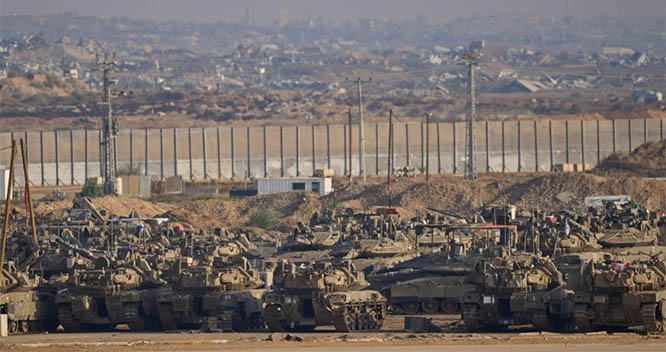
Local authorities say the Israeli military has expanded the so-called “yellow line” truce demarcation in Gaza City and repositioned its forces deeper into the territory in violation of a ceasefire agreement that came into force on October 10, besieging dozens of Palestinian families.

Gaza’s Government Media Office announced in a statement on Thursday that Israeli forces widened the boundary by shifting the markers, and advanced roughly 300 meters (984 feet) into the neighborhoods of Ash-Shaaf, An-Nazzaz and Baghdad Street.

The move pushed further into civilian areas, trapping families who were unable to flee as tanks rolled forward, it added.

“The fate of many of these families remains unknown amidst the shelling that targeted the area,” the office said, adding that the expansion of the yellow line shows a “blatant disregard” for the ceasefire deal.

On Friday, sources said the Israeli military carried out continued air and artillery strikes inside the so-called “yellow line” east of Khan Younis in the southern Gaza Strip.

According to the reports, Israeli warplanes and tanks targeted areas within the zone. One Palestinian was reported killed and several others wounded in the strikes, the sources said.

The fresh aggression came only a day after 25 Palestinians were killed in Israeli airstrikes on Gaza City and Khan Younis on Wednesday.

The media office reported that Israel has consistently violated the truce deal since its implementation last month, with near-daily attacks by air, artillery and direct shootings.

The office said over 400 violations have been documented. These breaches have resulted in the deaths of more than 300 Palestinians and left hundreds injured.

The Government Media Office in Gaza urged the guarantors of the ceasefire — the US, Egypt, Qatar and Turkey — to take swift action to halt the ongoing violations and facilitate the delivery of food, shelter materials, medical aid, and infrastructure equipment.

The so-called “yellow line,” set out in the agreement between Israel and Hamas resistance movement, refers to a non-physical partition where the Israeli military repositioned itself when the truce deal took effect.

It has allowed Israel, which routinely fires at Palestinians who approach the line, to retain control over more than half of the Gaza Strip.

International bodies, including the UN Independent International Commission of Inquiry, the International Association of Genocide Scholars, Amnesty International, Human Rights Watch, B’Tselem, and other rights groups, have concluded that the Israeli war on Gaza amounts to genocide.

In the attacks in Gaza since October 2023, Israel has killed at least 69,546 people and injured 170,833 others, leveling large swaths of the territory and displacing almost all of the population. 

Comments

Add new comment

  • Coastaldigest.com reserves the right to delete or block any comments.
  • Coastaldigset.com is not responsible for its readers’ comments.
  • Comments that are abusive, incendiary or irrelevant are strictly prohibited.
  • Please use a genuine email ID and provide your name to avoid reject.
News Network
December 4,2025

indigoflight.jpg

Domestic carrier IndiGo has cancelled over 180 flights from three major airports — Mumbai, Delhi and Bengaluru — on Thursday, December 4, as the airline struggles to secure the required crew to operate its flights in the wake of new flight-duty and rest-period norms for pilots.

While the number of cancellations at Mumbai airport stands at 86 (41 arrivals and 45 departures) for the day, at Bengaluru, 73 flights have been cancelled, including 41 arrivals, according to a PTI report that quoted sources.

"IndiGo cancelled over 180 flights on Thursday at three airports-Mumbai, Delhi and Bengaluru," the source told the news agency.

Besides, it had cancelled as many as 33 flights at Delhi airport for Thursday, the source said, adding, "The number of cancellations is expected to be higher by the end of the day."

The Gurugram-based airline's On-Time Performance (OTP) nosedived to 19.7 per cent at six key airports — Delhi, Mumbai, Chennai, Kolkata, Bengaluru and Hyderabad — on December 3, as it struggled to get the required crew to operate its services, down from almost half of December 2, when it was 35 per cent.

"IndiGo has been facing acute crew shortage since the implementation of the second phase of the FDTL (Flight Duty Time Limitations) norms, leading to cancellations and huge delays in its operations across the airports," a source had told PTI on Wednesday.

Chaos continued at several major airports for the third day on Thursday because of the cancellations.

A spokesperson for the Kempegowda International Airport (KIA) in Bengaluru said that 73 IndiGo flights had been cancelled on Thursday.

At least 150 flights were cancelled and dozens of others delayed on Wednesday, airport sources said, leaving thousands of travellers stranded, according to news agency Reuters.

The Directorate General of Civil Aviation (DGCA) has said it is investigating IndiGo flight disruptions and has asked the airline to submit the reasons for the current situation, as well as its plans to reduce flight cancellations and delays.

It may be mentioned here that the pilots' body, Federation of Indian Pilots (FIP), has alleged that IndiGo, despite getting a two-year preparatory window before the full implementation of new flight duty and rest period norms for cockpit crew, "inexplicably" adopted a "hiring freeze".

The FIP said it has urged the safety regulator, the DGCA, not to approve airlines' seasonal flight schedules unless they have adequate staff to operate their services "safely and reliably" in accordance with the New Flight Duty Time Limitations (FDTL) norms.

In a letter to the DGCA late on Wednesday, the FIP urged the DGCA to consider re-evaluating and reallocating slots to other airlines, which have the capacity to operate them without disruption during the peak holiday and fog season if IndiGo continues to "fail in delivering on its commitments to passengers due to its own avoidable staffing shortages."

Comments

Add new comment

  • Coastaldigest.com reserves the right to delete or block any comments.
  • Coastaldigset.com is not responsible for its readers’ comments.
  • Comments that are abusive, incendiary or irrelevant are strictly prohibited.
  • Please use a genuine email ID and provide your name to avoid reject.
coastaldigest.com news network
November 28,2025

roadshow.jpg

Udupi district transformed into a sea of saffron and celebration on Friday, November 28, as Prime Minister Narendra Modi’s roadshow swept through the coastal temple town. Thousands of residents lined the streets, turning the event into a vibrant public spectacle filled with cheers, flags, and festive energy.

The procession route—from the helipad to the historic Sri Krishna Math—was decked with buntings, saffron flags, and multilayered security barricades. One of the district’s largest-ever security deployments was put in place for the high-profile visit, with over 3,000 police personnel on duty. The arrangement included ten SPs, 27 DSPs, 49 inspectors, 127 sub-inspectors, 232 assistant sub-inspectors, 1,608 constables, and 39 women staff.

Six platoons of the Karnataka State Reserve Police, six Quick Response Teams, bomb detection units, and dog squads were stationed across Udupi. Enhanced surveillance covered Adi Udupi, Bannanje bus stand, and the Sri Krishna Math parking zone, with combing operations carried out along the roadshow corridor.

At the 800-year-old Sri Krishna Math, preparations reached a ceremonial peak. Paryaya Puttige Math seer Sugunendra Teertha Swamiji said the Prime Minister would take part in the Laksha Kantha Geetha Parayana, a mass chanting of the Bhagavad Gita by one lakh devotees, and inaugurate the new Suvarna Teertha Mantapa.

“He will first offer floral tributes to saint-poet Kanakadasa and then unveil the golden covering over the Kanakana Kindi,” the seer said.

The Prime Minister will also receive a Poorna Kumbha welcome and have darshan of Lord Sri Krishna, Mukhyaprana Devaru, and the Suvarna Paduke. Union Minister Pralhad Joshi, Karnataka Governor Thaawarchand Gehlot, Minister Bairathi Suresh, Dharmadhikari D. Veerendra Heggade, and seers from the Ashta Maths are expected to join the ceremony.

Ahead of his arrival, the Prime Minister posted on X that he felt “honoured” to attend the spiritually significant gathering. “This is a special occasion that brings together people from different sections of society for a recital of the Gita. This Matha has a very special significance in our cultural life,” he wrote, noting the institution’s long-standing legacy rooted in the teachings of Sri Madhvacharya.

roadshow2.jpg

Comments

Add new comment

  • Coastaldigest.com reserves the right to delete or block any comments.
  • Coastaldigset.com is not responsible for its readers’ comments.
  • Comments that are abusive, incendiary or irrelevant are strictly prohibited.
  • Please use a genuine email ID and provide your name to avoid reject.