



Small cap stocks post biggest single day jump in 6 years after SEBI circular

Agencies
September 15, 2020

Mumbai, Sept 15: The small cap index posted its biggest single day gain in over six years on Monday after the SEBI circular on multi cap mutual funds triggered buying.

The estimates by analysts and brokerage houses indicate that the net inflow from large caps would be around Rs 27,000 crore into the small caps and around Rs 13,000 crore into the mid caps following the SEBI circular to invest 25 per cent each of assets of multi cap funds into large, mid and small cap stocks.

The huge rally in small cap stocks has come even after fund managers asked investors not to rush to buy small cap stocks in haste and there were clarifications that mutual funds have several options apart from rebalancing their schemes including a merger of schemes to comply with the circular.

Siddhartha Khemka, Head - Retail Research, Motilal Oswal Financial Services said mid-cap and small cap stocks gained sharply.

He said investors were attracted towards Mid/small caps due to the SEBI mandate to Multicap mutual funds to invest a minimum of 25 per cent each in large, mid and small cap stocks. Small Cap Index posted its biggest 1-day gain in over six years.

Deepak Jasani, Head of Retail Research, HDFC Securities said that the recent SEBI circular on allocation by Multicap schemes spurred buying in a lot of small and midcaps in anticipation of fund buying that could emerge later to adhere to the new regulation. The Nifty midcap index ended 2.6 per cent higher while the smallcap index gained 5.6 per cent - the most since May 2014.

Nifty has ended the first day of the week in the negative while the broader market has reacted positively to the latest SEBI circular, he added.

In a note to investors, Sage One has said that SEBI had done a big re-categorization of mutual funds (MFs) in early 2018 which triggered initial rotation from small/midcaps to large caps, and the falling prices created their own snowball effect resulting in the small cap universe correcting by 40-60 per cent. During this period the large cap indices delivered positive returns. In the latest re-categorization of multi-cap MFs, a small part of the 2018 action has been reversed.

As per the note, institutional shareholding (SH) in large cap space is currently 20 per cent above the December 2017 levels whereas it's 41 per cent lower for the small cap space.

The total institutional holding has increased by 10 per cent during this period. Small cap companies make up 10% of the total market capitalization, but the institutional holding is only at 5.3 per cent of their total holding. In December 2017 small cap companies made 16 per cent of the total market capitalization. The biggest contribution in the market drop was the forced selling by the domestic institutions. As prices dropped, it forces other investors to move out and seek performing asset classes such as the large caps, the note said.

The note said that whether MFs actually do the entire re-allocation or whether they merge their multi cap schemes into the large cap schemes is an unknown.

"Irrespective of the amount that actually gets re-allocated, just the anticipation could bring in fresh capital in small/mid cap schemes under MFs, PMS' and AIFs. It doesn't take much inflow to move stocks in this universe," the note said.

The research notes that the impact cost of actual exits was as high as 15 times in the small cap space. This means that if one was to invest fresh capital of Rs 1,000 crore in the small cap companies, on an average their market cap would go up by Rs 15,000 crore. There will not be enough sellers available when the expectation is that this space would do well in presence of forced buyers.

"Even if we assume that only half (Rs 13,500 crore) the capital would be re-allocated by the MFs and assume that there will be no fresh inflows in the small cap companies by other investors and in addition even if we assume that the buying impact would be half (7.5x), the increase in the market cap of the small cap universe would be more than Rs 1 lakh which is around 36% increase in total market cap (currently Rs 2.80 lakh crore) of the small cap companies," the research said.

This step would benefit more than 1000 companies compared to just 100 companies that benefited by the 2018 circular. In an environment when debt raising is multiple times difficult for the smaller companies, this SEBI triggered change would help equity raising capability of these companies.

HDFC Securities said in a note that given the size of multicap funds and higher allocation especially to smallcap stocks; some concerns have been raised about achieving the prescribed investment limits without creating a bubble in small and midcap stocks.

The AUM of smallcap stocks across equity categories (excluding sectoral) as on July 2020 is Rs 68,109 crore – compare this with Rs 28,000 crore worth fresh buying required.

"These stocks have less free float availability, relatively lower volumes, corporate governance issues and higher impact cost (both at the time of getting in and getting out). Also, liquidity issues in smallcap stocks could get compounded in bear markets when these funds face redemption pressure and are required to sell small cap stocks where impact costs could be large," it said.

Schemes requiring the least reshuffling include multicap funds from Invesco, IDFC and Nippon, while schemes requiring the most reshuffling include Kotak Standard, HDFC Equity, Motilal Multicap 35, Axis and Canara Robeco Eq diversified fund, HFDC Securities said.

Comments

Add new comment

  • Coastaldigest.com reserves the right to delete or block any comments.
  • Coastaldigset.com is not responsible for its readers’ comments.
  • Comments that are abusive, incendiary or irrelevant are strictly prohibited.
  • Please use a genuine email ID and provide your name to avoid reject.
News Network
January 19,2026

trump.jpg

Donald Trump has linked his repeated threats to seize Greenland to his failure to win the Nobel Peace Prize, in a letter to Norwegian Prime Minister Jonas Gahr Støre.

The authenticity of the letter, in which Trump says he no longer feels obligated to “think purely of peace,” was confirmed by Støre to the Norwegian newspaper VG.

“Considering your country decided not to give me the Nobel Peace Prize for having stopped eight wars plus, I no longer feel an obligation to think purely of peace,” Trump wrote, adding he can now “think about what is good and proper for the United States.”

Støre said Trump’s letter was in response to a short message he had sent earlier, on behalf of himself and Finland’s President Alexander Stubb.

Trump has escalated rhetoric toward Greenland, a self-governing Danish territory, insisting the US will take control “one way or the other.” Over the weekend, he tweeted: “Now it is time, and it will be done!!!”

On Saturday, Trump threatened a 10% tariff on imports from Denmark, Norway, Sweden, France, Germany, the UK, the Netherlands, and Finland from 1 February until the US is allowed to purchase the island. EU diplomats met for emergency talks on possible retaliatory tariffs and sanctions.

In his letter, Trump argued Denmark “cannot protect” Greenland from Russia or China, questioning Danish ownership: “There are no written documents; it’s only that a boat landed there hundreds of years ago.” He added that NATO should support the US, claiming the world is “not secure unless we have complete and total control of Greenland.”

Trump’s stance has unsettled the EU and NATO, as he refused to rule out military action to take control of the mineral-rich island.

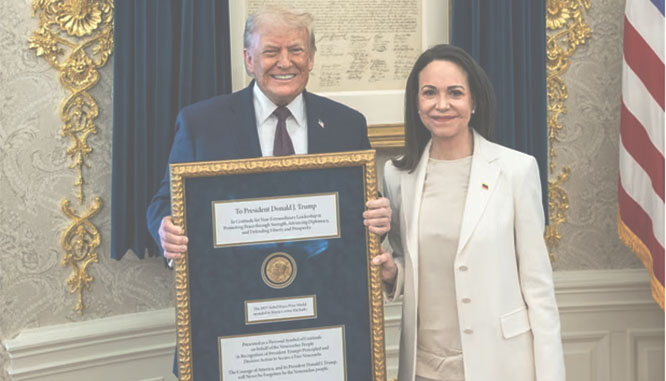
The Nobel Peace Prize is awarded by the independent Norwegian Nobel Committee, not the government. Trump had campaigned for last year’s prize, which went to Venezuelan opposition leader María Corina Machado, who dedicated her award to him.

Støre reiterated that the Nobel Prize decision rests solely with the committee.

Comments

Add new comment

  • Coastaldigest.com reserves the right to delete or block any comments.
  • Coastaldigset.com is not responsible for its readers’ comments.
  • Comments that are abusive, incendiary or irrelevant are strictly prohibited.
  • Please use a genuine email ID and provide your name to avoid reject.
News Network
January 23,2026

Karnataka Governor Thaawarchand Gehlot read only three lines from the 122-paragraph address prepared by the Congress-led state government while addressing the joint session of the Legislature on Thursday, effectively bypassing large sections critical of the BJP-led Union government.

The omitted portions of the customary Governor’s address outlined what the state government described as a “suppressive situation in economic and policy matters” under India’s federal framework. The speech also sharply criticised the Centre’s move to replace the Mahatma Gandhi National Rural Employment Guarantee Act (MGNREGA) with the Viksit Bharat–Guarantee for Rozgar and Ajeevika Mission (Gramin) Act, commonly referred to as the VB-GRAM (G) Act.

Governor Gehlot had earlier conveyed his objection to several paragraphs that were explicitly critical of the Union government. On Thursday, he confined himself to the opening lines — “I extend a warm welcome to all of you to the joint session of the State legislature. I am extremely pleased to address this august House” — before jumping directly to the concluding sentence of the final paragraph.

He ended the address by reading the last line of paragraph 122: “Overall, my government is firmly committed to doubling the pace of the State’s economic, social and physical development. Jai Hind — Jai Karnataka.”

According to the prepared speech, the Karnataka government demanded the scrapping of the VB-GRAM (G) Act, describing it as “contractor-centric” and detrimental to rural livelihoods, and called for the full restoration of MGNREGA. The state government argued that the new law undermines decentralisation, weakens labour protections, and centralises decision-making in violation of constitutional norms.

Key points from the unread sections of the speech:

•    Karnataka facing a “suppressive” economic and policy environment within the federal system

•    Repeal of MGNREGA described as a blow to rural livelihoods

•    VB-GRAM (G) Act accused of protecting corporate and contractor interests

•    New law alleged to weaken decentralised governance

•    Decision-making said to be imposed by the Centre without consulting states

•    Rights of Adivasis, women, backward classes and agrarian communities curtailed

•    Labourers allegedly placed under contractor control

•    States facing mounting fiscal stress due to central policies

•    VB-GRAM (G) Act accused of enabling large-scale corruption

Comments

Add new comment

  • Coastaldigest.com reserves the right to delete or block any comments.
  • Coastaldigset.com is not responsible for its readers’ comments.
  • Comments that are abusive, incendiary or irrelevant are strictly prohibited.
  • Please use a genuine email ID and provide your name to avoid reject.