Small cap stocks post biggest single day jump in 6 years after SEBI circular

Agencies
September 15, 2020

stocks.png

Mumbai, Sept 15: The small cap index posted its biggest single day gain in over six years on Monday after the SEBI circular on multi cap mutual funds triggered buying.

The estimates by analysts and brokerage houses indicate that the net inflow from large caps would be around Rs 27,000 crore into the small caps and around Rs 13,000 crore into the mid caps following the SEBI circular to invest 25 per cent each of assets of multi cap funds into large, mid and small cap stocks.

The huge rally in small cap stocks has come even after fund managers asked investors not to rush to buy small cap stocks in haste and there were clarifications that mutual funds have several options apart from rebalancing their schemes including a merger of schemes to comply with the circular.

Siddhartha Khemka, Head - Retail Research, Motilal Oswal Financial Services said mid-cap and small cap stocks gained sharply.

He said investors were attracted towards Mid/small caps due to the SEBI mandate to Multicap mutual funds to invest a minimum of 25 per cent each in large, mid and small cap stocks. Small Cap Index posted its biggest 1-day gain in over six years.

Deepak Jasani, Head of Retail Research, HDFC Securities said that the recent SEBI circular on allocation by Multicap schemes spurred buying in a lot of small and midcaps in anticipation of fund buying that could emerge later to adhere to the new regulation. The Nifty midcap index ended 2.6 per cent higher while the smallcap index gained 5.6 per cent - the most since May 2014.

Nifty has ended the first day of the week in the negative while the broader market has reacted positively to the latest SEBI circular, he added.

In a note to investors, Sage One has said that SEBI had done a big re-categorization of mutual funds (MFs) in early 2018 which triggered initial rotation from small/midcaps to large caps, and the falling prices created their own snowball effect resulting in the small cap universe correcting by 40-60 per cent. During this period the large cap indices delivered positive returns. In the latest re-categorization of multi-cap MFs, a small part of the 2018 action has been reversed.

As per the note, institutional shareholding (SH) in large cap space is currently 20 per cent above the December 2017 levels whereas it's 41 per cent lower for the small cap space.

The total institutional holding has increased by 10 per cent during this period. Small cap companies make up 10% of the total market capitalization, but the institutional holding is only at 5.3 per cent of their total holding. In December 2017 small cap companies made 16 per cent of the total market capitalization. The biggest contribution in the market drop was the forced selling by the domestic institutions. As prices dropped, it forces other investors to move out and seek performing asset classes such as the large caps, the note said.

The note said that whether MFs actually do the entire re-allocation or whether they merge their multi cap schemes into the large cap schemes is an unknown.

"Irrespective of the amount that actually gets re-allocated, just the anticipation could bring in fresh capital in small/mid cap schemes under MFs, PMS' and AIFs. It doesn't take much inflow to move stocks in this universe," the note said.

The research notes that the impact cost of actual exits was as high as 15 times in the small cap space. This means that if one was to invest fresh capital of Rs 1,000 crore in the small cap companies, on an average their market cap would go up by Rs 15,000 crore. There will not be enough sellers available when the expectation is that this space would do well in presence of forced buyers.

"Even if we assume that only half (Rs 13,500 crore) the capital would be re-allocated by the MFs and assume that there will be no fresh inflows in the small cap companies by other investors and in addition even if we assume that the buying impact would be half (7.5x), the increase in the market cap of the small cap universe would be more than Rs 1 lakh which is around 36% increase in total market cap (currently Rs 2.80 lakh crore) of the small cap companies," the research said.

This step would benefit more than 1000 companies compared to just 100 companies that benefited by the 2018 circular. In an environment when debt raising is multiple times difficult for the smaller companies, this SEBI triggered change would help equity raising capability of these companies.

HDFC Securities said in a note that given the size of multicap funds and higher allocation especially to smallcap stocks; some concerns have been raised about achieving the prescribed investment limits without creating a bubble in small and midcap stocks.

The AUM of smallcap stocks across equity categories (excluding sectoral) as on July 2020 is Rs 68,109 crore – compare this with Rs 28,000 crore worth fresh buying required.

"These stocks have less free float availability, relatively lower volumes, corporate governance issues and higher impact cost (both at the time of getting in and getting out). Also, liquidity issues in smallcap stocks could get compounded in bear markets when these funds face redemption pressure and are required to sell small cap stocks where impact costs could be large," it said.

Schemes requiring the least reshuffling include multicap funds from Invesco, IDFC and Nippon, while schemes requiring the most reshuffling include Kotak Standard, HDFC Equity, Motilal Multicap 35, Axis and Canara Robeco Eq diversified fund, HFDC Securities said.

Comments

Add new comment

  • Coastaldigest.com reserves the right to delete or block any comments.
  • Coastaldigset.com is not responsible for its readers’ comments.
  • Comments that are abusive, incendiary or irrelevant are strictly prohibited.
  • Please use a genuine email ID and provide your name to avoid reject.
News Network
November 27,2025

siddDKS.jpg

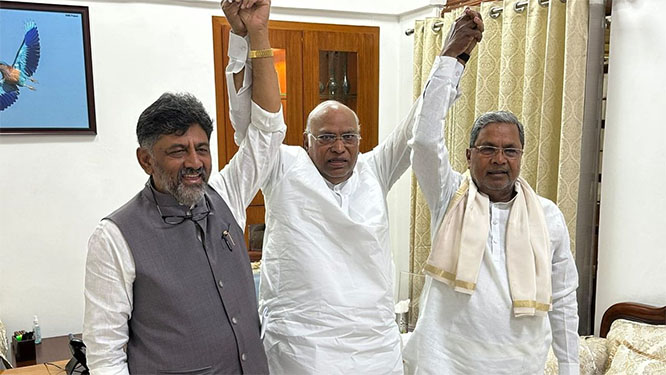
Congress president Mallikarjun Kharge on Thursday announced that he will convene a high-level meeting in New Delhi with senior leaders — including Rahul Gandhi, Karnataka Chief Minister Siddaramaiah and Deputy Chief Minister D.K. Shivakumar — to resolve the escalating leadership turmoil in Karnataka and “put an end to the confusion.”

Kharge said the discussions would focus on the way forward for the ruling party, as rumours of a possible leadership change continue to swirl. The speculation has intensified after the Congress government crossed the halfway mark of its five-year term on November 20, reviving talk of an alleged 2023 “power-sharing agreement” between Siddaramaiah and Shivakumar.

“After reaching Delhi, I will call three or four important leaders and hold discussions. Once we talk, we will decide how to move ahead and end this confusion,” Kharge told reporters in Bengaluru, according to PTI.

When asked specifically about calling Siddaramaiah and Shivakumar to Delhi, he responded: “Certainly, we should call them. We will discuss with them and settle the issue.”

He confirmed that Rahul Gandhi, the Chief Minister, the Deputy Chief Minister and other senior members would be part of the deliberations. “After discussing with everyone, a decision will be made,” he said.

Meanwhile, Siddaramaiah held a separate strategy meeting at his Bengaluru residence with ministers and leaders seen as his close confidants, including G. Parameshwara, Satish Jarkiholi, H.C. Mahadevappa, K. Venkatesh and K.N. Rajanna.
Signalling calm, the Chief Minister told reporters, “Will go to Delhi if the high command calls.”

Shivakumar echoed a similar stance, saying he too would head to the national capital if summoned by the party leadership.

Comments

Add new comment

  • Coastaldigest.com reserves the right to delete or block any comments.
  • Coastaldigset.com is not responsible for its readers’ comments.
  • Comments that are abusive, incendiary or irrelevant are strictly prohibited.
  • Please use a genuine email ID and provide your name to avoid reject.
News Network
November 24,2025

israelsyra.jpg

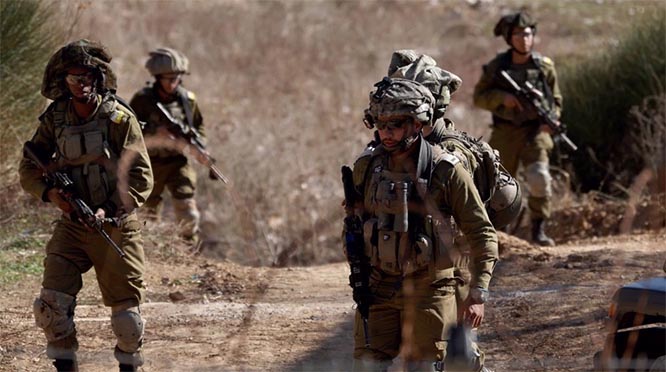
Israeli forces have pushed over the Syrian frontier, erecting a checkpoint and stopping vehicles in the southwestern city of Quneitra, in yet another breach of the Arab country’s sovereignty.

The violation took place on Sunday, when the troops made their way across the border, setting up the outpost near the Ain al-Bayda junction in northern Quneitra, Syrian outlets reported.

According to the al-Ikhbariya paper, an Israeli detachment positioned itself at the junction, halting cars and conducting searches.

The Syrian Arab News Agency (SANA) reported that three Israeli military vehicles then moved further into the northern countryside, deploying between the town of Jubata al-Khashab and the villages of Ofaniya and Ain al-Bayda. The agency added that a separate Israeli unit mounted a new incursion in the central region, approaching the villages of Umm Batina and al-Ajraf.

Residents said such activities have surged in recent months, pointing to Israeli advances onto farmland, leveling of extensive forested areas, arrests, and spread of mobile checkpoints.

The Israeli regime began markedly increasing its military aggression against Syria last year.

The escalation coincided with increasingly ferocious onslaughts throughout the country by the so-called Hay'at Tahrir al-Sham (HTS) Takfiri terrorist group, which the government of President Bashar al-Assad had confined to northwestern Syria. The HTS, however, managed to overthrow the government as the Israeli attacks would pummel the country’s civilian and defensive infrastructure.

Various reports have shown that, during the escalation, the regime conducted more than 1,000 airstrikes on the Syrian territory and over 400 ground raids into the south.

Following the collapse of the Assad government, Tel Aviv also widened its grip over the occupied Golan Heights by taking control of a demilitarized buffer zone, in defiance of a 1974 Disengagement Agreement. Earlier this month, senior Israeli officials, including Prime Minister Benjamin Netanyahu, visited the buffer zone, prompting expressions of alarm on the part of the United Nations.

The United States, the regime’s biggest ally, has, meanwhile, been fraternizing the HTS head Abu Mohammed al-Jolani amid the widely reported prospect of rapprochement with Tel Aviv.

Comments

Add new comment

  • Coastaldigest.com reserves the right to delete or block any comments.
  • Coastaldigset.com is not responsible for its readers’ comments.
  • Comments that are abusive, incendiary or irrelevant are strictly prohibited.
  • Please use a genuine email ID and provide your name to avoid reject.
Agencies
November 22,2025

indiapak.jpg

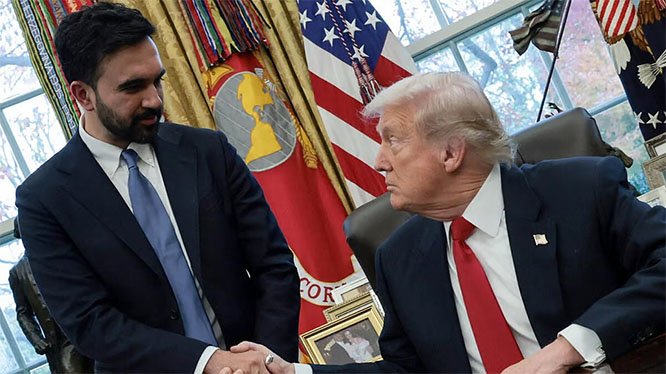
New York/Washington: US President Donald Trump has again claimed to have solved the conflict between India and Pakistan, repeating his assertion during a meeting with New York City Mayor-elect Zohran Mamdani in the Oval Office.

Mamdani flew to Washington DC for his first meeting with Trump in the White House on Friday. Trump said he “enjoyed” the meeting, which he described as “great.”

During remarks in the Oval Office, with Mamdani standing next to him, Trump repeated his claim that he solved the May conflict between India and Pakistan.

"I did eight peace deals of countries, including India and Pakistan,” he said.

On Wednesday, Trump had said he threatened to put 350 per cent tariffs on India and Pakistan if they did not end their conflict, repeating his claim that he solved the fighting between the nuclear-armed neighbours and that Prime Minister Narendra Modi had called him to say “we're not going to go to war.”

Since May 10, when Trump announced on social media that India and Pakistan had agreed to a “full and immediate” ceasefire after a “long night” of talks mediated by Washington, he has repeated his claim over 60 times that he “helped settle” the tensions between India and Pakistan.

India has consistently denied any third-party intervention. India launched Operation Sindoor on May 7, targeting terror infrastructure in Pakistan and Pakistan-occupied Kashmir in retaliation for the April 22 Pahalgam attack that killed 26 civilians. India and Pakistan reached an understanding on May 10 to end the conflict after four days of intense cross-border drone and missile strikes.

Mamdani emerged victorious in the closely-watched battle for New York City Mayor, becoming the first South Asian and Muslim to be elected to sit at the helm of the largest city in the US.

He had been the front-runner in the NYC Mayoral election for months and defeated Republican nominee Curtis Sliwa and political heavyweight former New York State Governor Andrew Cuomo, who ran as an independent candidate and was officially endorsed by Trump just hours before the elections.

Indian-descent Mamdani is the son of renowned filmmaker Mira Nair and Columbia University professor Mahmood Mamdani. He was born and raised in Kampala, Uganda and moved to New York City with his family when he was 7. Mamdani became a naturalised US citizen only recently, in 2018.

Comments

Add new comment

  • Coastaldigest.com reserves the right to delete or block any comments.
  • Coastaldigset.com is not responsible for its readers’ comments.
  • Comments that are abusive, incendiary or irrelevant are strictly prohibited.
  • Please use a genuine email ID and provide your name to avoid reject.