



Modi addresses nation over radio

October 3, 2014

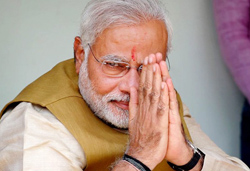
New Delhi, Oct 3: Seeking to reach out to more people, Prime Minister Narendra Modi today addressed the countrymen over radio for the first time, giving a pep talk about how to shed despondency and use their skills for betterment and prosperity of the country.
modi copy

He advocated the need for use of khadi products as a homage to Mahatma Gandhi and impressed upon the people to generate confidence among themselves, including the specially-abled children.

Promising to make the radio broadcast a regular affair, Modi invited ideas from the citizens while noting that he had been receiving a number of suggestions since it was announced that he would be addressing the nation over radio.

In his 15-minute address, he sought to motivte people to recognise their capabilities and use them.

"You know, our scientists have undertaken the Mars mission successfully at minimum expenses. There is nothing lacking in our capabilities. We only have forgotten our strengths. We have forgotten ourselves as if we have become despondents. My brothers and sisters, this cannot be," he said.

"We need to recognise our internal strengths," the Prime Minister said while narrating a short story of Swami Vivekananda about how a lion brought up by sheep rediscovered his prowess after coming in touch with another lion.

"If we move ahead with self-respect and right identity, we will emerge victorious," he said.

He also referred to Mahatma Gandhi, whose birth anniversary was celebrated yesterday, and impressed upon people to use at least one khadi product, may it be a handkerchief or even a bedsheet. It will benefit the poor, he said.

In the 'Mann ki Baat' (heart talk) programme that coincided with Dussehra, the Prime Minister said, "the 125 crore Indians are blessed with immense skill and strength. All we need to do is to understand our strengths."

He cited some suggestions received by him through emails, which included that skill development should start from 5th Standard, special programmes for specially-abled children to motivate them, more dustins, ban on polythene and making easier the registration of small scale industries.

"If you have ideas and actual incidents which are constructive, do share with me. Together let us serve India and take our Nation to newer heights," Modi said.

Referring to the specially-abled children, he said they should be a part of the development journey as the nation belongs to everyone.

"They are the responsibility of not only their families but the entire society," he said.

Appreciating the suggestion for special programmes for the specially-abled children, Modi recalled his days as Gujarat Chief Minister and said "we began Khel Mahakumbh for specially-abled athletes and I myself would go and see the sports."

He also said he would consider the suggestion for making it easier for registration of small scall industries.

Modi referred to the 'swachh bharat' campaign launched yesterday by him and noted that he had invited participation of nine people, each of whom should rope in nine more, who will involve nine more and so on, to create a chain.

"Let us pledge to affirm to remove dirt. Yesterday we began the Swachh Bharat Abhiyaan & I want you all to join this Abhiyaan," he said.

The Prime Minister said that he keeps laying emphasis on 125 crore citizens of the country because till now there has been a mindset that the government will do everything.

"We have seen where we stand. If we have to move ahead, 125 crore Indians will have to act," he said.

To press his point, Modi narrated another story regarding a person who sat on the wayside and kept asking several people the way to his destination, but was told the correct path only when he got up to walk.

"Till we don't decide to get up and walk, we won't find guides to show us the way," he added.

While emphasising on greater participation of common people, the Prime Minister said the country belongs to not only the government but everyone.

Modi referred to his first radio talk on 'Vijaydashmi' as an "auspicious beginning" and said he would keep interacting on radio on Sundays, perhaps once or twice a month.

Explaining his decision to address the nation over radio, he said it is such a simple medium and through the broadcast he would be able to reach far and wide and the homes of the poor.

"The strength of the country is in the huts of the poor, the strength of my country lies in villages, the strength of my country in mothers, sisters, youth and farmers. The country will progress on the basis of your strength, this I believe in.

I have faith in your strength, so I believe in the future of India," he said.

While talking about more use of khadi, Modi said, "If you buy khadi, you light the lamp of prosperity in the house of a poor person."

Modi's address, which had been recorded exclusively by All India Radio, was also telecast by Doordarshan which aired the audio feed along with a visual of the Prime Minister on its screen.

Comments

Add new comment

  • Coastaldigest.com reserves the right to delete or block any comments.
  • Coastaldigset.com is not responsible for its readers’ comments.
  • Comments that are abusive, incendiary or irrelevant are strictly prohibited.
  • Please use a genuine email ID and provide your name to avoid reject.
News Network
December 16,2025

jordan.jpg

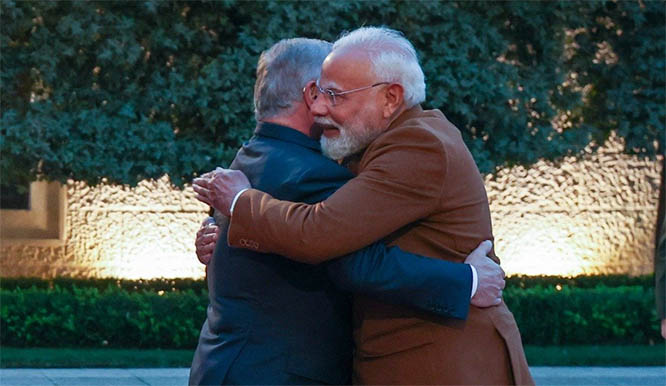
Prime Minister Narendra Modi on Monday held talks with Jordan’s King Abdullah II in Amman, during which the two leaders discussed ways to further strengthen bilateral relations, with the Prime Minister outlining an eight-point vision covering key areas of cooperation.

Describing the meeting as “productive”, PM Modi said he shared a roadmap focused on trade and economy, fertilisers and agriculture, information technology, healthcare, infrastructure, critical and strategic minerals, civil nuclear cooperation, and people-to-people ties.

In a post on social media platform X, the Prime Minister praised King Abdullah II’s personal commitment to advancing India–Jordan relations, particularly as both countries mark the 75th anniversary of the establishment of diplomatic ties this year.

“Held productive discussions with His Majesty King Abdullah II in Amman. His personal commitment towards vibrant India-Jordan relations is noteworthy. This year, we are celebrating the 75th anniversary of our bilateral diplomatic relations,” PM Modi said.

The meeting took place at the Al Husseiniya Palace, where the two leaders also exchanged views on regional and global issues of mutual interest. According to the Ministry of External Affairs (MEA), both sides agreed to further deepen cooperation in areas including trade and investment, defence and security, counter-terrorism and de-radicalisation, fertilisers and agriculture, infrastructure, renewable energy, tourism, and heritage.

The MEA said both leaders reaffirmed their united stand against terrorism.

PM Modi arrived in Amman earlier on Monday and was received by Jordanian Prime Minister Jafar Hassan, who accorded him a formal welcome. Following the talks, King Abdullah II hosted a banquet dinner in honour of the Prime Minister, reflecting the warmth of bilateral ties.

Jordan is the first leg of PM Modi’s three-nation tour. From Amman, the Prime Minister will travel to Ethiopia at the invitation of Prime Minister Abiy Ahmed Ali, marking his first official visit to the African nation. The tour will conclude with a visit to Oman.

Comments

Add new comment

  • Coastaldigest.com reserves the right to delete or block any comments.
  • Coastaldigset.com is not responsible for its readers’ comments.
  • Comments that are abusive, incendiary or irrelevant are strictly prohibited.
  • Please use a genuine email ID and provide your name to avoid reject.
News Network
December 13,2025

New Delhi: School-going children are picking up drug and smoking habits and engaging in consumption of alcohol, with the average age of introduction to such harmful substances found to be around 13 years, suggesting a need for earlier interventions as early as primary school, a multi-city survey by AIIMS-Delhi said.

The findings also showed substance use increased in higher grades, with grade XI/XII students two times more likely to report use of substances when compared with grade VIII students. This emphasised the importance of continued prevention and intervention through middle and high school.

The study led by Dr Anju Dhawan of AIIMS's National Drug Dependence Treatment Centre, published in the National Medical Journal of India this month, looks at adolescent substance use across diverse regions.

The survey included 5,920 students from classes 8, 9, 11 and 12 in urban government, private and rural schools across 10 cities -- Bengaluru, Chandigarh, Delhi, Dibrugarh, Hyderabad, Imphal, Jammu, Lucknow, Mumbai, and Ranchi. The data were collected between May 2018 and June 2019.

The average age of initiation for any substance was 12.9 (2.8) years. It was lowest for inhalants (11.3 years) followed by heroin (12.3 years) and opioid pharmaceuticals (without prescription; 12.5 years).

Overall, 15.1 per cent of participants reported lifetime use, 10.3 per cent reported past year use, and 7.2 per cent reported use in the past month of any substance, the study found.

The most common substances used in the past year, after tobacco (4 per cent) and alcohol (3.8 per cent), were opioids (2.8 per cent), followed by cannabis (2 per cent) and inhalants (1.9 per cent). Use of non-prescribed pharmaceutical opioids was most common among opioid users (90.2 per cent).

On being asked, 'Do you think this substance is easily available for a person of your age' separately for each substance category, nearly half the students (46.3 per cent) endorsed that tobacco products and more than one-third of the students (36.5 per cent) agreed that a person of their age can easily procure alcohol products.

Similarly, for Bhang (21.9 per cent), ganja/charas (16.1 per cent), inhalants (15.2 per cent), sedatives (13.7 per cent), opium and heroin (10 per cent each), the students endorsed that these can be easily procured.

About 95 per cent of the children, irrespective of their grade, agreed with the statement that 'drug use is harmful'.

The rates of substance use (any) among boys were significantly higher than those of girls for substance use (ever), use in the past year and use in the past 30 days. Compared to grade VIII students, grade IX students were more likely, and grade XI/XII students were twice as likely to have used any substance (ever).

The likelihood of past-year use of any substance was also higher for grade IX students and for grade XI/XII students as compared to grade VIII students.

About 40 per cent of students mentioned that they had a family member who used tobacco or alcohol each. The use of cannabis (any product) and opioid (any product) by a family member was reported by 8.2 per cent and 3.9 per cent of students, respectively, while the use of other substances, such as inhalants/sedatives by family was 2-3 per cent, the study found.

A relatively smaller percentage of students reported use of tobacco or alcohol among peers as compared to among family members, while a higher percentage reported inhalants, sedatives, cannabis or opioid use among peers.

Children using substances (past year) compared to non-users reported significantly higher any substance use by their family members and peers.

There were 25.7 per cent students who replied 'yes' to the question 'conflicts/fights often occur in your family'. Most students also replied affirmatively to 'family members are aware of how their time is being spent' and 'damily members are aware of with whom they spend their time'.

Comments

Add new comment

  • Coastaldigest.com reserves the right to delete or block any comments.
  • Coastaldigset.com is not responsible for its readers’ comments.
  • Comments that are abusive, incendiary or irrelevant are strictly prohibited.
  • Please use a genuine email ID and provide your name to avoid reject.