



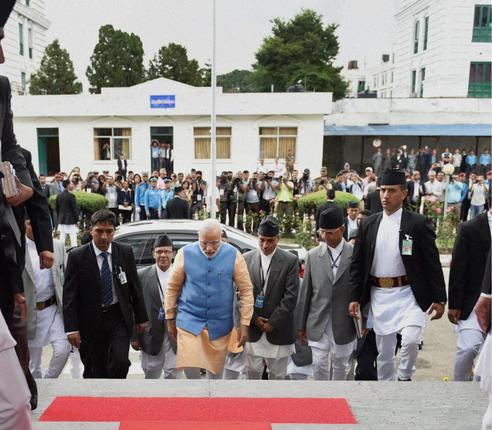
Kathmandu, Aug 3: Assuring Nepal that India did not want to interfere in its internal affairs, Narendra Modi, the first Indian Premier to visit the Himalayan nation in 17 years, today emphasised that their border should be a "bridge" and not a barrier even as he announced USD 1 billion Line Of Credit to this country.
As India makes efforts to deepen its diplomatic and economic engagement with its neighbours, Modi said he wanted to see Nepal become a developed nation and was ready to work with that country in all its efforts and offered a "HIT" mantra-- Highways, I-Ways and Transways for its development.
Allaying fears of Indian interference in Nepal's affairs, the Prime Minister said, "Nepal is a truly sovereign nation. We have always believed that it is not our job to interfere in what you do but to support you in the path you decide to take."
Modi, who arrived here on a two-day visit to Nepal, was addressing the Nepalese Constituent Assembly. It is only the second time that a foreign leader was addressing the Parliament with German Chancellor Helmut Kohl being the first to have the honour to deliver a keynote speech in 1990.
Modi was given a thunderous applause as he began his 45-minute speech telecast live nationally with few sentences in Nepali language just hours after his talks with his Nepalese counterpart Sushil Koirala during which the two sides signed three agreements.
"I have come here with the goodwill and love from one and a quarter billion people of India," Modi said in Nepali, which prompted members to thump their desks.
Stating that India's relations with Nepal is as old as the Himalayas and the Ganga, Modi said, "border should be a bridge not a barrier between the two neighbours."
"India has decided to provide Nepal with NRs 10,000 crore (USD 1 billion) as concessional Line Of Credit for various development purposes."
"This amount is separate from the previous assistance that India has already provided to Nepal," Modi said.
Earlier, India had provided USD 250 million Line Of Credit to Nepal through the Exim Bank of India.
The new grant will be utilised for infrastructure development and energy projects as per Nepal's priority, according to Nepalese Foreign Ministry.
Proposing a model development formula for Nepal, Modi said, "I want to HIT Nepal", drawing wide applause from the lawmakers.
Elaborating his strategy, Modi said HIT in his lexicon implies - H:Highways, I:I-ways and T:Transways.
He said these three combined together would pave the way for rapid development of the country and India wants to "give this gift at the earliest".
Modi was earlier given a rousing welcome with his counterpart receiving him at the Tribhuvan International Airport, deviating from protocol for the purpose.
After their talks at Singha Durbar Secretariat, Modi and Koirala witnessed the signing of three agreements including one regarding the amendment of Terms of Reference (TOR) of the Pancheshwar Multipurpose Project on the Mahakali river.
India will provide a grant assistance worth NRs 69 million to supply iodated salt to curb goitre and other diseases related with iodine deficiency under another agreement.
The third agreement relates to cooperation between Nepal Television and Doordarshan, the state-owned television stations of both the countries.
Along with Koirala, Deputy Prime Ministers Bam Dev Gautam and Prakash Man Singh were also present at the airport
During their talks, Modi and Koirala discussed various issues including Nepal's peace process and constitution-drafting process as well as economic issues.
They also touched upon various facets of mutual relations and issues of common interest.
On his way to the Constituent Assembly, Modi stopped his convoy to meet common people.
In his address, Modi told the lawmakers, "Being your neighbour and seeing our experience as a democracy we feel happy at the direction in which you are going. Our only wish is that Nepal's progress reaches as high as the Himalayas."
Modi said India will help Nepal in constructing highways for better connectivity.
India will provide assistance to the country for developing information highways so that "Nepal should not be left behind among the nations of the world."
"Nepal too has to catch up with the digital age and it has to be connected to the world at large," he said.
He said Nepal has abundant potential for developing its hydropower sector and for this purpose India is committed to establish transmission lines for the export and import of electricity.
"I want to double the amount of electricity India is providing Nepal today so we have to lay the transmission lines as soon as possible," the Prime Minister said, adding India wants to buy electricity from Nepal.
"This is my notion of hitting Nepal and you too would agree that it soon becomes a hit," he said.
Striking an optimistic note, Modi said "for now we will remove darkness here and a decade later Nepal will come to our help. This is our bonding".
He said India welcomes and respects the aspirations of a Nepalese Federal Democratic Republic.
Praising the contribution of Gurkha soldiers in India's defence, Modi said India has won no war without the sacrifices by Nepalese soldiers.
"I salute those brave hearts who laid their lives for India," he said. Invoking Sam Manekshaw, the first Field Marshal in the Indian army, Modi said, "Any soldier who says I am not afraid of death would either be lying or is a Gurkha."


Comments
Add new comment