Modi govt pursuing bold strategies for universal Internet access by 2022: Ajit Pai

Agencies
June 13, 2019

Washington, Jun 13: India is pursuing bold strategies to achieve the ambitious goal of universal Internet access by 2022, a top American official has said, highlighting the challenges in building broadband networks in rural areas.
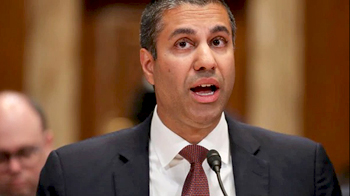
"I commend Prime Minister Modi and the Indian government for their ambitious goals of universal Internet access by 2022 and fixed broadband access to 50 per cent of households by 2022," Federal Communications Commission Chairman Ajit Pai said at the India Ideas summit of US-India Business Council here on Wednesday.

"To meet these targets, they're pursuing bold strategies such as installing two million public Wi-Fi hotspots in rural areas and redesigning and expanding the Universal Service Obligation Fund, he said.

Pai said despite the good news, millions of Indians and Americans still live in rural areas where there is currently no case for the private sector alone to build broadband networks.

"As is the case in parts of Assam, Uttarakhand, and Karnataka, we have communities in Alaska, Utah, and Kansas that don't have access," he said.

To connect these communities, FCC's Universal Service Fund provides federal subsidies to private carriers to leverage additional investment. The US has begun allocating some of this support by using a reverse auction, which harnesses market forces and a diverse array of technologies to maximise the impact and efficiency of this investment, he said.

Just this week, FCC authorised USD167 million in universal service subsidies to connect 60,000 unserved rural homes and businesses in some of the hardest-to-connect corners of the US. "Obviously, India's connectivity challenges are significantly different in nature and scale," Pai said.

Observing that 5G could be transformative, enabling things like telemedicine and precision agriculture, automotive safety and gaming, industrial IoT and other breakthroughs that one can't even conceive today, Pai said one of their top priorities is to protect the security and integrity of the communications supply chain.

That's why the FCC has proposed to prohibit the use of the broadband funding we administer to purchase equipment or services from any company that poses a national security threat to the integrity of United States communications networks or the communications supply chain, he said.

That's why the FCC denied the application of China Mobile USA, a wireless carrier ultimately owned by the Chinese government, to provide international telecommunications services in the United States, he said.

When making decisions that impact 5G security, in particular, one needs to remember that the implications are wide-ranging. 5G will affect militaries, industries, critical infrastructure, and much more. The procurement and deployment decisions made now will have a generational impact on the country's security, economy, and society.

When it comes to 5G, we cannot afford to make risky choices and just hope for the best. We must see clearly the threats to the security of our networks and act to address them. And the more that allies like the United States and India can work together and make security decisions based on shared principles, the safer that our 5G networks will be, Pai said.

Pai said he is looking forward to working with Indian and American business communities in the days ahead to connect, to propel, and to secure the digital future of the United States and India two strong allies and two good friends.

Comments

Add new comment

  • Coastaldigest.com reserves the right to delete or block any comments.
  • Coastaldigset.com is not responsible for its readers’ comments.
  • Comments that are abusive, incendiary or irrelevant are strictly prohibited.
  • Please use a genuine email ID and provide your name to avoid reject.
News Network
January 23,2026

Mangaluru: The Karnataka Government Polytechnic (KPT), Mangaluru, has achieved autonomous status from the All India Council for Technical Education (AICTE), becoming the first government polytechnic in the country to receive such recognition in its 78-year history. The status was granted by AICTE, New Delhi, and subsequently approved by the Karnataka Board of Technical Education in October last year.

Officials said the autonomy was conferred a few months ago. Until recently, AICTE extended autonomous status only to engineering colleges, excluding diploma institutions. However, with a renewed national focus on skill development, several government polytechnics across India have now been granted autonomy.

KPT, the second-largest polytechnic in Karnataka, was established in 1946 with four branches and has since expanded to offer eight diploma programmes, including computer science and polymer technology. The institution is spread across a 19-acre campus.

Ravindra M Keni, the first dean of the institution, told The Times of India that AICTE had proposed autonomous status for polytechnic institutions that are over 25 years old. “Many colleges applied. In the first round, 100 institutions were shortlisted, which was further narrowed down to 15 in the second round. We have already completed one semester after becoming an autonomous institution,” he said. He added that nearly 500 students are admitted annually across eight three-year diploma courses.

Explaining the factors that helped KPT secure autonomy, Keni said the institution has consistently recorded 100 per cent admissions and placements for its graduates. He also noted its strong performance in sports, with the college emerging champions for 12 consecutive years, along with active student participation in NCC and NSS activities.

Autonomous status allows KPT to design industry-oriented curricula, conduct examinations, prepare question papers, and manage academic documentation independently. The institution can also directly collaborate with industries and receive priority funding from AICTE or the Ministry of Education. While academic autonomy has been granted, financial control will continue to rest with the state government.

“There will be separate committees for examinations, question paper setting, boards of studies, and boards of examiners. The institution will now have the freedom to conduct admissions without government notifications and issue its own marks cards,” Keni said, adding that new academic initiatives would be planned after a year of functioning under the autonomous framework.

Comments

Add new comment

  • Coastaldigest.com reserves the right to delete or block any comments.
  • Coastaldigset.com is not responsible for its readers’ comments.
  • Comments that are abusive, incendiary or irrelevant are strictly prohibited.
  • Please use a genuine email ID and provide your name to avoid reject.
News Network
January 28,2026

ajit.jpg

Mumbai: The sudden death of Maharashtra Deputy Chief Minister Ajit Pawar in a plane crash in his hometown of Baramati has plunged the state into political uncertainty, raising a pressing question for both the Nationalist Congress Party (NCP) and its rival faction, the Nationalist Congress Party (Sharadchandra Pawar): what next?

For the two factions that emerged after the dramatic split of June–July 2023, the moment marks their gravest challenge yet. Many believe the answer now rests with party founder Sharad Pawar.

Sharad Pawar, who founded the NCP in 1999 after parting ways with the Congress over Sonia Gandhi’s foreign origin, has already indicated his intention to step away from electoral politics once his Rajya Sabha term ends in April 2026.

Speaking at a public event in Baramati ahead of his 85th birthday on December 12, 2025, Pawar said he would not contest any further elections. “I have contested 14 elections. The younger generation needs to be given an opportunity,” he said, adding that he would decide later whether to seek another Rajya Sabha term.

Often described as the Bhishma Pitamah of Indian politics, Pawar also spoke of his gradual withdrawal from active leadership. “For the first 30 years, I handled everything. For the next 25–30 years, Ajit Dada handled responsibilities. Now, arrangements must be made for new leadership,” he said.

Ajit Pawar’s death has dramatically altered that transition, especially as he was working towards reunifying the two NCP factions.

“After the developments of June–July 2023 and the 2024 Lok Sabha and Vidhan Sabha elections, there were deep changes within the family and the party. In the last six months, serious efforts were made to reunite. Even workers from both sides wanted unity. This is a massive blow,” a Pawar family insider told DH over phone from Baramati.

Electoral outcomes over the past year reflected the split. In the 2024 Lok Sabha elections, NCP (SP) recorded the best strike rate in Maharashtra, winning eight of the 10 seats it contested. The NCP, by contrast, won just one seat out of four.

However, the trend reversed in the subsequent Vidhan Sabha elections, where the NCP emerged stronger, securing 41 of the 288 seats, while NCP (SP) managed only 10.

Within NCP (SP), Sharad Pawar’s daughter Supriya Sule serves as Working President, followed by leaders such as Rohit Pawar, state president Shashikant Shinde and former state chief Jayant Patil.

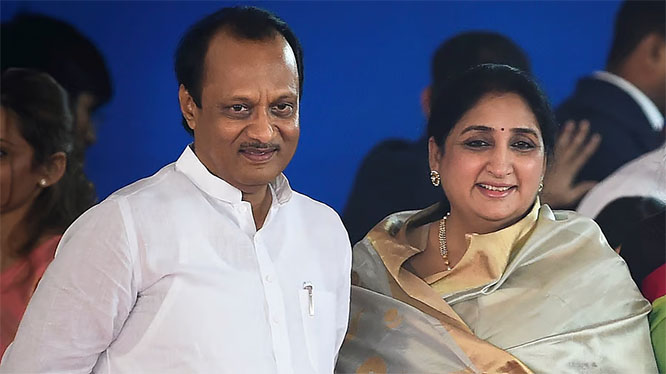
In the NCP, Praful Patel is the Working President and Raigad MP Sunil Tatkare heads the state unit. Ajit Pawar’s wife, Sunetra Pawar, is a Rajya Sabha MP, while their sons Parth and Jay are not actively involved in day-to-day politics. Parth Pawar briefly entered electoral politics in 2019 but lost the Lok Sabha election from Maval. Jay Pawar’s political debut was under consideration.

With Ajit Pawar gone, speculation has intensified that a member of the family may be asked to assume a larger role. For now, Sunetra Pawar is expected to play a key coordinating role in party affairs, alongside Patel and Tatkare.

The NCP continues to have several heavyweight leaders, including Chhagan Bhujbal, Hasan Mushrif, Dattatreya Bharne, Manikrao Kokate and Dhananjay Munde.

Ajit Pawar had already begun steps towards reconciliation between the two factions. While they contested the Pune and Pimpri-Chinchwad municipal elections separately, they later decided to fight the zilla parishad elections together under the ‘clock’ symbol—seen as the first formal step towards reunification.

Nagpur meet and party roadmap

Both NCP factions claim adherence to the ideology of ‘Shiv–Shahu–Phule–Ambedkar’. At the Rashtravadi Chintan Shivir held in Nagpur on September 19, 2025, the NCP reaffirmed its commitment to sarva dharma sambhav and discussed strengthening ties with the BJP “for the welfare and development of Maharashtra”.

In recent days, reports had suggested Ajit Pawar might return to the Maha Vikas Aghadi following the party’s poor performance in Pune municipal elections, but these claims were denied.

Big question for Maha Yuti

Ajit Pawar’s death also presents an immediate challenge for the Devendra Fadnavis-led Maha Yuti government. Pawar held crucial portfolios, including Finance, Planning and Excise. With the Budget Session approaching, appointing a new Finance Minister has become urgent.

Beyond numbers and portfolios, Maha Yuti has lost a swift decision-maker known for his administrative grip and political finesse—leaving a vacuum that will not be easy to fill.

Comments

Add new comment

  • Coastaldigest.com reserves the right to delete or block any comments.
  • Coastaldigset.com is not responsible for its readers’ comments.
  • Comments that are abusive, incendiary or irrelevant are strictly prohibited.
  • Please use a genuine email ID and provide your name to avoid reject.
News Network
January 20,2026

KCFabudhabi.jpg

KCF, a global socio-cultural organisation of Karnataka expatriates, is actively involved in education, humanitarian initiatives and community well-being across several countries. The awardees were selected following a structured evaluation of nominations by the Annual Council Program Committee, based on the depth, consistency and long-term impact of their social service.

One of the award recipients, Abdul Razak Haji, a prominent UAE-based entrepreneur from the Qamcon Group of Companies, was honoured for his significant contributions to society. Through both his professional journey and personal initiatives, he has supported numerous employees and families, while also extending assistance in education, housing for the underprivileged and various charitable causes, largely carried out quietly over the years. His award was presented earlier during the Annual Council Program held at the KCF Abu Dhabi office.

The second award was conferred on Latheef Kakkinje, a young social worker based in Abu Dhabi, in recognition of his active involvement in community engagement programmes, sports initiatives, talent festivals and family-oriented social activities. His consistent volunteering efforts and commitment to humanitarian causes were highly appreciated by the selection committee.

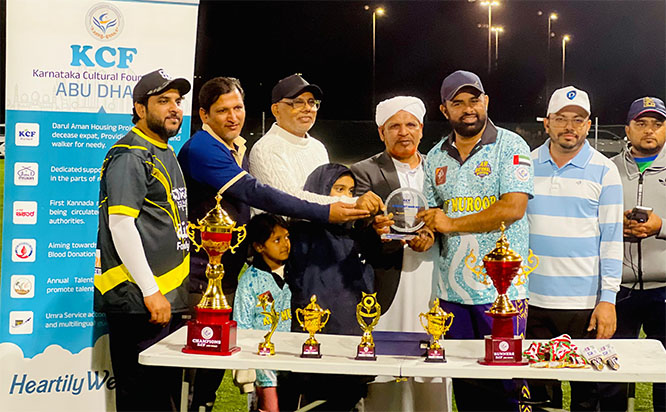
The award presentation ceremony for Latheef Kakkinje was held at the Zayed Cricket Stadium (Astro Turf Ground) in the presence of Kedumbady Ibrahim Saqafi, President of KCF UAE; Ibrahim, General Secretary; Kabeer Bayambady, President of KCF Abu Dhabi; Ummer Ishwaramangila, General Secretary; along with other members of the KCF Abu Dhabi cabinet.

Congratulating both awardees, KCF leaders reiterated the organisation’s commitment to recognising individuals who selflessly work for social upliftment and community service.

KCFabudhabi1.jpg

Comments

Add new comment

  • Coastaldigest.com reserves the right to delete or block any comments.
  • Coastaldigset.com is not responsible for its readers’ comments.
  • Comments that are abusive, incendiary or irrelevant are strictly prohibited.
  • Please use a genuine email ID and provide your name to avoid reject.