



Modi govt's crackdown on Muslim-run leather units dents exports, hits jobs

Agencies
October 3, 2017

New Delhi, Oct 3: A government crackdown on Muslim-dominated abattoirs and the trade of cattle dragged down India's exports of leather shoes by more than 13 percent in June, as leading global brands turned to China, Bangladesh, Indonesia and Pakistan to secure supplies.
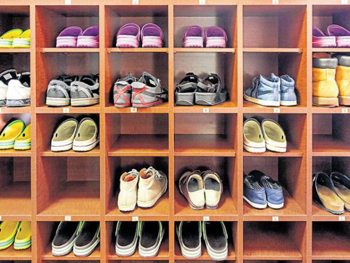
The drop in exports of shoes and leather garments comes as a setback for Prime Minister Narendra Modi, who has sought to create millions of jobs by more than doubling the leather industry's revenues to $27 billion by 2020.

Emboldened by the victory of Modi's Bharatiya Janata Party (BJP) in the 2014 general election, Hindu hard-liners, who consider cows sacred, became more assertive in their calls for a clamp-down on both the meat and leather industries, run by Muslims, who make up 14 percent of India's 1.3 billion people.

"The writing was already on the wall," Nazir Ahmed, CEO of shoemaker Park Exports, told Reuters by phone from Agra, a shoe-making hub and home to the Taj Mahal. "We have killed the goose that laid the golden egg."

India, the world's second-biggest supplier of shoes and leather garments, exports nearly half its leather goods, with overseas sales estimated at $5.7 billion in the 2016/17 fiscal year to March, down 3.2 percent from a year earlier. Footwear exports fell more than 4 percent in April-June, to $674 million.

Informal sector

In March, after being appointed chief minister of Uttar Pradesh, India's most populous state and a major leather exporter, Yogi Adityanath, a firebrand Hindu monk, ordered a closure of abattoirs operating without licenses.

Slaughterhouse owners complain that much of India's meat and leather trade takes place in the informal sector, and it's hard to get licences, especially for smaller units.

In May, citing cruelty to animals, the federal government banned the trade of cattle for slaughter, and restricted livestock sales only for agricultural purposes such as ploughing and dairy production.

But the country’s top court overturned that order, citing the hardship the ban had caused.

That has not brought relief as repeated attacks on trucks carrying cattle still rankle the leather trade.

"The supreme court has allowed the resumption of trade for cattle, but the ground reality is that cow vigilante groups continue to be active and no one wants to risk his life by transporting cattle," Ahmed said.

Deterred by a clutch of measures that squeezed the supply of leather, a key raw material, brands like H&M, Inditex -owned Zara and Clarks, cut back their orders to India, said M. Rafeeque Ahmed, a leading shoe exporter from the southern city of Chennai and former president of the Federation of Indian Export Organisations.

"We lost orders because our buyers were sceptical of our ability to meet their requirements. Instead, most buyers moved to rival suppliers in Asia and southeast Asia," he said.
A spokesman for India's trade ministry declined to comment.

Earlier this year, a finance ministry report said India should sign more free trade agreements and make tax and labour reforms to drive leather exports, which offer "tremendous opportunities for (the) creation of jobs."

The industry is also grappling with a Goods and Services Tax, introduced in July, which has pushed up production costs by 6-7 percent, exporters said.

Nowhere to hide

The crackdown also hurt day-workers employed at shoe and garment making units and hit leather supplies, forcing manufacturers to import hides from the United States, Australia, and some European nations, raising the cost of production and squeezing margins.
Many tanneries, as a result, have run out of leather.

"My business has come to a standstill because I don't have any inventory at all. Most large shoemakers are importing hides now," said a tannery owner, who asked not to be named so as to avoid retaliation from cow vigilante groups.

Nearly a third of the roughly 3 million-strong workforce, mostly lowly-paid casual workers employed in the leather sector, have lost their jobs in the past six months, according to six shoemakers and two tannery owners interviewed by Reuters for this article.

Since most Indian states have outlawed cow slaughter, the supply of leather largely comes from the legal slaughter of buffaloes whose skins are used in many leather goods.

"Everyone must abide by the rule on cow slaughter and respect sentiments, but by choking the supply of other animal hides, we have nearly killed a thriving industry," said Ahmed of Park Exports.

Comments

Add new comment

  • Coastaldigest.com reserves the right to delete or block any comments.
  • Coastaldigset.com is not responsible for its readers’ comments.
  • Comments that are abusive, incendiary or irrelevant are strictly prohibited.
  • Please use a genuine email ID and provide your name to avoid reject.
News Network
February 1,2026

Bengaluru, Feb 1: For travelers landing at Kempegowda International Airport (KIA), the sleek, wood-paneled curves of Terminal 2 promise a world-class welcome. But the famed “Garden City” charm quickly withers at the curb. As India’s aviation sector swells to record numbers—handling over 43 million passengers in Bengaluru alone this past year—the “last mile” has turned into a marathon of frustration.

The Bengaluru Logjam: Rules vs Reality

While the city awaits the 2027 completion of the Namma Metro Blue Line, the interim has been chaotic. Recent “decongestion” rules at Terminal 1 have pushed app-based cab pickups to distant parking zones, forcing weary passengers into a 20-minute walk with luggage.

“I landed after ten months away and felt like a stranger in my own city,” says Ruchitha Jain, a Koramangala resident. “My driver couldn’t find me, staff couldn’t guide me, and the so-called ‘Premium’ lane is just a fancy tax on convenience.”

•    The Cost of Distance: A 40-km cab ride can now easily cross ₹1,500, driven by demand pricing and airport surcharges.

•    The Bus Gap: While Vayu Vajra remains a lifeline, its ₹300–₹400 fare is often cited as the most expensive airport bus service in the country.

A National Pattern of Disconnect

The struggle is not unique to Karnataka. From Chennai’s coast to Hyderabad’s plateau, India’s airports tell a familiar story: brilliant runways, broken exits.

City:    Primary Issue   |    Recent Development

Bengaluru:    Cab pickup restrictions & distance  |    App-based taxis shifted to far parking zones; long walks and fare spikes reported

Chennai:    Multi-Level Parking (MLCP) hike  |    Passengers report 40-minute walks to reach cab pickup points

Hyderabad:    “Taxi mafia” & touting  |    Over 440 touting cases reported; security presence intensified

Mumbai:    Fare scams  |     Tourists charged ₹18,000 for just 400 metres, triggering police action

In Hyderabad, travelers continue to battle entrenched local groups that intimidate Uber and Ola drivers, pushing passengers toward overpriced private taxis. Chennai flyers, meanwhile, complain that reaching the designated pickup zones now takes longer than short-haul flights from cities like Coimbatore.

The ‘Budget Day’ Hope

As Finance Minister Nirmala Sitharaman presents the Union Budget 2026 today, the aviation sector is watching closely. With the government’s renewed emphasis on multimodal integration, there is cautious hope for funding toward seamless airport-metro-bus hubs.

The vision is clear: a future where planes, trains, and metros speak the same language. Until then, passengers at KIA—and airports across India—will continue to discover that the hardest part of flying isn’t the thousands of kilometres in the air, but the last few on the ground.

Comments

Add new comment

  • Coastaldigest.com reserves the right to delete or block any comments.
  • Coastaldigset.com is not responsible for its readers’ comments.
  • Comments that are abusive, incendiary or irrelevant are strictly prohibited.
  • Please use a genuine email ID and provide your name to avoid reject.
News Network
January 23,2026

Karnataka Governor Thaawarchand Gehlot read only three lines from the 122-paragraph address prepared by the Congress-led state government while addressing the joint session of the Legislature on Thursday, effectively bypassing large sections critical of the BJP-led Union government.

The omitted portions of the customary Governor’s address outlined what the state government described as a “suppressive situation in economic and policy matters” under India’s federal framework. The speech also sharply criticised the Centre’s move to replace the Mahatma Gandhi National Rural Employment Guarantee Act (MGNREGA) with the Viksit Bharat–Guarantee for Rozgar and Ajeevika Mission (Gramin) Act, commonly referred to as the VB-GRAM (G) Act.

Governor Gehlot had earlier conveyed his objection to several paragraphs that were explicitly critical of the Union government. On Thursday, he confined himself to the opening lines — “I extend a warm welcome to all of you to the joint session of the State legislature. I am extremely pleased to address this august House” — before jumping directly to the concluding sentence of the final paragraph.

He ended the address by reading the last line of paragraph 122: “Overall, my government is firmly committed to doubling the pace of the State’s economic, social and physical development. Jai Hind — Jai Karnataka.”

According to the prepared speech, the Karnataka government demanded the scrapping of the VB-GRAM (G) Act, describing it as “contractor-centric” and detrimental to rural livelihoods, and called for the full restoration of MGNREGA. The state government argued that the new law undermines decentralisation, weakens labour protections, and centralises decision-making in violation of constitutional norms.

Key points from the unread sections of the speech:

•    Karnataka facing a “suppressive” economic and policy environment within the federal system

•    Repeal of MGNREGA described as a blow to rural livelihoods

•    VB-GRAM (G) Act accused of protecting corporate and contractor interests

•    New law alleged to weaken decentralised governance

•    Decision-making said to be imposed by the Centre without consulting states

•    Rights of Adivasis, women, backward classes and agrarian communities curtailed

•    Labourers allegedly placed under contractor control

•    States facing mounting fiscal stress due to central policies

•    VB-GRAM (G) Act accused of enabling large-scale corruption

Comments

Add new comment

  • Coastaldigest.com reserves the right to delete or block any comments.
  • Coastaldigset.com is not responsible for its readers’ comments.
  • Comments that are abusive, incendiary or irrelevant are strictly prohibited.
  • Please use a genuine email ID and provide your name to avoid reject.
News Network
January 20,2026

Mangaluru: In a major step towards strengthening rural innovation, the Office of the Principal Scientific Adviser (PSA) to the Government of India is supporting the establishment of RuTAGe Smart Village Centres (RSVCs) across the country through collaborations with academic institutions, civil society organisations and philanthropic partners.

As part of this national initiative, Nitte (Deemed to be University) will set up the first RSVCs in the region at Nitte GP in Udupi district and at the Nitte Health Centre, Sevanjali Trust, Farangipete, in Dakshina Kannada district. The centres will be inaugurated on January 21. In South India, the programme is being implemented by the Section Infin-8 Foundation (SI-8).

Speaking to reporters on Monday, SI-8 founder-director Vishwas US said experts from Nitte University and SI-8 would work closely with farmers, students, youth and local entrepreneurs to adapt and deploy technologies tailored to local needs.

Project head Prof Iddya Karunasagar, representing Nitte DU, said the RSVCs at Nitte and Farangipete would serve as demonstration hubs for a wide range of agriculture, energy, skill-development and assistive technologies. These include solar dryers for fruits, vegetables and crops; soil-testing solutions; power weeders and women-friendly farm tools; wind-powered devices for rural artisans; grain storage systems; grass-cutting and tree-climbing equipment; and liquid fertiliser production using cowshed waste.

SI-8 CEO Aravind C Kumar said the centres would also provide access to digital and knowledge-based platforms such as ISRO applications, government scheme portals, market linkage tools and gamified learning resources, along with assistive technologies for persons with visual impairments.

Highlighting the broader impact of the initiative, Principal Scientific Adviser Prof Ajay Kumar Sood said it demonstrated how applied research could bridge the rural–urban divide and help create self-reliant, technology-enabled villages.

The initiative has been made possible through philanthropic support from Dr NC Murthy of ACM Business Solutions, LLC, USA. Dr Sapna Poti, Director (Strategic Alliances) at the Office of the Principal Scientific Adviser, said the long-term objective is to build self-sufficient, technology-driven communities capable of generating sustainable livelihoods on their own.

Comments

Add new comment

  • Coastaldigest.com reserves the right to delete or block any comments.
  • Coastaldigset.com is not responsible for its readers’ comments.
  • Comments that are abusive, incendiary or irrelevant are strictly prohibited.
  • Please use a genuine email ID and provide your name to avoid reject.