Modi govt's crackdown on Muslim-run leather units dents exports, hits jobs

Agencies
October 3, 2017

New Delhi, Oct 3: A government crackdown on Muslim-dominated abattoirs and the trade of cattle dragged down India's exports of leather shoes by more than 13 percent in June, as leading global brands turned to China, Bangladesh, Indonesia and Pakistan to secure supplies.
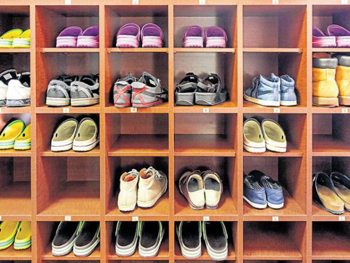
The drop in exports of shoes and leather garments comes as a setback for Prime Minister Narendra Modi, who has sought to create millions of jobs by more than doubling the leather industry's revenues to $27 billion by 2020.

Emboldened by the victory of Modi's Bharatiya Janata Party (BJP) in the 2014 general election, Hindu hard-liners, who consider cows sacred, became more assertive in their calls for a clamp-down on both the meat and leather industries, run by Muslims, who make up 14 percent of India's 1.3 billion people.

"The writing was already on the wall," Nazir Ahmed, CEO of shoemaker Park Exports, told Reuters by phone from Agra, a shoe-making hub and home to the Taj Mahal. "We have killed the goose that laid the golden egg."

India, the world's second-biggest supplier of shoes and leather garments, exports nearly half its leather goods, with overseas sales estimated at $5.7 billion in the 2016/17 fiscal year to March, down 3.2 percent from a year earlier. Footwear exports fell more than 4 percent in April-June, to $674 million.

Informal sector

In March, after being appointed chief minister of Uttar Pradesh, India's most populous state and a major leather exporter, Yogi Adityanath, a firebrand Hindu monk, ordered a closure of abattoirs operating without licenses.

Slaughterhouse owners complain that much of India's meat and leather trade takes place in the informal sector, and it's hard to get licences, especially for smaller units.

In May, citing cruelty to animals, the federal government banned the trade of cattle for slaughter, and restricted livestock sales only for agricultural purposes such as ploughing and dairy production.

But the country’s top court overturned that order, citing the hardship the ban had caused.

That has not brought relief as repeated attacks on trucks carrying cattle still rankle the leather trade.

"The supreme court has allowed the resumption of trade for cattle, but the ground reality is that cow vigilante groups continue to be active and no one wants to risk his life by transporting cattle," Ahmed said.

Deterred by a clutch of measures that squeezed the supply of leather, a key raw material, brands like H&M, Inditex -owned Zara and Clarks, cut back their orders to India, said M. Rafeeque Ahmed, a leading shoe exporter from the southern city of Chennai and former president of the Federation of Indian Export Organisations.

"We lost orders because our buyers were sceptical of our ability to meet their requirements. Instead, most buyers moved to rival suppliers in Asia and southeast Asia," he said.
A spokesman for India's trade ministry declined to comment.

Earlier this year, a finance ministry report said India should sign more free trade agreements and make tax and labour reforms to drive leather exports, which offer "tremendous opportunities for (the) creation of jobs."

The industry is also grappling with a Goods and Services Tax, introduced in July, which has pushed up production costs by 6-7 percent, exporters said.

Nowhere to hide

The crackdown also hurt day-workers employed at shoe and garment making units and hit leather supplies, forcing manufacturers to import hides from the United States, Australia, and some European nations, raising the cost of production and squeezing margins.
Many tanneries, as a result, have run out of leather.

"My business has come to a standstill because I don't have any inventory at all. Most large shoemakers are importing hides now," said a tannery owner, who asked not to be named so as to avoid retaliation from cow vigilante groups.

Nearly a third of the roughly 3 million-strong workforce, mostly lowly-paid casual workers employed in the leather sector, have lost their jobs in the past six months, according to six shoemakers and two tannery owners interviewed by Reuters for this article.

Since most Indian states have outlawed cow slaughter, the supply of leather largely comes from the legal slaughter of buffaloes whose skins are used in many leather goods.

"Everyone must abide by the rule on cow slaughter and respect sentiments, but by choking the supply of other animal hides, we have nearly killed a thriving industry," said Ahmed of Park Exports.


Comments

Add new comment

  • Coastaldigest.com reserves the right to delete or block any comments.
  • Coastaldigset.com is not responsible for its readers’ comments.
  • Comments that are abusive, incendiary or irrelevant are strictly prohibited.
  • Please use a genuine email ID and provide your name to avoid reject.
News Network
February 1,2026

Golf.jpg

The coastal city of Mangaluru is gearing up for a major sporting milestone with the launch of a Golf Excellence Academy at the Pilikula Golf Club (PGC), scheduled to open on May 31. The initiative aims to position Mangaluru firmly on India’s national golfing map.

Speaking to reporters on Saturday during PGC’s first-ever floodlit Pro-Am tournament, club captain Manoj Kumar Shetty said the project is being funded by UAE-based philanthropist Michael D’Souza and is currently in the design phase. Experts from leading golf academies across the country are expected to visit Mangaluru to help shape the training programme and infrastructure.

The academy will train 20 young golfers at a time, with a long-term vision of producing national-level players from the region. Until now, PGC relied on an in-house coach, but the recent renovation of the course and the introduction of floodlights have opened new possibilities for expanding the sport.

Shetty said discussions are underway with two reputed coaching academies, whose heads are expected to visit PGC shortly. “A dormitory for trainers is already under construction. We are inviting academies to assess the facilities and suggest changes so we can build a truly world-class Golf Excellence Academy,” he said.

Professional golfer Aryan Roopa Anand noted that the floodlit course would be a game-changer for young players. “Students can now practise after school hours, even up to 8 or 9 pm, without compromising on academics,” he said.

Comments

Add new comment

  • Coastaldigest.com reserves the right to delete or block any comments.
  • Coastaldigset.com is not responsible for its readers’ comments.
  • Comments that are abusive, incendiary or irrelevant are strictly prohibited.
  • Please use a genuine email ID and provide your name to avoid reject.
News Network
January 20,2026

DGP.jpg

Karnataka DGP (Civil Rights Enforcement) K Ramachandra Rao was suspended with immediate effect, as per a state government order issued on Monday, 19 January. The order cited conduct unbecoming of a government servant and causing embarrassment to the state administration.

The Karnataka government suspended Rao after a purported video showed him in a compromising position with a woman inside his official chamber. The video went viral on social media. Rao rejected the videos outright, terming them "fabricated and false".

Who is K Ramachandra Rao?

Rao is a DGP-rank officer who was heading the Directorate of Civil Rights Enforcement until his suspension. He was promoted to DGP in September 2023 and assumed office in October 2023, the Sunday Guardian reported.

He also served as the Chairman and Managing Director of the Karnataka State Police Housing and Infrastructure Development Corporation Limited.

His stint as the Inspector General of Police (IGP) for the Southern Range was also marred by controversy. In 2014, during a cash seizure near Mysuru’s Yelwal, officials claimed the seized amount was ₹20 lakh, while the accused (Kerala-based merchants) claimed it was around ₹2.27 crore.

Rao, who was present during the seizure, denied all allegations. However, he was transferred soon after.

Allegations of collusion with a businessman surfaced, and a senior police officer was quoted by The Sunday Guardian as saying, “In Rao’s case, the CID has clearly mentioned that there was a great degree of lapse on the part of Rao and a deputy superintendent of police after it was brought to their notice that a few policemen, including a gunman attached to the IGP, were involved in the robbery.”

Rao had denied all wrongdoing in that incident. Despite past controversies, he rose to the state’s top police position, the Sunday Guardian reported.

Ranya Rao’s stepfather

Rao is the stepfather of Kannada actress Harshavardhini Ranya alias Ranya Rao, accused of orchestrating the illegal import of gold worth over ₹12.56 crore from Dubai to India along with two others — businessman Tarun Raju, and jewellery dealer Sahil Jain.

‘Obscene video’ controversy

A viral video showed Rao behaving inappropriately with a woman inside his office while in uniform.

The Karnataka government said in its Monday order that “vide videos and news reports widely broadcast on public news channels and media platforms, it is observed that Dr K Ramachandra Rao has acted in an obscene manner which is unbecoming of a Government Servant and also causing embarrassment to the Government.”

The order said the matter was examined by the state government, which found that the officer's conduct amounted to a violation of Rule 3 of the All India Services (Conduct) Rules, 1968.

The government said it is prima facie satisfied that "it is necessary to place Rao under suspension with immediate effect, pending inquiry".

During the suspension period, Rao will be entitled to subsistence allowance as per Rule 4 of the All India Services (Discipline and Appeal) Rules, 1969.

The order also places restrictions on his movement, stating that during the period of suspension, the officer must not leave headquarters under any circumstances without the written permission of the state government.

Comments

Add new comment

  • Coastaldigest.com reserves the right to delete or block any comments.
  • Coastaldigset.com is not responsible for its readers’ comments.
  • Comments that are abusive, incendiary or irrelevant are strictly prohibited.
  • Please use a genuine email ID and provide your name to avoid reject.
coastaldigest.com news network
January 19,2026

rizwanzameer.jpg

Bengaluru: As the dust settles on the recent legislative session, the corridors of Vidhana Soudha are buzzing with more than just policy talk. A high-stakes game of political musical chairs has begun, exposing a deepening rift within the Congress party’s Muslim leadership as a major Cabinet reshuffle looms.

With the party hierarchy signaling a "50% refresh" to gear up for the 2028 Assembly elections, the race to fill three projected Muslim ministerial berths has transformed from a strategic discussion into an all-out turf war.

The "Star Son" Spark

The internal friction turned public this week following provocative remarks by Zaid Khan, actor and son of Wakf Minister Zameer Ahmed Khan. Zaid’s claim—that his father "helped" secure a ticket for Shivajinagar MLA Rizwan Arshad in 2023—has acted as a lightning rod for resentment.

Rizwan’s camp was quick to fire back, dismissing the comment as a desperate attempt by Zameer to manufacture seniority. "Rizwan’s political pedigree was forged in the NSUI and Youth Congress long before Zameer even stepped into the party," a supporter noted, highlighting Rizwan’s tenure as an AICC secretary and his two-term presidency of the State Youth Congress.

A Tale of Two Loyalists

While both Zameer Ahmed Khan and Rizwan Arshad are staunch allies of Chief Minister Siddaramaiah and represent Bengaluru strongholds, their political DNA could not be more different:

•    Zameer Ahmed Khan: A four-time MLA who crossed over from JD(S) in 2018. Known for his "overzealous" and often polarizing outreach during communal flashpoints—from the DJ Halli riots to the recent Wakf land notice controversy—his style has frequently left the Congress high command in a state of "discomfort."

•    Rizwan Arshad: A homegrown organizational man. Seen as a "quiet performer," Arshad represents the sophisticated, moderate face of the party, preferred by those who find Zameer’s brand of politics too volatile.

The Outsiders Looking In

The bickering isn't limited to a duo. The "Beary" community, represented by leaders like N A Haris and Saleem Ahmed, is demanding its pound of flesh. Saleem Ahmed, the Chief Whip in the Legislative Council, has dropped the veil of diplomacy, openly declaring his ministerial aspirations.

"I was the only working president not included in the Cabinet last time," Saleem noted pointedly, signaling that the "loyalty quota" is no longer enough to keep the peace.

As Chief Minister Siddaramaiah prepares to finalize the list, he faces a delicate balancing act: rewarding the aggressive grassroots mobilization of Zameer’s camp without alienating the organizational stalwarts and minority sub-sects who feel increasingly sidelined by the "Chamarajpet-Shivajinagar" binary.

Comments

Add new comment

  • Coastaldigest.com reserves the right to delete or block any comments.
  • Coastaldigset.com is not responsible for its readers’ comments.
  • Comments that are abusive, incendiary or irrelevant are strictly prohibited.
  • Please use a genuine email ID and provide your name to avoid reject.