



Modi govt's crackdown on Muslim-run leather units dents exports, hits jobs

Agencies
October 3, 2017

New Delhi, Oct 3: A government crackdown on Muslim-dominated abattoirs and the trade of cattle dragged down India's exports of leather shoes by more than 13 percent in June, as leading global brands turned to China, Bangladesh, Indonesia and Pakistan to secure supplies.
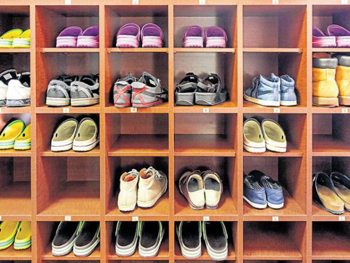
The drop in exports of shoes and leather garments comes as a setback for Prime Minister Narendra Modi, who has sought to create millions of jobs by more than doubling the leather industry's revenues to $27 billion by 2020.

Emboldened by the victory of Modi's Bharatiya Janata Party (BJP) in the 2014 general election, Hindu hard-liners, who consider cows sacred, became more assertive in their calls for a clamp-down on both the meat and leather industries, run by Muslims, who make up 14 percent of India's 1.3 billion people.

"The writing was already on the wall," Nazir Ahmed, CEO of shoemaker Park Exports, told Reuters by phone from Agra, a shoe-making hub and home to the Taj Mahal. "We have killed the goose that laid the golden egg."

India, the world's second-biggest supplier of shoes and leather garments, exports nearly half its leather goods, with overseas sales estimated at $5.7 billion in the 2016/17 fiscal year to March, down 3.2 percent from a year earlier. Footwear exports fell more than 4 percent in April-June, to $674 million.

Informal sector

In March, after being appointed chief minister of Uttar Pradesh, India's most populous state and a major leather exporter, Yogi Adityanath, a firebrand Hindu monk, ordered a closure of abattoirs operating without licenses.

Slaughterhouse owners complain that much of India's meat and leather trade takes place in the informal sector, and it's hard to get licences, especially for smaller units.

In May, citing cruelty to animals, the federal government banned the trade of cattle for slaughter, and restricted livestock sales only for agricultural purposes such as ploughing and dairy production.

But the country’s top court overturned that order, citing the hardship the ban had caused.

That has not brought relief as repeated attacks on trucks carrying cattle still rankle the leather trade.

"The supreme court has allowed the resumption of trade for cattle, but the ground reality is that cow vigilante groups continue to be active and no one wants to risk his life by transporting cattle," Ahmed said.

Deterred by a clutch of measures that squeezed the supply of leather, a key raw material, brands like H&M, Inditex -owned Zara and Clarks, cut back their orders to India, said M. Rafeeque Ahmed, a leading shoe exporter from the southern city of Chennai and former president of the Federation of Indian Export Organisations.

"We lost orders because our buyers were sceptical of our ability to meet their requirements. Instead, most buyers moved to rival suppliers in Asia and southeast Asia," he said.
A spokesman for India's trade ministry declined to comment.

Earlier this year, a finance ministry report said India should sign more free trade agreements and make tax and labour reforms to drive leather exports, which offer "tremendous opportunities for (the) creation of jobs."

The industry is also grappling with a Goods and Services Tax, introduced in July, which has pushed up production costs by 6-7 percent, exporters said.

Nowhere to hide

The crackdown also hurt day-workers employed at shoe and garment making units and hit leather supplies, forcing manufacturers to import hides from the United States, Australia, and some European nations, raising the cost of production and squeezing margins.
Many tanneries, as a result, have run out of leather.

"My business has come to a standstill because I don't have any inventory at all. Most large shoemakers are importing hides now," said a tannery owner, who asked not to be named so as to avoid retaliation from cow vigilante groups.

Nearly a third of the roughly 3 million-strong workforce, mostly lowly-paid casual workers employed in the leather sector, have lost their jobs in the past six months, according to six shoemakers and two tannery owners interviewed by Reuters for this article.

Since most Indian states have outlawed cow slaughter, the supply of leather largely comes from the legal slaughter of buffaloes whose skins are used in many leather goods.

"Everyone must abide by the rule on cow slaughter and respect sentiments, but by choking the supply of other animal hides, we have nearly killed a thriving industry," said Ahmed of Park Exports.

Comments

Add new comment

  • Coastaldigest.com reserves the right to delete or block any comments.
  • Coastaldigset.com is not responsible for its readers’ comments.
  • Comments that are abusive, incendiary or irrelevant are strictly prohibited.
  • Please use a genuine email ID and provide your name to avoid reject.
News Network
December 2,2025

Puttur: The long-cherished dream of a government medical college in Puttur has moved a decisive step closer to reality, with the Karnataka State Finance Department granting its official approval for the construction of a new 300-bed hospital.

Puttur MLA Ashok Kumar Rai announced the crucial development to reporters on Monday, confirming that the official communication from the finance department was issued on November 27. This 300-bed facility is intended to be the cornerstone for the establishment of the government medical college, a project announced in the state budget.

Fast-Track Implementation

The MLA outlined an aggressive timeline for the project:

•    A Detailed Project Report (DPR) for the hospital is expected to be ready within 45 days.

•    The tender process for the construction will be completed within two months.

Following the completion of the tender process, Chief Minister Siddaramaiah is scheduled to lay the foundation stone for the project.

"Setting up a medical college in Puttur is a historical decision by the Congress government in Karnataka," Rai stated. The project has an estimated budget allocation of Rs 1,000 crore for the medical college.

Focus on Medical Education Department

The MLA highlighted a key strategic move: requesting the government to implement the hospital construction through the Medical Education Department instead of the Health and Family Welfare Department. This is intended to streamline the entire process of establishing the full medical college, ensuring the facilities—including labs, operation theatres, and other necessary infrastructure—adhere to the strict guidelines set by the Medical Council of India (MCI). The proposed site for the project is in Bannur.

Rai also took the opportunity to address political criticism, stating that the government has fulfilled its promise despite "apprehensions" and "mocking and criticising" from opposition parties who had failed to take similar initiatives when they were in power. "Chief Minister Siddaramaiah has kept his word," he added.

Comments

Add new comment

  • Coastaldigest.com reserves the right to delete or block any comments.
  • Coastaldigset.com is not responsible for its readers’ comments.
  • Comments that are abusive, incendiary or irrelevant are strictly prohibited.
  • Please use a genuine email ID and provide your name to avoid reject.
News Network
November 24,2025

israelsyra.jpg

Israeli forces have pushed over the Syrian frontier, erecting a checkpoint and stopping vehicles in the southwestern city of Quneitra, in yet another breach of the Arab country’s sovereignty.

The violation took place on Sunday, when the troops made their way across the border, setting up the outpost near the Ain al-Bayda junction in northern Quneitra, Syrian outlets reported.

According to the al-Ikhbariya paper, an Israeli detachment positioned itself at the junction, halting cars and conducting searches.

The Syrian Arab News Agency (SANA) reported that three Israeli military vehicles then moved further into the northern countryside, deploying between the town of Jubata al-Khashab and the villages of Ofaniya and Ain al-Bayda. The agency added that a separate Israeli unit mounted a new incursion in the central region, approaching the villages of Umm Batina and al-Ajraf.

Residents said such activities have surged in recent months, pointing to Israeli advances onto farmland, leveling of extensive forested areas, arrests, and spread of mobile checkpoints.

The Israeli regime began markedly increasing its military aggression against Syria last year.

The escalation coincided with increasingly ferocious onslaughts throughout the country by the so-called Hay'at Tahrir al-Sham (HTS) Takfiri terrorist group, which the government of President Bashar al-Assad had confined to northwestern Syria. The HTS, however, managed to overthrow the government as the Israeli attacks would pummel the country’s civilian and defensive infrastructure.

Various reports have shown that, during the escalation, the regime conducted more than 1,000 airstrikes on the Syrian territory and over 400 ground raids into the south.

Following the collapse of the Assad government, Tel Aviv also widened its grip over the occupied Golan Heights by taking control of a demilitarized buffer zone, in defiance of a 1974 Disengagement Agreement. Earlier this month, senior Israeli officials, including Prime Minister Benjamin Netanyahu, visited the buffer zone, prompting expressions of alarm on the part of the United Nations.

The United States, the regime’s biggest ally, has, meanwhile, been fraternizing the HTS head Abu Mohammed al-Jolani amid the widely reported prospect of rapprochement with Tel Aviv.

Comments

Add new comment

  • Coastaldigest.com reserves the right to delete or block any comments.
  • Coastaldigset.com is not responsible for its readers’ comments.
  • Comments that are abusive, incendiary or irrelevant are strictly prohibited.
  • Please use a genuine email ID and provide your name to avoid reject.
News Network
December 5,2025

indigoCEO.jpg

New Delhi, Dec 5: IndiGo CEO Pieter Elbers issued a public apology this evening after more than a thousand flights were cancelled today, making it the "most severely impacted day" in terms of cancellations. The biggest airline of the country cancelled "more than half" of its daily number of flights on Friday, said Elbers. He also said that even though the crisis will persist on Saturday, the airline anticipates fewer than 1,000 flight cancellations.

"Full normalisation is expected between December 10 and 15, though IndiGo cautions that recovery will take time due to the scale of operations," the IndiGo CEO said. 

IndiGo operates around 2,300 domestic and international flights daily.

Pieter Elbers, while apologising for the major inconvenience due to delays and cancellations, said the situation is a result of various causes.

The crisis at IndiGo stems from new regulations that boost pilots' weekly rest requirements by 12 hours to 48 and allow only two night-time landings per week, down from six. IndiGo has attributed the mass cancellations to "misjudgment and planning gaps".

Elbers also listed three lines of action that the airline will adopt to address the issue.

"Firstly, customer communication and addressing your needs, for this, messages have been sent on social media. And just now, a more detailed communication with information, refunds, cancellations and other customer support measures was sent," he said.

The airline has also stepped up its call centre capacity.

"Secondly, due to yesterday's situation, we had customers stranded mostly at the nation's largest airports. Our focus was for all of them to be able to travel today itself, which will be achieved. For this, we also ask customers whose flights are cancelled not to come to the airports as notifications are sent," the CEO said.

"Thirdly, cancellations were made for today to align our crew and planes to be where they need to start tomorrow morning afresh. Earlier measures of the last few days, regrettable, have proven not to be enough, but we have decided today to reboot all our systems and schedules, resulting in the highest numbers of cancellations so far, but imperative for progressive improvements starting from tomorrow," he added.

As airports witnessed chaotic scenes, the Directorate General of Civil Aviation (DGCA) stepped in to grant IndiGo a temporary exemption from stricter night duty rules for pilots. It also allowed substitution of leaves with a weekly rest period. 

Civil Aviation Minister Ram Mohan Naidu has said a high-level inquiry will be ordered and accountability will be fixed.

Comments

Add new comment

  • Coastaldigest.com reserves the right to delete or block any comments.
  • Coastaldigset.com is not responsible for its readers’ comments.
  • Comments that are abusive, incendiary or irrelevant are strictly prohibited.
  • Please use a genuine email ID and provide your name to avoid reject.