Money has lost anonymity post demonetisation: Jaitley

January 8, 2017

New Delhi, Jan 8: With doubts being raised about demonetisation eliminating black money, Finance Minister Arun Jaitley today said colour of funds has not changed by merely depositing them in banks as the money has now lost its 'anonymity' and can be identified with the owner.
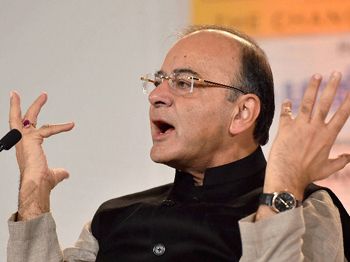
Jaitley
In a Facebook post titled 'Demonetisation -- A look back at the last two months', he also said the period of pain and inconveniences is getting over and the economic activity is being restored.

Large amount of cash with banks will lead to lower interest rates, he further said.

"When 86 per cent of a country's currency, constituting 12.2 per cent of its GDP, is squeezed out of the market and sought to be replaced by a new currency, there would obviously be significant consequences of that decision," he said, adding that the queues outside the banks have disappeared and remonetisation has moved ahead.

"The period of pain and inconveniences is getting over. Economic activity is being restored," he said.

Jaitley said demonetisation required both courage and stamina. "The implementation of the decision carried pain. It can lead to short-term criticism and inconveniences. Drop in economic activity on account of the currency squeeze during the remonetisation period would have a transient impact on the economy."

"The fact that large quantum of high denominational currency has been deposited with the banks does not render this money to be legitimate cash. Black money does not change its colour merely because it is deposited in bank. On the contrary, it loses its anonymity and can now be identified with its owner," he said.

The comments follow reports about an estimated 97 per cent of junked notes getting deposited in bank accounts, thus casting doubts on the effectiveness of demonetisation move in checking the black money menace.

The Revenue Department, he said, would be entitled to tax this money. "In any case, the amendment to the Income Tax Act itself provides that the said money, if voluntarily declared or if involuntarily detected, would be liable for differential and high rates of taxation and penalty," he said.

Jaitley further said India suffers as "a hugely tax non-compliant society".

"In the year 2015-16, 3.7 crore assesses of the total population of over 125 crore, filed income tax returns.

"Out of these, 99 lakh declared income below Rs 2.5 lakh and paid no taxes; 1.95 crore declared income less than Rs 5 lakh; 52 lakh declared income between Rs 5 to 10 lakh, and only 24 lakh declared income above Rs 10 lakh.

"No better evidence is required to substantiate that both in the matter of direct and indirect taxes, India continues to suffer being a hugely tax non-compliant society," he said.

Jaitley said the expenditure required for poverty eradication, national security and economic development have to be compromised with on account of tax non-compliances.

He further said, "Tax evasion has been considered as neither unethical nor immoral. It was just a way of life. Several Governments have allowed this 'normal' to continue even though this compromised with larger public interest.

"The Prime Minister's decision (of demonetisation) is intended to create a new 'normal'," he said.

The Finance Minister further said the move seeks to change the expenditure pattern of India and Indians.

"It is obviously disruptive. All reforms are disruptive. They change the retrograde status quo. The demonetisation puts a premium on honesty and penalises dishonest conduct.

"Excessive cash as a medium of exchange is favoured by the underground economy, resulting in non-compliance in tax payments. Mountains of cash money reach tax havens through the hawala route from the original paper currency," he added.

Jaitley further said that cash is the medium which funds bribery, corruption, counterfeit currency and terrorism.

Stating that ethical and developed societies aided by technology have consistently moved towards banking and digital transactions as against the excessive use of cash, he said that reducing cash may not eliminate crime and terrorism but it can inflict serious blow on them.

Jaitley said banks today have a lot more money available in order to lend for growth.

"Since this money constitutes low-cost deposits with the banks, it is bound to bring down the rate of interest. Both these things have already happened. Lakhs of crores, which were floating in the market as loose currency, have now entered the banking system. Not only has the money lost is anonymity, its owners, after being taxed, are entitled to put it to more effective uses," he said.

Jaitley said the Narendra Modi Government wanted to move against the shadow economy and black money from Day-1, and went on to list the steps taken including constituting SIT on black money and international cooperation in sharing information on base erosion and profit shifting.

"Modi Government is determined to act against the shadow economy and black money. All efforts in this regard till date have been fruitful," Jaitley later tweeted.

He said agreement was reached with Switzerland to get details of assets held by Indian citizens from 2019 and tax treaties with Mauritius, Cyprus and Singapore renegotiated to end round-tripping.

"PM Narendra Modi mustered international support against evils of black money since he took over as PM of India," Jaitley tweeted.

He said India enacted a law for dealing with black money outside India and a 'highly successful' Income Declaration Scheme (IDS) for domestic black money holders was launched.

Also PAN card requirement for cash transaction above Rs 2 lakhs has put hurdles on expenditure through black money.

Stating that GST, to be implemented this year, will provide for better indirect tax administration and being a more efficient law will check tax evasion, he said the demonetisation of high denominational currency notes was the big step in the same direction.

With the demonetisation, the size of the banking transactions and consequently the size of the economy is bound to increase, he said, adding that in the medium and long run, the GDP would be bigger and cleaner.

"Money entering into the banking system and officially transacted would give an ample scope for higher taxation -– both direct and indirect. The Centre and the State Governments would both stand to gain. The economy would also be serviced by both cash and highly digitised transactions," he said.

Jaitley said there was a "marked difference" in the approach of Modi and his opponents in dealing with the menace of black money and terror financing.

"The Prime Minister was being futuristic, and thinking of a more modern, technology driven cleaner economy. He is now speaking of cleaning the political funding systems. His opponents want a cash dominated, cash generating and cash exchange system to continue.

"The difference between Prime Minister Narendra Modi and Rahul Gandhi was clear -- the Prime Minister was thinking of the next generation while Rahul Gandhi was only looking at how to disrupt the next session of Parliament," Jaitley wrote.

Stating that there was no social unrest while implementing the major demonetisation decision, Jaitley cited opinion polls conducted by independent media organisations which showed that an overwhelmingly large percentage of people have supported the government's decision.

"The opposition disrupted a full session of Parliament. Their protests have been ineffective. Their exaggerated claims on the disruption of the economy have proved wrong. It is a tragedy that a national party like the Congress decided to adopt a political position, opposing both technology, change and reforms. It sided with black money friendly status quo," it said.

Comments

Demetra
 - 
Monday, 16 Jan 2017

I like what you guys are up too. Such clever work and exposure!
Keep up the superb works guys I've included you guys to my blogroll.

my webpage Jona: http://yahoo.co.uk

Add new comment

  • Coastaldigest.com reserves the right to delete or block any comments.
  • Coastaldigset.com is not responsible for its readers’ comments.
  • Comments that are abusive, incendiary or irrelevant are strictly prohibited.
  • Please use a genuine email ID and provide your name to avoid reject.
News Network
December 5,2025

indigoCEO.jpg

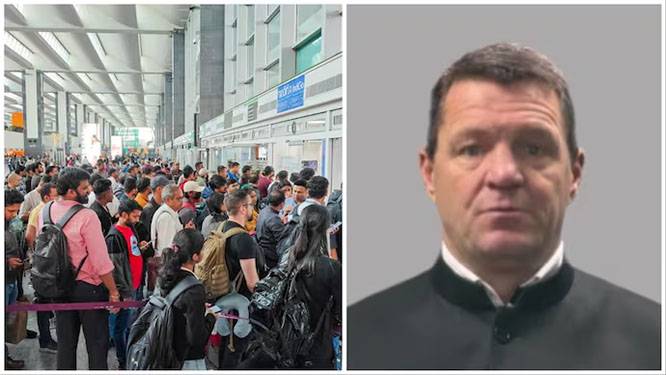
New Delhi, Dec 5: IndiGo CEO Pieter Elbers issued a public apology this evening after more than a thousand flights were cancelled today, making it the "most severely impacted day" in terms of cancellations. The biggest airline of the country cancelled "more than half" of its daily number of flights on Friday, said Elbers. He also said that even though the crisis will persist on Saturday, the airline anticipates fewer than 1,000 flight cancellations.

"Full normalisation is expected between December 10 and 15, though IndiGo cautions that recovery will take time due to the scale of operations," the IndiGo CEO said. 

IndiGo operates around 2,300 domestic and international flights daily.

Pieter Elbers, while apologising for the major inconvenience due to delays and cancellations, said the situation is a result of various causes.

The crisis at IndiGo stems from new regulations that boost pilots' weekly rest requirements by 12 hours to 48 and allow only two night-time landings per week, down from six. IndiGo has attributed the mass cancellations to "misjudgment and planning gaps".

Elbers also listed three lines of action that the airline will adopt to address the issue.

"Firstly, customer communication and addressing your needs, for this, messages have been sent on social media. And just now, a more detailed communication with information, refunds, cancellations and other customer support measures was sent," he said.

The airline has also stepped up its call centre capacity.

"Secondly, due to yesterday's situation, we had customers stranded mostly at the nation's largest airports. Our focus was for all of them to be able to travel today itself, which will be achieved. For this, we also ask customers whose flights are cancelled not to come to the airports as notifications are sent," the CEO said.

"Thirdly, cancellations were made for today to align our crew and planes to be where they need to start tomorrow morning afresh. Earlier measures of the last few days, regrettable, have proven not to be enough, but we have decided today to reboot all our systems and schedules, resulting in the highest numbers of cancellations so far, but imperative for progressive improvements starting from tomorrow," he added.

As airports witnessed chaotic scenes, the Directorate General of Civil Aviation (DGCA) stepped in to grant IndiGo a temporary exemption from stricter night duty rules for pilots. It also allowed substitution of leaves with a weekly rest period. 

Civil Aviation Minister Ram Mohan Naidu has said a high-level inquiry will be ordered and accountability will be fixed.

Comments

Add new comment

  • Coastaldigest.com reserves the right to delete or block any comments.
  • Coastaldigset.com is not responsible for its readers’ comments.
  • Comments that are abusive, incendiary or irrelevant are strictly prohibited.
  • Please use a genuine email ID and provide your name to avoid reject.
News Network
December 20,2025

train.jpg

At least seven elephants were killed and one calf injured after a herd collided with the Sairang-New Delhi Rajdhani Express in Assam's Hojai on Saturday morning, leading to disruption of rail services. 

The Sairang-New Delhi Rajdhani Express struck a herd of elephants, resulting in the derailment of the locomotive and five coaches. No passenger casualties or injuries were reported, officials said.

The New Delhi-bound train met with the accident around 2.17 am, PTI reported. The Sairang-New Delhi Rajdhani Express connects Mizoram's Sairang (near Aizawl) to Anand Vihar Terminal (Delhi). 

Railway has issued helpline numbers at the Guwahati Railway Station:-

•    0361-2731621
•    0361-2731622
•    0361-2731623

The accident site is located about 126 km from Guwahati. Following the incident, accident relief trains and railway officials rushed to the spot to initiate rescue operations.

Train Services Disrupted

Sources said that due to the derailment and elephant body parts scattered on the tracks, train services to Upper Assam and other parts of the Northeast were affected.

Passengers from the affected coaches were temporarily accommodated in vacant berths available in other coaches of the train. Once the train reaches Guwahati, additional coaches will be attached to accommodate all passengers, after which the train will resume its onward journey.

The incident occurred at a location that is not a designated elephant corridor. The loco pilot, upon spotting the herd on the tracks, applied emergency brakes. Despite this, the elephants dashed into the train, leading to the collision and derailment.

Last month, an elephant was killed after being hit by a train in Dhupguri in West Bengal's Jalpaiguri district. The incident took place on November 30. 

The adult elephant was killed on the spot, and a calf was discovered lying injured beside the tracks. 

Over 70 Elephants Killed In Train Collisions Over Last 5 Years

At least 79 elephants have died in train collisions across the country in the last five years, the Environment Ministry had informed Parliament in August.

In a written reply in the Lok Sabha, Minister of State for Environment Kirti Vardhan Singh had said the figure is based on reports from state governments and Union Territory administrations for the period 2020-21 to 2024-25.

He said that the ministry does not maintain consolidated data on the deaths of other wild animals on railway tracks, including in designated elephant corridors.

Singh confirmed that three elephants, including a mother and her calf, were killed on July 18 this year after being hit by a speeding express train on the Kharagpur-Tatanagar section in West Bengal's Paschim Midnapore district. The incident took place near Banstala between Jhargram and Banstala stations.

The minister said several measures have been taken jointly by the Environment Ministry and the Railways to prevent such accidents.

These include imposing speed restrictions in elephant habitats, pilot projects such as seismic sensor-based detection of elephants near tracks and construction of underpasses, ramps and fencing at vulnerable points.

The Wildlife Institute of India, in consultation with the ministry and other stakeholders, has also issued guidelines titled 'Eco-friendly Measures to Mitigate Impacts of Linear Infrastructure' to help agencies design railways and other projects in ways that reduce human-animal conflicts.

Singh added that capacity-building workshops were conducted for railway officials at the Wildlife Institute of India in 2023 and 2024 to raise awareness on elephant conservation and protection.

A detailed report titled 'Suggested Measures to Mitigate Elephant & Other Wildlife Train Collisions on Vulnerable Railway Stretches in India' had also been prepared after surveys across 127 railway stretches covering 3,452 km.

Of these, 77 stretches spanning 1,965 km in 14 states were prioritised for mitigation, with site-specific interventions suggested. 

Comments

Add new comment

  • Coastaldigest.com reserves the right to delete or block any comments.
  • Coastaldigset.com is not responsible for its readers’ comments.
  • Comments that are abusive, incendiary or irrelevant are strictly prohibited.
  • Please use a genuine email ID and provide your name to avoid reject.
News Network
December 6,2025

pilot.jpg

New Delhi: IndiGo, India’s largest airline, faced major operational turbulence this week after failing to prepare for new pilot-fatigue regulations issued by the Directorate General of Civil Aviation (DGCA). The stricter rules—designed to improve flight safety—took effect in phases through 2024, with the latest implementation on November 1. IndiGo has acknowledged that inadequate roster planning led to widespread cancellations and delays.

Below are the key DGCA rules that affected IndiGo’s operations:

1. Longer Mandatory Weekly Rest

Weekly rest for pilots has been increased from 36 hours to 48 hours.

The government says the extended break is essential to curb cumulative fatigue. This rule remains in force despite the current crisis.

2. Cap on Night Landings

Pilots can now perform only two night landings per week—a steep reduction from the earlier limit of six.

Night hours, defined as midnight to early morning, are considered the least alert period for pilots.

Given the disruptions, this rule has been temporarily relaxed for IndiGo until February 10.

3. Reduced Maximum Night Flight Duty

Flight duty that stretches into the night is now capped at 10 hours.

This measure has also been kept on hold for IndiGo until February 10 to stabilize operations.

4. Weekly Rest Cannot Be Replaced With Personal Leave

Airlines can no longer count a pilot’s personal leave as part of the mandatory 48-hour rest.

Pilots say this closes a loophole that previously reduced actual rest time.

Currently, all airlines are exempt from this rule to normalise travel.

5. Mandatory Fatigue Monitoring

Airlines must submit quarterly fatigue reports along with corrective actions to DGCA.

This system aims to create a transparent fatigue-tracking framework across the industry.

The DGCA has stressed that these rules were crafted to strengthen flight safety and align India with global fatigue-management standards. The temporary relaxations are expected to remain until February 2025, giving IndiGo time to stabilise its schedules and restore normal air travel.

Comments

Add new comment

  • Coastaldigest.com reserves the right to delete or block any comments.
  • Coastaldigset.com is not responsible for its readers’ comments.
  • Comments that are abusive, incendiary or irrelevant are strictly prohibited.
  • Please use a genuine email ID and provide your name to avoid reject.