



Money in Swiss banks: India moves to 73rd place

Agencies
July 1, 2018

Zurich/New Delhi, Jul 1: India has moved up to 73rd place in terms of money parked by its citizens and companies with Swiss banks, while the UK remains on the top.

India had slipped to 88th place with a 44 per cent plunge in such funds during 2016, but the latest data from the Swiss National Bank (SNB) shows an increase of over 50 per cent during 2017 to CHF 1.01 billion (about Rs 7,000 crore).

Pakistan is now placed one place higher than India at 72nd position, down one slot, after 21 per cent dips in funds from that country in Swiss banks during 2017.

The funds, described by SNB as 'liabilities' of Swiss banks or 'amounts due to' their clients, are official figures disclosed by Swiss authorities and do not indicate to the exact quantum of the much-debated alleged black money held in famed safe havens of Switzerland.

The official figures, disclosed annually by Switzerland's central bank, also do not include the money that Indians, NRIs or others might have in Swiss banks in the names of entities from different countries.

It has been often alleged that Indians and other nationals seeking to stash their illicit wealth abroad use multiple layers of various jurisdictions, including tax havens, to shift the money in Swiss banks.

Also, with Switzerland putting in place an automatic information exchange framework with India and various other countries, the famed secrecy walls of Swiss banks are said to have crumbled. India will start getting this automatic data from next year, while it has already been getting information on accounts where proof of illicit funds can be furnished.

However, the increase in Indians' money in Swiss banks has already triggered a sharp opposition attack on the government, which in turn has said that it would be wrong to assume that all funds deposited in Swiss banks were 'black money' and strong action would be taken against wrongdoers.

The funds officially held by Indians with banks in Switzerland now accounts for only 0.07 per cent, though up from 0.04 per cent a year ago, of the total funds kept by all foreign clients in the Swiss banking system, as per an analysis of the latest figures compiled by the SNB (Swiss National Bank) as on 2017-end.

India was placed at 75th position in 2015 and at 61st in the year before, though it used to be among top-50 countries in terms of holdings in Swiss banks till 2007. The country was ranked highest at 37th place in the year 2004.

The total money held in Swiss banks by foreign clients from across the world rose by about 3 per cent to CHF 1.46 trillion (about Rs 100 lakh crore) in 2017.

In terms of individual countries, the UK continued to account for the largest chunk at about CHF 403 billion (over 27 per cent) of the total foreign money with Swiss banks. The UK saw an increase of over 12 per cent in such funds.

The US remains on the second position despite a dip of about 6 per cent in such funds to CHF 166 billion (11 per cent share of all foreign funds). No other country accounted for a double-digit percentage share, while others in the top-ten included West Indies, France, Hong Kong, Bahamas, Germany, Guernsey, Luxembourg and Cayman Islands.

Among BRICS countries, India remains to rank the lowest -- China at 20th place (CHF 160 billion with an increase of 67 per cent during 2017), Russia at 23rd (CHF 135 billion after 13 per cent fall), Brazil 61st (CHF 1.9 billion after 28 per cent fall) and South Africa 67th (CHF 1.5 billion after 31 per cent dip). Among these five, only China and India saw an increase in their funds.

Others ranked higher than India are: Singapore, UAE, Saudi Arabia, Panama, Japan, Jersey, Australia, Netherlands, Italy, Belgium, Cyprus, Israel, Mexico, Bermuda, Turkey, Kuwait, Marshall Islands, Canada, Thailand, South Korea, Malaysia, Belize, Isle of Man, Indonesia, Seychelles, Gibraltar, Samoa, New Zealand, Philippines, Iran, Kazakhstan and Ukraine.

Those ranked below India were Mauritius (77th place), Bangladesh (95th), Sri Lanka (108th), Nepal (112th), Vatican City State (122nd), Iraq (132nd), Afghanistan (155th), Burkina Faso (162nd), Bhutan (203rd), North Korea (205th) and Palau was last at 214th place.

The total money belonging to the developed countries rose 10 per cent to CHF 876 billion, while those from developing nations rose marginally to CHF 209 billion. The offshore financial centres actually saw a dip of 3 per cent to CHF 378 billion.

India was ranked in top-50 continuously between 1996 and 2007, but started declining after that -- 55th in 2008, 59th in 2009 and 2010 each, 55th again in 2011, 71st in 2012 and then to 58th in 2013.

In terms of percentage increase, India's 50 per cent rise was 23rd highest. The maximum increase of as much as 4,000 per cent was seen by Solomon Islands, followed by over 2,200 per cent for Faroe Islands and 1,200 per cent for British Indian Ocean Territory.

The increase was more than 100 per cent for Maldives, Grenada, Turkmenistan, Laos, Lesotho, Qatar, Bonaire, Sint Eustatius and Saba, Federated States of Micronesia, Equatorial Guinea; and Sao Tome and Principe.

Others with higher increase than India's were Guyana, Mongolia, Barbados, Cote d'Ivoire, South Sudan, Bahrain, Kuwait and Ireland.

The jurisdictions that saw the maximum decline in such funds included Palau, St Helena and Gambia, while North Korea, Bhutan, Macao, Burkina Faso and Iraq also recorded significant dips.

Comments

Add new comment

  • Coastaldigest.com reserves the right to delete or block any comments.
  • Coastaldigset.com is not responsible for its readers’ comments.
  • Comments that are abusive, incendiary or irrelevant are strictly prohibited.
  • Please use a genuine email ID and provide your name to avoid reject.
News Network
December 6,2025

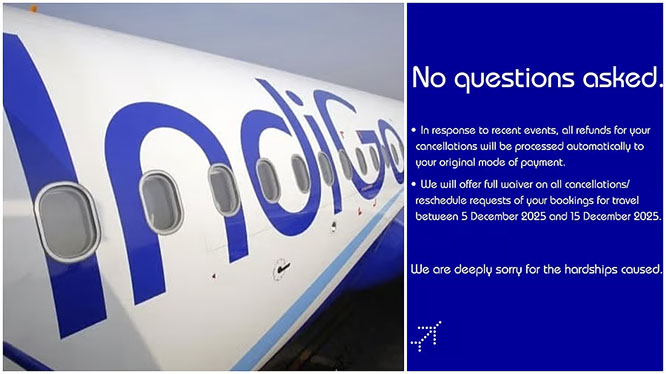
indigoticket.jpg

With IndiGo flight disruptions impacting thousands of passengers, the airline on Saturday said that it will offer full waiver on all cancellations/reschedule requests for travel bookings between December 5, 2025 and December 15, 2025.

Earlier in the day, the civil aviation ministry had directed the airline to complete the ticket refund process for the cancelled flights by Sunday evening, as well as ensure baggage separated from the travellers are delivered in the next two days.

In a post on X, titled 'No questions asked', IndiGo wrote, "In response to recent events, all refunds for your cancellations will be processed automatically to your original mode of payment."

"We are deeply sorry for the hardships caused," it further added.

Several passengers, however, complained of not getting full refund as promised by the airline.

Netizens have shared screenchots of getting charged for airline cancellation fee and convenience fee.

"Please tell me why u have did this airline cancellation charges when u say full amount will be refunded (sic)," a user wrote sharing a screenshot of the refund page.

"Well, but you have still debited the convenience charges," wrote another.

Passengers have also raised concerns about the "cancel" option being disabled on the IndiGo app. "First enable the 'Cancel' button on your App & offer full refund on tickets cancelled by customers between the said dates," wrote a user.

A day after the country's largest airline, IndiGo, cancelled more than 1,000 flights and caused disruptions for the fifth day on Saturday, the ministry said that any delay or non-compliance in refund processing will invite immediate regulatory action.

The refund process for all cancelled or disrupted flights must be completed by 8 pm on Sunday, the ministry said in a statement.

"Airlines have also been instructed not to levy any rescheduling charges for passengers whose travel plans were affected by cancellations," it said.

On Saturday, more than 400 flights were cancelled at various airports.

IndiGo has also been instructed to set up dedicated passenger support and refund facilitation cells.

Comments

Add new comment

  • Coastaldigest.com reserves the right to delete or block any comments.
  • Coastaldigset.com is not responsible for its readers’ comments.
  • Comments that are abusive, incendiary or irrelevant are strictly prohibited.
  • Please use a genuine email ID and provide your name to avoid reject.
News Network
December 13,2025

New Delhi: School-going children are picking up drug and smoking habits and engaging in consumption of alcohol, with the average age of introduction to such harmful substances found to be around 13 years, suggesting a need for earlier interventions as early as primary school, a multi-city survey by AIIMS-Delhi said.

The findings also showed substance use increased in higher grades, with grade XI/XII students two times more likely to report use of substances when compared with grade VIII students. This emphasised the importance of continued prevention and intervention through middle and high school.

The study led by Dr Anju Dhawan of AIIMS's National Drug Dependence Treatment Centre, published in the National Medical Journal of India this month, looks at adolescent substance use across diverse regions.

The survey included 5,920 students from classes 8, 9, 11 and 12 in urban government, private and rural schools across 10 cities -- Bengaluru, Chandigarh, Delhi, Dibrugarh, Hyderabad, Imphal, Jammu, Lucknow, Mumbai, and Ranchi. The data were collected between May 2018 and June 2019.

The average age of initiation for any substance was 12.9 (2.8) years. It was lowest for inhalants (11.3 years) followed by heroin (12.3 years) and opioid pharmaceuticals (without prescription; 12.5 years).

Overall, 15.1 per cent of participants reported lifetime use, 10.3 per cent reported past year use, and 7.2 per cent reported use in the past month of any substance, the study found.

The most common substances used in the past year, after tobacco (4 per cent) and alcohol (3.8 per cent), were opioids (2.8 per cent), followed by cannabis (2 per cent) and inhalants (1.9 per cent). Use of non-prescribed pharmaceutical opioids was most common among opioid users (90.2 per cent).

On being asked, 'Do you think this substance is easily available for a person of your age' separately for each substance category, nearly half the students (46.3 per cent) endorsed that tobacco products and more than one-third of the students (36.5 per cent) agreed that a person of their age can easily procure alcohol products.

Similarly, for Bhang (21.9 per cent), ganja/charas (16.1 per cent), inhalants (15.2 per cent), sedatives (13.7 per cent), opium and heroin (10 per cent each), the students endorsed that these can be easily procured.

About 95 per cent of the children, irrespective of their grade, agreed with the statement that 'drug use is harmful'.

The rates of substance use (any) among boys were significantly higher than those of girls for substance use (ever), use in the past year and use in the past 30 days. Compared to grade VIII students, grade IX students were more likely, and grade XI/XII students were twice as likely to have used any substance (ever).

The likelihood of past-year use of any substance was also higher for grade IX students and for grade XI/XII students as compared to grade VIII students.

About 40 per cent of students mentioned that they had a family member who used tobacco or alcohol each. The use of cannabis (any product) and opioid (any product) by a family member was reported by 8.2 per cent and 3.9 per cent of students, respectively, while the use of other substances, such as inhalants/sedatives by family was 2-3 per cent, the study found.

A relatively smaller percentage of students reported use of tobacco or alcohol among peers as compared to among family members, while a higher percentage reported inhalants, sedatives, cannabis or opioid use among peers.

Children using substances (past year) compared to non-users reported significantly higher any substance use by their family members and peers.

There were 25.7 per cent students who replied 'yes' to the question 'conflicts/fights often occur in your family'. Most students also replied affirmatively to 'family members are aware of how their time is being spent' and 'damily members are aware of with whom they spend their time'.

Comments

Add new comment

  • Coastaldigest.com reserves the right to delete or block any comments.
  • Coastaldigset.com is not responsible for its readers’ comments.
  • Comments that are abusive, incendiary or irrelevant are strictly prohibited.
  • Please use a genuine email ID and provide your name to avoid reject.
News Network
December 20,2025

Mangaluru, Dec 20: The Mangaluru City Police have issued a detailed traffic advisory ahead of the inaugural ceremony of Karavali Utsava, which will be held at the Karavali Utsava Ground on Saturday.

The festival will be inaugurated at 6:00 pm by Dakshina Kannada District Minister Dinesh Gundu Rao. Cultural and public programmes will be held at the venue every evening and will continue until January 2.

According to City Police Commissioner Sudheer Kumar Reddy, parking of vehicles is strictly prohibited on both sides of the road from Lalbagh to Karavali Utsava Ground. Visitors are requested to park their vehicles only at designated parking areas.

To help the public, traffic signboards and parking guidance flex boards have been installed along the routes leading to the venue. The police have urged commuters and visitors to follow these instructions to ensure smooth traffic movement.

Designated Parking Locations

•    Urwa Market Ground – Cars
•    Gandhinagar Government School (near Press Club) – Two-wheelers and cars
•    Ladyhill Church parking area – Two-wheelers and cars
•    Canara School Ground, Mannagudda – Two-wheelers and cars
•    Thimmappa Hotel premises – Two-wheelers and cars
•    Scout and Guide Bhavana premises (behind Karavali Utsava Grounds) – Two-wheelers
•    Urwa Market Road – Two-wheelers
•    Hat Hill Road – Two-wheelers

The police have appealed to the public to cooperate by following traffic rules and parking guidelines to avoid inconvenience during the festival.

Comments

Add new comment

  • Coastaldigest.com reserves the right to delete or block any comments.
  • Coastaldigset.com is not responsible for its readers’ comments.
  • Comments that are abusive, incendiary or irrelevant are strictly prohibited.
  • Please use a genuine email ID and provide your name to avoid reject.