To the Moon and back: 50 years on, a giant leap

Agencies
July 14, 2019

Washington, Jul 14: The first four days of Apollo 11's journey to the Moon had gone according to plan, but just twenty minutes before landing, the atmosphere grew tense as the crew encountered a series of problems.

It was July 20, 1969, and as the world followed the spacecraft's progress, it briefly lost radio contact with mission control in Houston. Then, as the lunar module Eagle was in the middle of its descent, piloted by Edwin "Buzz" Aldrin and mission commander Neil Armstrong, an alarm bell began ringing.

Eagle had detached two hours earlier from the main part of the vessel, the command module, Columbia, where the third crew member Michael Collins remained in orbit.

It was an anxious moment for Armstrong. "Give us a reading on the 1202 Programme Alarm," he radios to mission control. They are told to keep going. Houston realizes the onboard computer is experiencing an overflow, but all systems are functional.

Below them, the Moon's craters are zipping by fast. Too fast, realizes Armstrong: at this rate, they will overshoot the landing site by several miles.

He switches to manual control and starts to scope out a new landing site from his porthole. But there's trouble finding the perfect spot, and it's going to be tight.

Aldrin continues to tell him speed and altitude readings from the computer. "Coming down nicely," he says.

Meanwhile, the fuel is rapidly depleting. Houston continues to announce the number of seconds left to the "Bingo fuel call" -- the point at which Eagle will have 20 seconds left to land, or abort the mission. It is now 30 seconds left to Bingo.

Armstrong, summoning all his experience, is silent as he concentrates.

The module comes to a rest on the ground. "Contact Light," says Aldrin, meaning one of the leg's foot sensors has touched down. The engines are switched off.

"Houston, Tranquility Base here. The Eagle has landed," announces Armstrong.

"We copy you on the ground. You got a bunch of guys about to turn blue. We're breathing again. Thanks a lot," replies Charlie Duke, the CapCom or capsule communicator on the ground.

In 1961, President John F Kennedy called upon his vice president Lyndon Johnson to beat the Soviets in space.

Johnson reaches out to the godfather of NASA's space program: Wernher von Braun. The former card-carrying Nazi was the inventor of the V-2 rockets that rained destruction on London in World War II. Toward the end of the war, he surrendered himself to the Americans, who brought him and a hundred of his best engineers to Alabama, as part of the secret "Operation Paperclip."

Braun told Johnson that while the US was well behind, they could conceivably beat the Russians if they immediately started work on a giant booster rocket.

Eight years later, Richard Nixon was president when the goal was realized.

Between October 1968 and May 1969, four preparatory Apollo missions were launched. Armstrong was chosen in December 1968 to command the eleventh.

Months from launch, Armstrong told Aldrin he was pulling rank and would be the first to set foot on the lunar surface.

When the monstrous rocket designed by Braun launched with the Apollo 11 capsule at its summit on July 16, 1969, one million people flocked to the beach to watch.

But many had doubts that they'd succeed in landing on the Moon on the first attempt. For those in America, the final descent would take place on Sunday evening.

In Europe, it was already nighttime, but everyone was glued to their televisions, though they could only hear crackling radio communications until Armstrong set up his black and white camera ahead of his first step.

As he climbed down to the foot of the ladder, he observed that Eagle's footpads had sunk into the ground by only an inch or two, and the surface appeared very fine grained. "It's almost like a powder," he recalled.

Then, over the radio: "Okay. I'm going to step off the LM now." A pause, and then the immortal words: "That's one small step for man; one giant leap for mankind."

According to Armstrong, the line wasn't scripted. "I thought about it after landing," he would say in an oral history recorded by NASA in 2001.

One problem: without the indefinite article ("a man"), it wasn't grammatically correct. Armstrong said he meant to say it, but agreed it was inaudible.

What does the Moon look like, up close?

Its colour varies with the angle of the Sun: from brown to grey to black as coal. And the lower level of gravity takes getting used to.

"I started jogging around a bit, and it felt like I was moving in slow motion in a lazy lope, often with both of my feet floating in the air," Aldrin wrote in a book in 2009.

Over the course of two-and-a-half hours, Armstrong picks up piles and piles of Moon rocks and takes photographs. Aldrin installs a seismometer and two other scientific instruments.

They plant the US flag, and leave behind a host of items including a medal honouring the first man in space, Russia's Yuri Gagarin.

Happily, the lunar module's engine worked, it rendezvoused back with Columbia, and the trio began the long journey home.

On July 24, it enters the atmosphere, becoming for a while a fireball in the sky before deploying three parachutes and splashing down safely into the Pacific.

At their first press conference, three weeks later, reporters asked the three men, now global heroes, whether they would ever consider returning to the Moon.

"In the Lunar Receiving Laboratory, we had very little time for meditation," replied Armstrong, ever to the point.

None of them would go back to space ever again.

After six more missions, the Apollo programme was terminated in 1972.

It was not until Donald Trump came to office that the US would decide to return to the Moon, under the Artemis program, named for Apollo's twin sister.

Comments

Add new comment

  • Coastaldigest.com reserves the right to delete or block any comments.
  • Coastaldigset.com is not responsible for its readers’ comments.
  • Comments that are abusive, incendiary or irrelevant are strictly prohibited.
  • Please use a genuine email ID and provide your name to avoid reject.
News Network
December 4,2025

indigoflight.jpg

Domestic carrier IndiGo has cancelled over 180 flights from three major airports — Mumbai, Delhi and Bengaluru — on Thursday, December 4, as the airline struggles to secure the required crew to operate its flights in the wake of new flight-duty and rest-period norms for pilots.

While the number of cancellations at Mumbai airport stands at 86 (41 arrivals and 45 departures) for the day, at Bengaluru, 73 flights have been cancelled, including 41 arrivals, according to a PTI report that quoted sources.

"IndiGo cancelled over 180 flights on Thursday at three airports-Mumbai, Delhi and Bengaluru," the source told the news agency.

Besides, it had cancelled as many as 33 flights at Delhi airport for Thursday, the source said, adding, "The number of cancellations is expected to be higher by the end of the day."

The Gurugram-based airline's On-Time Performance (OTP) nosedived to 19.7 per cent at six key airports — Delhi, Mumbai, Chennai, Kolkata, Bengaluru and Hyderabad — on December 3, as it struggled to get the required crew to operate its services, down from almost half of December 2, when it was 35 per cent.

"IndiGo has been facing acute crew shortage since the implementation of the second phase of the FDTL (Flight Duty Time Limitations) norms, leading to cancellations and huge delays in its operations across the airports," a source had told PTI on Wednesday.

Chaos continued at several major airports for the third day on Thursday because of the cancellations.

A spokesperson for the Kempegowda International Airport (KIA) in Bengaluru said that 73 IndiGo flights had been cancelled on Thursday.

At least 150 flights were cancelled and dozens of others delayed on Wednesday, airport sources said, leaving thousands of travellers stranded, according to news agency Reuters.

The Directorate General of Civil Aviation (DGCA) has said it is investigating IndiGo flight disruptions and has asked the airline to submit the reasons for the current situation, as well as its plans to reduce flight cancellations and delays.

It may be mentioned here that the pilots' body, Federation of Indian Pilots (FIP), has alleged that IndiGo, despite getting a two-year preparatory window before the full implementation of new flight duty and rest period norms for cockpit crew, "inexplicably" adopted a "hiring freeze".

The FIP said it has urged the safety regulator, the DGCA, not to approve airlines' seasonal flight schedules unless they have adequate staff to operate their services "safely and reliably" in accordance with the New Flight Duty Time Limitations (FDTL) norms.

In a letter to the DGCA late on Wednesday, the FIP urged the DGCA to consider re-evaluating and reallocating slots to other airlines, which have the capacity to operate them without disruption during the peak holiday and fog season if IndiGo continues to "fail in delivering on its commitments to passengers due to its own avoidable staffing shortages."

Comments

Add new comment

  • Coastaldigest.com reserves the right to delete or block any comments.
  • Coastaldigset.com is not responsible for its readers’ comments.
  • Comments that are abusive, incendiary or irrelevant are strictly prohibited.
  • Please use a genuine email ID and provide your name to avoid reject.
News Network
November 27,2025

siddDKS.jpg

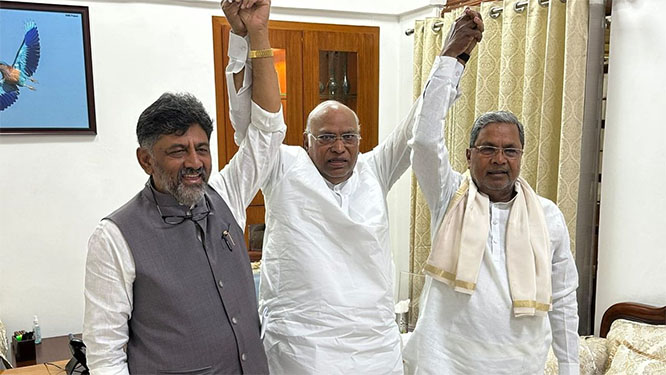
Congress president Mallikarjun Kharge on Thursday announced that he will convene a high-level meeting in New Delhi with senior leaders — including Rahul Gandhi, Karnataka Chief Minister Siddaramaiah and Deputy Chief Minister D.K. Shivakumar — to resolve the escalating leadership turmoil in Karnataka and “put an end to the confusion.”

Kharge said the discussions would focus on the way forward for the ruling party, as rumours of a possible leadership change continue to swirl. The speculation has intensified after the Congress government crossed the halfway mark of its five-year term on November 20, reviving talk of an alleged 2023 “power-sharing agreement” between Siddaramaiah and Shivakumar.

“After reaching Delhi, I will call three or four important leaders and hold discussions. Once we talk, we will decide how to move ahead and end this confusion,” Kharge told reporters in Bengaluru, according to PTI.

When asked specifically about calling Siddaramaiah and Shivakumar to Delhi, he responded: “Certainly, we should call them. We will discuss with them and settle the issue.”

He confirmed that Rahul Gandhi, the Chief Minister, the Deputy Chief Minister and other senior members would be part of the deliberations. “After discussing with everyone, a decision will be made,” he said.

Meanwhile, Siddaramaiah held a separate strategy meeting at his Bengaluru residence with ministers and leaders seen as his close confidants, including G. Parameshwara, Satish Jarkiholi, H.C. Mahadevappa, K. Venkatesh and K.N. Rajanna.
Signalling calm, the Chief Minister told reporters, “Will go to Delhi if the high command calls.”

Shivakumar echoed a similar stance, saying he too would head to the national capital if summoned by the party leadership.

Comments

Add new comment

  • Coastaldigest.com reserves the right to delete or block any comments.
  • Coastaldigset.com is not responsible for its readers’ comments.
  • Comments that are abusive, incendiary or irrelevant are strictly prohibited.
  • Please use a genuine email ID and provide your name to avoid reject.
News Network
November 30,2025

girlnomore.jpg

Mangaluru, Nov 30: A 22-year-old college student succumbed to her injuries at a private hospital in Mangaluru today, days after she was hit by a goods tempo while crossing a road in Padubidri.

The deceased has been identified as Preksha, a resident of Nadsalu Billitota in Padubidri. The fatal incident occurred as Preksha, who was returning home after completing her examination, attempted to cross the service road towards Mangaluru. She was struck by a goods tempo approaching from the Udupi side, causing her to fall and sustain a severe head injury.

Prompt action from local residents ensured she received immediate first aid before being rushed to a hospital in Mangaluru for specialised treatment. Despite medical efforts, she passed away while undergoing care.

Preksha was a student at Karavali College, Vamanjoor on the outskirts of Mangaluru city. The tragedy is compounded by the fact that she belonged to a financially vulnerable family, having previously lost her father. She is survived by her mother and brother.

A case related to the accident has been registered at the Padubidri police station, and an investigation is underway to determine the exact circumstances that led to the collision. The incident highlights the growing concerns over road safety, particularly on busy service roads, and serves as a tragic reminder of the human cost of traffic accidents.

Comments

Add new comment

  • Coastaldigest.com reserves the right to delete or block any comments.
  • Coastaldigset.com is not responsible for its readers’ comments.
  • Comments that are abusive, incendiary or irrelevant are strictly prohibited.
  • Please use a genuine email ID and provide your name to avoid reject.