Mukesh Ambani, the richest Asian, adds this much wealth while 128 tycoons lose $137 billion in 2018

Agencies
December 24, 2018

Dec 24: The world’s fastest growing source of mega-wealth hit a speed bump this year. The 128 people in Asia with enough money to crack the 500-member Bloomberg Billionaires Index lost a combined $137 billion in 2018, the first time wealth in the region has dropped since the ranking started in 2012.

Global trade tensions and concerns that stock valuations are too frothy hammered some of the area’s biggest fortunes. China’s tech sector was hit particularly hard, while India and South Korea weren’t spared. The declines occurred even as banks and money managers aggressively stepped up efforts to cater to Asia’s richest. Asian equities retreated again on Friday, with benchmarks slipping in Japan, China and Australia.

“Difficult stock market conditions this year and the uncertainty of the trade tensions likely have been a challenge to many businesses,” said Philip Wyatt, a Hong Kong-based economist for UBS Group AG, who doesn’t see the downdraft continuing through 2019 or significantly reducing the ranks of billionaires. Conditions are actually ripe for the region to create more of the mega rich as new technologies attract private capital and government support, he said.

For now, though, fear in the market is trampling fortunes. More than two-thirds of the 40 Chinese on the Bloomberg ranking saw their wealth dwindle. Wanda Group’s Wang Jianlin, whose property conglomerate is selling assets to cut debt, lost $10.8 billion, the most of anyone in Asia. JD.com founder Richard Liu, who was arrested in the U.S. in August for less than 24 hours on suspicion of rape before being released, took the heaviest losses in percentage terms, with his wealth cut almost in half to $4.8 billion. Liu won’t be charged, authorities in Minneapolis said Friday.

India’s 23 richest people, meanwhile, saw $21 billion vanish. Lakshmi Mittal, who controls the world’s largest steelmaker, led the way, losing $5.6 billion, or 29 percent of his net worth, followed by Dilip Shanghvi, the founder of Sun Pharmaceutical Industries, the world’s fourth-largest generic drugmaker, whose wealth declined $4.6 billion.

South Korea’s tycoons didn’t escape the carnage either. The market rout lopped $17.2 billion from the fortunes of the country’s seven richest people. The father and son who control Samsung Electronics, Lee Kun-Hee and son Jay Y Lee, account for more than a third of that decline. In Hong Kong, titans of real estate took a big hit. Li Ka-shing, who retired as chairman of CK Hutchison and CK Asset in March, lost $6 billion in 2018, while Lee Shau Kee, the city’s second-richest person, ends the year about $3.3 billion poorer. There were still plenty of winners to emerge from the wreckage of 2018.

Lei Jun, the chairman of Chinese smartphone maker Xiaomi Corp., added $8.7 billion, with a July initial public offering catapulting him into the Top 100 of the Bloomberg index after he started the year outside the ranking. The IPO also turned three of his co-founders into billionaires. Japan’s richest person, Tadashi Yanai, added $6.3 billion to his fortune as shares of Fast Retailing Co., the world’s largest apparel retailer, surged 30 percent. India’s Mukesh Ambani added $4 billion to his fortune and eclipsed Alibaba Group Holding Ltd.’s Jack Ma as Asia’s richest person, thanks in part to the performance of Reliance Industries Ltd. Among the winners, the Bloomberg Billionaires Index added new members in technology, consumer, biotech and pharmaceuticals.

E-commerce platform Pinduoduo Inc.’s Colin Huang was the second-largest winner in the region, adding $6.6 billion to his net worth. China’s third largest online retailer was targeted by short seller Blue Orca Capital in November for overstating financials, though its shares traded higher that week as the company denied the accusation and posted strong growth in sales. While most of the newcomers to Asia’s ranks of billionaires are from China, there are five from Korea and four from Japan. Two new billionaires were identified in Southeast Asia. The household “must-have” fish sauce condiment saw Nguyen Dang Quang, chairman of Vietnam’s consumer giant Masan Group, join the ultra-rich club. Indonesian real estate mogul Donald Sihombing, who works 20 hours a day, also joined the list. At least six Asian billionaires died, leaving behind a total of $29 billion.

Walter Kwok, the former chairman of Hong Kong’s biggest real estate developer Sun Hung Kai Properties Ltd. who was worth $9.1 billion, died in October at the age of 68. His two sons inherited a $3 billion stake from the company, according to regulatory filings. Vichai Srivaddhanaprabha, the founder of Thailand’s duty-free giant King Power Group, was killed in a helicopter crash in October. He owned English Premier League team Leicester City.


Comments

shaji
 - 
Wednesday, 26 Dec 2018

Ambani, Adani etc are earning billions mainly due to support from the Govt.    These looters are free to do any cheating / malpractice etc etc.   they are looting money from common indian and increasing their wealth which they will take with them at the time of death.  

Add new comment

  • Coastaldigest.com reserves the right to delete or block any comments.
  • Coastaldigset.com is not responsible for its readers’ comments.
  • Comments that are abusive, incendiary or irrelevant are strictly prohibited.
  • Please use a genuine email ID and provide your name to avoid reject.
News Network
December 6,2025

pilot.jpg

New Delhi: IndiGo, India’s largest airline, faced major operational turbulence this week after failing to prepare for new pilot-fatigue regulations issued by the Directorate General of Civil Aviation (DGCA). The stricter rules—designed to improve flight safety—took effect in phases through 2024, with the latest implementation on November 1. IndiGo has acknowledged that inadequate roster planning led to widespread cancellations and delays.

Below are the key DGCA rules that affected IndiGo’s operations:

1. Longer Mandatory Weekly Rest

Weekly rest for pilots has been increased from 36 hours to 48 hours.

The government says the extended break is essential to curb cumulative fatigue. This rule remains in force despite the current crisis.

2. Cap on Night Landings

Pilots can now perform only two night landings per week—a steep reduction from the earlier limit of six.

Night hours, defined as midnight to early morning, are considered the least alert period for pilots.

Given the disruptions, this rule has been temporarily relaxed for IndiGo until February 10.

3. Reduced Maximum Night Flight Duty

Flight duty that stretches into the night is now capped at 10 hours.

This measure has also been kept on hold for IndiGo until February 10 to stabilize operations.

4. Weekly Rest Cannot Be Replaced With Personal Leave

Airlines can no longer count a pilot’s personal leave as part of the mandatory 48-hour rest.

Pilots say this closes a loophole that previously reduced actual rest time.

Currently, all airlines are exempt from this rule to normalise travel.

5. Mandatory Fatigue Monitoring

Airlines must submit quarterly fatigue reports along with corrective actions to DGCA.

This system aims to create a transparent fatigue-tracking framework across the industry.

The DGCA has stressed that these rules were crafted to strengthen flight safety and align India with global fatigue-management standards. The temporary relaxations are expected to remain until February 2025, giving IndiGo time to stabilise its schedules and restore normal air travel.

Comments

Add new comment

  • Coastaldigest.com reserves the right to delete or block any comments.
  • Coastaldigset.com is not responsible for its readers’ comments.
  • Comments that are abusive, incendiary or irrelevant are strictly prohibited.
  • Please use a genuine email ID and provide your name to avoid reject.
News Network
December 6,2025

pilot.jpg

New Delhi: IndiGo, India’s largest airline, faced major operational turbulence this week after failing to prepare for new pilot-fatigue regulations issued by the Directorate General of Civil Aviation (DGCA). The stricter rules—designed to improve flight safety—took effect in phases through 2024, with the latest implementation on November 1. IndiGo has acknowledged that inadequate roster planning led to widespread cancellations and delays.

Below are the key DGCA rules that affected IndiGo’s operations:

1. Longer Mandatory Weekly Rest

Weekly rest for pilots has been increased from 36 hours to 48 hours.

The government says the extended break is essential to curb cumulative fatigue. This rule remains in force despite the current crisis.

2. Cap on Night Landings

Pilots can now perform only two night landings per week—a steep reduction from the earlier limit of six.

Night hours, defined as midnight to early morning, are considered the least alert period for pilots.

Given the disruptions, this rule has been temporarily relaxed for IndiGo until February 10.

3. Reduced Maximum Night Flight Duty

Flight duty that stretches into the night is now capped at 10 hours.

This measure has also been kept on hold for IndiGo until February 10 to stabilize operations.

4. Weekly Rest Cannot Be Replaced With Personal Leave

Airlines can no longer count a pilot’s personal leave as part of the mandatory 48-hour rest.

Pilots say this closes a loophole that previously reduced actual rest time.

Currently, all airlines are exempt from this rule to normalise travel.

5. Mandatory Fatigue Monitoring

Airlines must submit quarterly fatigue reports along with corrective actions to DGCA.

This system aims to create a transparent fatigue-tracking framework across the industry.

The DGCA has stressed that these rules were crafted to strengthen flight safety and align India with global fatigue-management standards. The temporary relaxations are expected to remain until February 2025, giving IndiGo time to stabilise its schedules and restore normal air travel.

Comments

Add new comment

  • Coastaldigest.com reserves the right to delete or block any comments.
  • Coastaldigset.com is not responsible for its readers’ comments.
  • Comments that are abusive, incendiary or irrelevant are strictly prohibited.
  • Please use a genuine email ID and provide your name to avoid reject.
News Network
December 6,2025

indigoticket.jpg

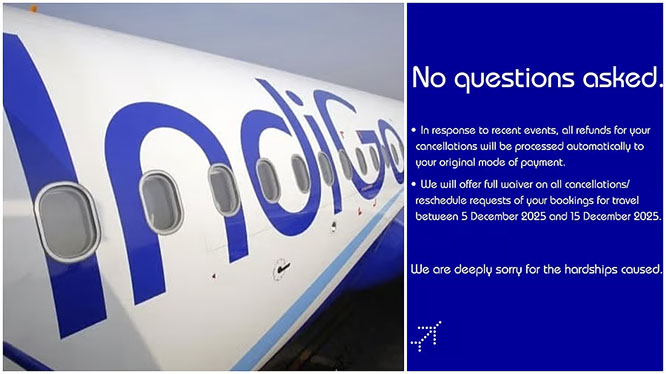
With IndiGo flight disruptions impacting thousands of passengers, the airline on Saturday said that it will offer full waiver on all cancellations/reschedule requests for travel bookings between December 5, 2025 and December 15, 2025.

Earlier in the day, the civil aviation ministry had directed the airline to complete the ticket refund process for the cancelled flights by Sunday evening, as well as ensure baggage separated from the travellers are delivered in the next two days.

In a post on X, titled 'No questions asked', IndiGo wrote, "In response to recent events, all refunds for your cancellations will be processed automatically to your original mode of payment."

"We are deeply sorry for the hardships caused," it further added.

Several passengers, however, complained of not getting full refund as promised by the airline.

Netizens have shared screenchots of getting charged for airline cancellation fee and convenience fee.

"Please tell me why u have did this airline cancellation charges when u say full amount will be refunded (sic)," a user wrote sharing a screenshot of the refund page.

"Well, but you have still debited the convenience charges," wrote another.

Passengers have also raised concerns about the "cancel" option being disabled on the IndiGo app. "First enable the 'Cancel' button on your App & offer full refund on tickets cancelled by customers between the said dates," wrote a user.

A day after the country's largest airline, IndiGo, cancelled more than 1,000 flights and caused disruptions for the fifth day on Saturday, the ministry said that any delay or non-compliance in refund processing will invite immediate regulatory action.

The refund process for all cancelled or disrupted flights must be completed by 8 pm on Sunday, the ministry said in a statement.

"Airlines have also been instructed not to levy any rescheduling charges for passengers whose travel plans were affected by cancellations," it said.

On Saturday, more than 400 flights were cancelled at various airports.

IndiGo has also been instructed to set up dedicated passenger support and refund facilitation cells.

Comments

Add new comment

  • Coastaldigest.com reserves the right to delete or block any comments.
  • Coastaldigset.com is not responsible for its readers’ comments.
  • Comments that are abusive, incendiary or irrelevant are strictly prohibited.
  • Please use a genuine email ID and provide your name to avoid reject.