Muslims have 150 countries to go but Hindus only have India: Gujarat CM Vijay Rupani

News Network
December 25, 2019

Ahmedabad, Dec 25: While Muslims can choose any one of the 150 Islamic countries in the world (for residence), India is the only country for Hindus, Gujarat Chief Minister Vijay Rupani said on Tuesday while justifying the Citizenship Amendment Act (CAA).
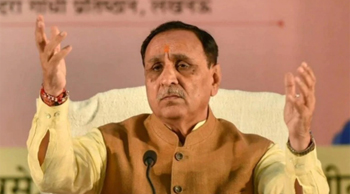
While addressing a rally in support of the CAA outside the Sabarmati Ashram here, the chief minister slammed the Congress for opposing the new law that grants Indian citizenship to non-Muslim refugees from Afghanistan, Pakistan and Bangladesh who have migrated till December 31, 2014.

"There were 22 per cent Hindus in Pakistan at the time of Partition (in 1947). Now, due to persecution, rapes and constant torture, their population has reduced to just 3 per cent. That is why Hindus want to come back to India. We are doing what the Congress was supposed to do to help these distressed Hindus. And when we are doing it now, you are opposing it," said Rupani.

He said the Hindu population has shrunken to just 2 per cent in Bangladesh.

"Out of 2 lakh Hindu and Sikh residents in Afghanistan some decades back, their number is just 500 today. Muslims can go to any of the 150 countries, but there in only country for the Hindus, and that is India. So what is the problem if they want to come back?" asked Rupani.

Seeking to counter protests against the Citizenship (Amendment) Act in various of the country, Gujarat BJP leaders and government functionaries on Tuesday took part in such pro-CAA rallies across all 33 districts of the state.

"Gandhiji was also of the opinion that India should grant citizenship to Hindus and Sikhs of Pakistan.  Even Manmohan Singh had supported such proposal when he was the PM (under the Congress rule). The Congress must explain to the nation why the party is opposing the CAA now," said Rupani.

Without taking names, Rupani also targetted Dalit leaders and outfits opposing the new citizenship law.

"There are 10,000 refugees from these countries living in Gujarat. Most of them who are living in Kutch are dalits, like Maheshwari and Meghwal communities. Dalit leaders need to explain why they are not in favour of granting citizenship to these dalit refugees. By opposing the CAA, these dalit leaders have been exposed," said Rupani.

The BJP leader further said it was "misfortune of India" to have parties and leaders like the "Congress, the Communists and (West Bengal CM) Mamata Banerjee".

"It appears that these parties are having fear that they may have to lose power if Hindus become citizens and illegal immigrants thrown out under the National Register of Citizens (NRC)," the CM said.

He said the BJP government in Gujarat has already started granting citizenship to such persecuted refugees.

Retired High Court Justice S M Soni, who heads Ahmedabad Nagrik Samiti, defended the CAA saying it does not violate any provisions of the Constitution as contended in some petitions filed before the supreme court against the act.

"The Act does not bar a Muslim from applying for Indian citizenship. He can do so by following proper procedures. This Act does not discriminate. Provisions of the Constitution does not apply to those who are yet to become citizens. This Act has fulfilled the dream of Mahatma Gandhi," said Soni.

Various BJP leaders and ministers attended similar events organised in different parts of state throughout the day.

In Surat, Forest Minister Ganpat Vasava and a large number of residents took part in a demonstration held near the collector's office and extended their support to the CAA.

Surat MP Darshana Jardosh and local MLAs Purnesh Modi and Vivek Patel also participated in a protest in support of the new law.


Comments

Add new comment

  • Coastaldigest.com reserves the right to delete or block any comments.
  • Coastaldigset.com is not responsible for its readers’ comments.
  • Comments that are abusive, incendiary or irrelevant are strictly prohibited.
  • Please use a genuine email ID and provide your name to avoid reject.
News Network
December 19,2025

Saudi Arabia has abolished fees on expatriate workers employed in licensed industrial establishments, signaling a strong push to empower national factories and enhance the Kingdom’s global industrial competitiveness. The move reflects the leadership’s commitment to building a sustainable and resilient industrial economy under Saudi Vision 2030.

The decision was approved by the Council of Ministers, chaired by Crown Prince and Prime Minister Mohammed bin Salman, following a recommendation from the Council of Economic and Development Affairs (CEDA). It forms part of a broader strategy to support, modernize, and strengthen the industrial sector.

By removing fees on foreign workers, industrial establishments gain greater operational flexibility and relief from financial pressures. This is expected to help factories expand production, improve efficiency, and compete more effectively in international markets, while reinforcing long-term sustainability.

The initiative aligns closely with Saudi Vision 2030, which identifies industry as a key pillar of economic diversification. A competitive and resilient industrial base is viewed as essential for driving innovation, attracting investment, and sustaining long-term economic growth.

Overall, the fee exemption underscores the Kingdom’s commitment to creating a supportive environment for industrial development and ensuring that Saudi factories remain globally competitive and capable of leading the nation’s economic transformation.

Comments

Add new comment

  • Coastaldigest.com reserves the right to delete or block any comments.
  • Coastaldigset.com is not responsible for its readers’ comments.
  • Comments that are abusive, incendiary or irrelevant are strictly prohibited.
  • Please use a genuine email ID and provide your name to avoid reject.
News Network
December 16,2025

jordan.jpg

Prime Minister Narendra Modi on Monday held talks with Jordan’s King Abdullah II in Amman, during which the two leaders discussed ways to further strengthen bilateral relations, with the Prime Minister outlining an eight-point vision covering key areas of cooperation.

Describing the meeting as “productive”, PM Modi said he shared a roadmap focused on trade and economy, fertilisers and agriculture, information technology, healthcare, infrastructure, critical and strategic minerals, civil nuclear cooperation, and people-to-people ties.

In a post on social media platform X, the Prime Minister praised King Abdullah II’s personal commitment to advancing India–Jordan relations, particularly as both countries mark the 75th anniversary of the establishment of diplomatic ties this year.

“Held productive discussions with His Majesty King Abdullah II in Amman. His personal commitment towards vibrant India-Jordan relations is noteworthy. This year, we are celebrating the 75th anniversary of our bilateral diplomatic relations,” PM Modi said.

The meeting took place at the Al Husseiniya Palace, where the two leaders also exchanged views on regional and global issues of mutual interest. According to the Ministry of External Affairs (MEA), both sides agreed to further deepen cooperation in areas including trade and investment, defence and security, counter-terrorism and de-radicalisation, fertilisers and agriculture, infrastructure, renewable energy, tourism, and heritage.

The MEA said both leaders reaffirmed their united stand against terrorism.

PM Modi arrived in Amman earlier on Monday and was received by Jordanian Prime Minister Jafar Hassan, who accorded him a formal welcome. Following the talks, King Abdullah II hosted a banquet dinner in honour of the Prime Minister, reflecting the warmth of bilateral ties.

Jordan is the first leg of PM Modi’s three-nation tour. From Amman, the Prime Minister will travel to Ethiopia at the invitation of Prime Minister Abiy Ahmed Ali, marking his first official visit to the African nation. The tour will conclude with a visit to Oman.

Comments

Add new comment

  • Coastaldigest.com reserves the right to delete or block any comments.
  • Coastaldigset.com is not responsible for its readers’ comments.
  • Comments that are abusive, incendiary or irrelevant are strictly prohibited.
  • Please use a genuine email ID and provide your name to avoid reject.
News Network
December 21,2025

hadith.jpg

Invoking the teachings of Prophet Muhammad—“pay the worker before his sweat dries”—the Madras High Court has directed a municipal corporation to settle long-pending legal dues owed to a former counsel. The court observed that this principle reflects basic fairness and applies equally to labour and service-related disputes.

Justice G. R. Swaminathan made the observation while hearing a petition filed by advocate P. Thirumalai, who claimed that the Madurai City Municipal Corporation failed to pay him legal fees amounting to ₹13.05 lakh. Earlier, the High Court had asked the corporation to consider his representation. However, a later order rejected a major portion of his claim, prompting the present petition.

The court allowed Thirumalai to approach the District Legal Services Authority (DLSA) and submit a list of cases in which he had appeared. It also directed the corporation to settle the verified fee bills within two months, without interest. The court noted that the petitioner had waited nearly 18 years before challenging the non-payment and that the corporation could not be fully blamed, as the fee bills were not submitted properly.

‘A Matter of Embarrassment’

Justice Swaminathan described it as a “matter of embarrassment” that the State has nearly a dozen Additional Advocate Generals. He observed that appointing too many law officers often leads to unnecessary allocation of work and frequent adjournments, as government counsel claim that senior officers are engaged elsewhere.

He expressed hope that such practices would end at least in the Madurai Bench of the High Court and added that Additional Advocate Generals should “turn a new leaf” from 2026 onwards.

‘Scandalously High Amounts’

While stating that the court cannot examine the exact fees paid to senior counsel or law officers, Justice Swaminathan stressed that good governance requires public funds to be used prudently. He expressed concern over the “scandalously high amounts” paid by government and quasi-government bodies to a few favoured law officers.

In contrast, the court noted that Thirumalai’s total claim was “a pittance” considering the large number of cases he had handled.

Background

Thirumalai served as the standing counsel for the Madurai City Municipal Corporation for more than 14 years, from 1992 to 2006. During this period, he represented the corporation in about 818 cases before the Madurai District Courts.

As the former counsel was unable to hire a clerk to obtain certified copies of judgments in all 818 cases, the court directed the District Legal Services Authority to collect the certified copies within two months. The court further ordered the corporation to bear the cost incurred by the DLSA and deduct that amount from the final settlement payable to the petitioner.

Comments

Add new comment

  • Coastaldigest.com reserves the right to delete or block any comments.
  • Coastaldigset.com is not responsible for its readers’ comments.
  • Comments that are abusive, incendiary or irrelevant are strictly prohibited.
  • Please use a genuine email ID and provide your name to avoid reject.